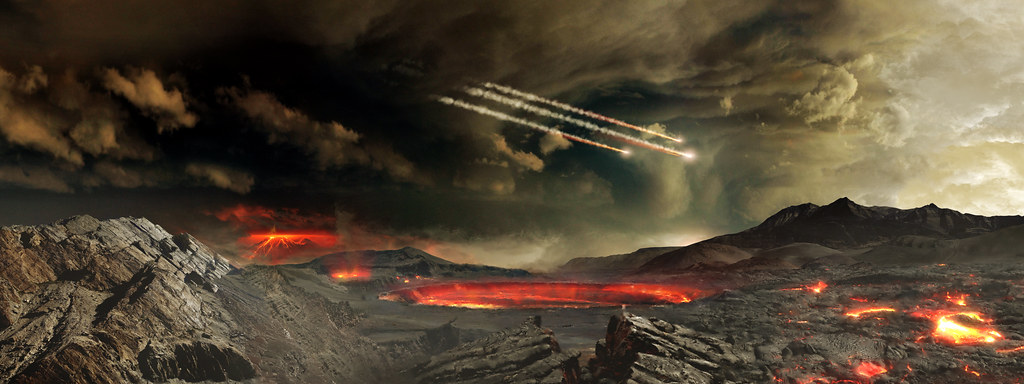
One of the most fascinating questions in biology is how multicellular life — all plants, fungi and animals — first arose. Single‑celled organisms had been around for thousands of millions of years, at least from about 3.5 billion years ago, just ~1 billion years after the Earth formed at 4.5 billion years. Bacteria and archaea were already present over 4 billion years ago, quietly running the planet’s chemistry long before anything with limbs or leaves appeared. There are hints of multicellular organisms at around 1.4 billion years – red algae are a possible candidate- but that’s still quite late considering the time available. The brutal truth is that wasn’t until about 600 million years ago that truly multicellular organisms begin to show up in the rocks. How, why and when the Great Organising took place is a mystery still buried deep in time.
One possible clue lies in the kingdom of the archaea — those bacteria‑like beings that are not actually bacteria. A particular branch, the Asgard archaea, may hold the key to how complex cells — and eventually multicellular life — emerged. Today’s Nature Briefing has a short, elegant piece called Meet the Parents on the latest findings, and it offers some intriguing hints about how a bunch of free swimming cells learned to co-operate and thereby sparked the great leap to complexity. Is there a lesson for today in there somewhere perhaps?
Microorganisms from which all complex life might be descended — the Asgard archaea — were discovered in 2015 from DNA in sediments plucked from the bottom of the North Atlantic. Since then, researchers have been painstakingly culturing these exotic organisms and finding lots of surprises along the way.Nature | 11 min read
#Bacteria #archaea #multicellular #unicellular #evolution #biology #precambrian #asgard #biology #complaxity #signalling #red algae #procaryote #eucaryote


