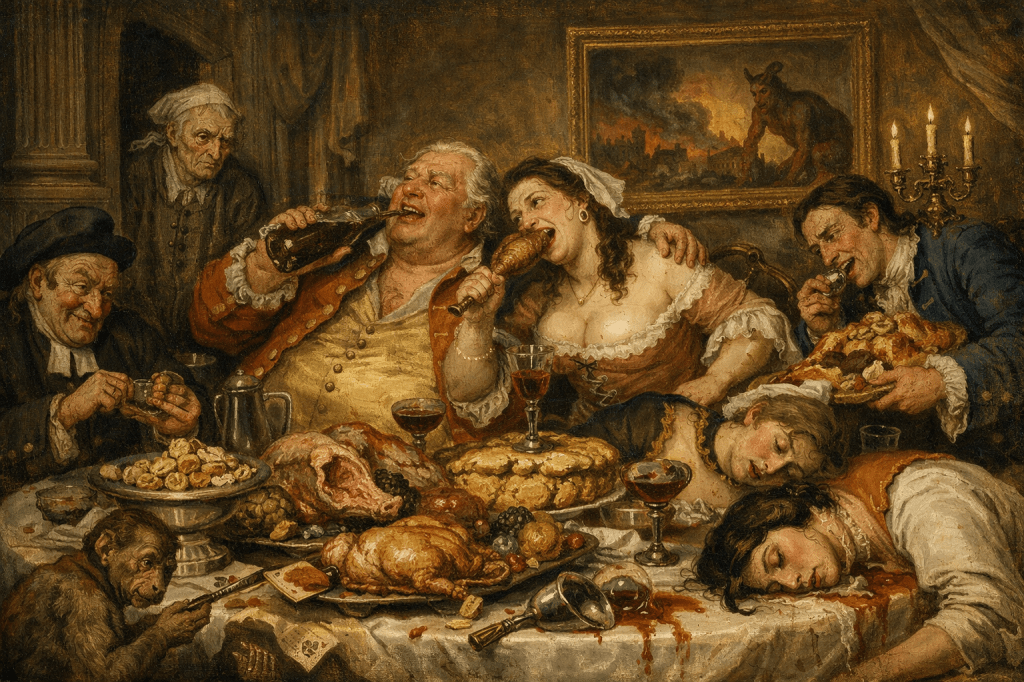


As historians of the future pick through the rubble of America’s decline and fall after its supreme triumph in 1991, they will ask one plaintive question: “How was such a winning position thrown away so decisively — and so quickly?” There will be plenty of blame to go around, plenty of suspects against whom fingers will be pointed. But one name keeps coming up again and again: Alan Greenspan, Chairman of the Federal Reserve of the United States from 1987 to 2006.
Today, the case for the prosecution against “ol’ Al” is made loudly, cogently, and with devastating clarity by Robert Reich, US Secretary of Labor under Clinton and now a professor at Berkeley.
We really think you should read this [1] — especially if you have a home, a family, a community, and, most pertinently of all, a job where the salary has not risen significantly in twenty years or so. But for those pressed for time, Reich summarises what he sees as Greenspan’s masterpiece of misjudgement thus:
“If any single person was responsible for the financial crisis of 2008, it was Greenspan… the worst collapse since 1929… resulted from the deregulation of Wall Street that Greenspan advocated.”
“He pushed Clinton and Congress to repeal the Glass–Steagall Act, which since the 1930s had separated investment banking from commercial banking, thereby preventing banks from gambling with personal savings. He also argued vigorously against regulating derivatives — essentially financial bets on financial bets — that later proved to be weapons of mass financial destruction.”
Yet we ask: is the culprit really Greenspan? Or is it actually ourselves?
Greenspan was widely regarded by critics as an enthusiastic advocate of the ultra‑rich and the values they espouse: hierarchy, conspicuous consumption, obsessive individualism. Whether these are virtues or vices is a matter of debate — but they were adopted enthusiastically by wide sections of the population for decades, making the task of Greenspan and his Wall Street fellow‑travellers infinitely easier.
For the ultimate illusion they peddled was Common Sense: it makes sense to reduce the deficit, for what is a nation but a giant household? Well, it is a bit — but mostly it isn’t. So things like infrastructure, research, and health go into the “nice‑but‑we‑can’t‑afford‑it” ledger too many times, and slowly but surely decline acquires a momentous, unstoppable hegemony of its own.
So don’t just blame Greenspan — blame ourselves for buying into a system that puts that sort of man into that sort of job. And hope that future societies develop much more judicious HR policies.
[1] RIP Alan Greenspan: you were charming, powerful and wrong | Robert Reich | The Guardian
#business #economics #united states of America #alan greenspan #robert reich #finance #markets


