
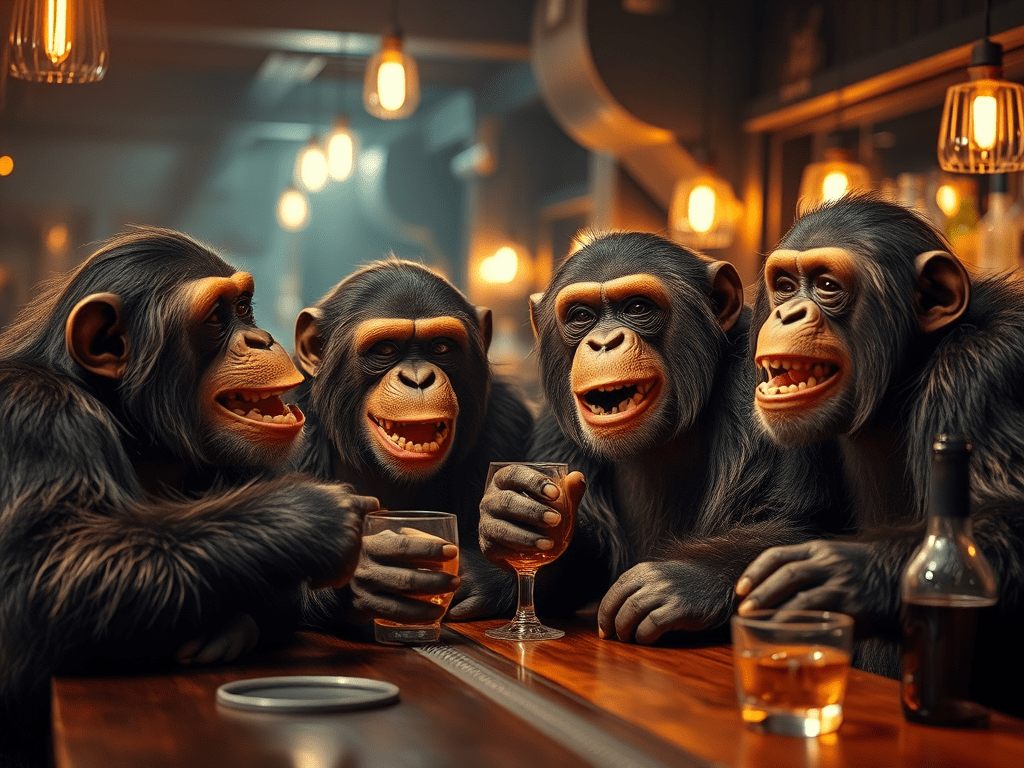

Are we really a happy bunch of co-operative happy monkeys, or a nasty gang of ultra violent killer apes locked in a nihilistic struggle for food and mates? Today we throw the blog open to two articles from impeccable journals, both adducing works of impeccable scholarship, And then you make your own minds up, gentle readers: you’re a pretty bright lot. One is Nature, revisiting the work of the indefatigable Richard Dawkins, whose The Selfish Gene has now hit 50, incredible as that may seem. The other, by David Kaposi for the Conversation on the famous Stanford Prison experiment, coupled with the obedience studies of Stanley Milgram.
Not knowing the answers ourselves, we fell back on a few things we do know. Both Dawkins and the Psychologists(is that a band?-ed) were incredible controversial in their day-and have remained so. But that is the mark of original thinking. Both changed the way we look at the world. But that only proves the truth of Keynes’ doctrine. “when the facts change I change my mind!” That the questions both sets of work raised are actually very ancient, and still seem utterly incapable of resolution. If we dared to hint at an opinion, it might be this: are words an adequate tool to understand human behaviour anyway? Might it be time to create entirely new tools based on the mathematics of something Complexity Theory and statistics? That’s us done:over to you
50 years on, go beyond the Selfish Gene
The idea set out in Richard Dawkins’s 1976 book The Selfish Gene — that bodies are just genes’ way of making more of themselves — “seemed pretty harmless”, writes historian of science Nathaniel Comfort. Today, “the determinism baked into the ‘gene’s-eye view’ in the book troubles me, as does the passivity of the organism in Dawkins’s telling”. Comfort dives into modern efforts to synthesize ecology, evolution, genetics and developmental biology to create “a less gene-centred view” that “is more accurate — and infinitely more satisfying”.
behaviour #psychology #evolution #richard Dawkins #genes # human nature #stanford prison experiments #conformity #authority


