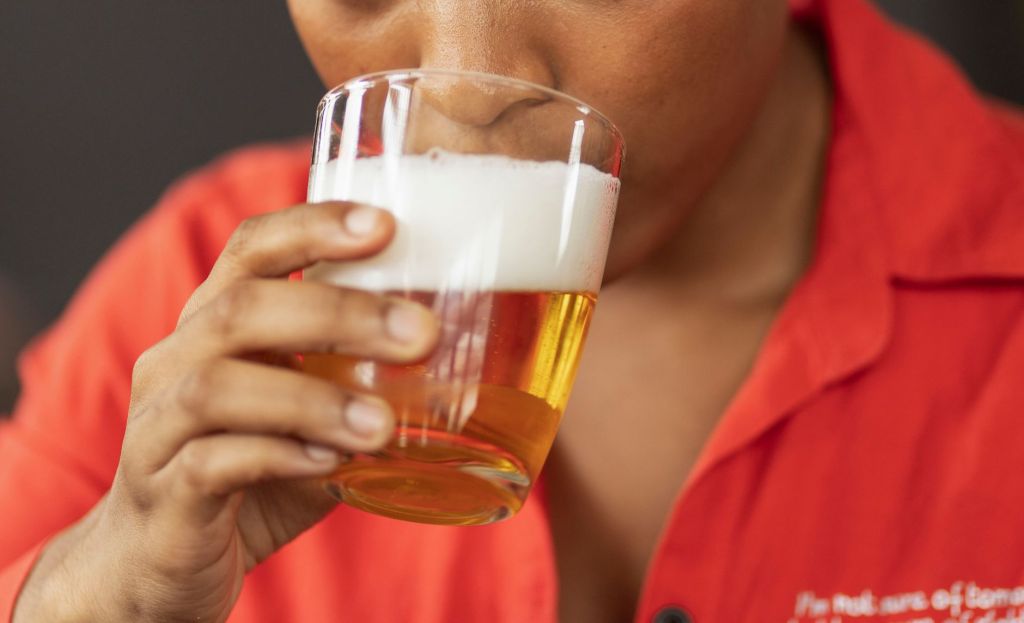


Friday Night Feast of Fun: What to Wear for Cocktails

A few years ago (LSS 15 5 20) we received a plaintive call for help from a reader in Bridport in Dorset. He posed an age old and much-debated question: how should the Gentleman of Fashion dress for Friday Night Cocktail?. And this is the answer we gave

“Dear Mr AF: the rules on this have always been very prescriptive, but fair. In winter, a dark blue or black jacket, striped shirt, creased chinos and smart black shoes. Tie; anything regimental. old school, or your golf club. The building, not the thing you hit the ball with! In summer you may sport a light jacket, summer being defined as any date from Easter Sunday until the final Bank Holiday in August. You may of course wear a Panama. But don’t wear it indoors, or you will look like a numpty.”

Well, we will not change a dot or comma of that answer. Rules of dress are timeless, like rules of Golf or Morality. What you see above is how it is ladies and gentleman and we can no mor exchange that than we can ask for a rewrite on one of the Ten Commandments. (not even the one about Adultery) But we will add an appendix. A coda if you like, to recognise the times we live in.

Because since that blog was published quite a lot has changed. global temperatures have climbed by roughly 0.3 °C, 2024 became the hottest year ever recorded at about 1.55 °C above pre‑industrial levels , mountain glaciers have kept shrinking with more than 27 m water‑equivalent lost since 1970 and record mass losses in five of the past six years , and extreme events—heatwaves, storms, floods, droughts, and fires—have intensified across almost every corner of the biosphere. Yes, it’s got hotter, quite a lot hotter and it’s not just because you are standing too near the barbecue fire, ladies and gentlemen. So, just as St Benedict wisely relaxed monastic rules to make them more bearable , we are going to relax the Cocktail Code. A bit. In the warmest weather only. Gentleman may, with discretion, wear a polo shirt if working at the barbecue or serving the drinks, provided that you clear it first with the Guests.

Well there’s our advice . It’s nearly Six British Summer Time as we pen these lines, so we, like many of you are already thinking of slipping in to the time-honoured garb and wolfing down that first Pimms. We hope you enjoy your evening too, wherever you are.

#cocktails #clothes #global warming #st benedict #climate change #pimms #gin

Camilla Cavendish Confounds the Conspiracists

Of all the columnists we follow, Camilla Cavendish of the Financial Times is one of the most clear-eyed and objective. But the reason we’re showcasing her today is because she has turned her mind to that old LSS favourite: conspiracy theories and their devotees. Here is the reference [1] but because it’s behind the FT paywall* we’ll provide a short summary, clearly distinguishing Camilla’s points from our own riff on them, which is demarcated below.

CAMILLA SAYS

She notes sadly that an old pal (University educated!) has fallen for the hoary old belief that anthropogenic global warming is a hoax. Which leads her to consider why people need Conspiracy Theories: their History (apparently they had previous spikes around  the troubled years 1900 and 1950): that people have an inherent tendency to believe facts that confirm their existing beliefs: and most chilling of all, that believing one conspiracy acts as a gateway to believing all, as the susceptible mind links the dots between anything and everything. Astutely, she notes that the provision of facts and reason almost never help the sufferers, because these do not address the deep emotional and psychological needs which are really driving participation in these modern cults. She even provides further reading: a book called Foolproof: why we Fall for Misinformation by Professor Sander. Camilla concludes with an admirable determination to read more things that she disagrees with. A form of mental training also recommended by Bertrand Russell, another much admired favourite of this blog.

OUR THOUGHTS

She’s right, sadly. For us, what’s so depressing is the way that conspiracy theories and misinformation on just about anything choke up the worldwide interweb like bindweed in a garden.  The intellectual level of much conspiracy discourse-the use of language, evidence and reason-reminds us of the old Anonymous Letters we used to examine long ago in a Police Laboratory, long before the internet could spread such rubbish universally. So we’ve little enough to add, frankly. Except perhaps some further reading into Social Identity Theory as pioneered by the great Drs Tajfel and Turner [3], and its depressing observations that the species we are forced to belong to tends to draw its conclusions about what is true from the opinions of others rather than an objective consideration of the facts. In which case the only remedy is to choose you friends, family and above all, masters, with extreme care.

* or is it? Gentle readers when we clicked on this the whole thing came up in which case you can read all of Camilla’s article for yourselves. Go on, try it

[1] It’s far too easy to get sucked down a conspiracy theory rabbit hole

[2] Foolproof: Why We Fall for Misinformation and How to Build Immunity
London: Fourth Estate, 2023.ISBN: 978-0008466764

[3]https://en.wikipedia.org/wiki/Social_identity_theory#:~:text=As%20originally%20formulated%20by%20social%20psychologists%20Henri%20Tajfel,the%20activities%20in%20which%20o

Conspiracy theory #climate change #misinformation #internet #social identity theory #camilla cavendish #financial times

Another big thank you-and we apologise to a leading national newspaper and one of its most eminent journalists

Recently we have had so many likes, new readers and suggestions that we can’t keep up. As some of you know, we have other writing commitments beyond this blog, plus a busy programme of reading and learning; and many of you, erudite readers, will know the effort which that entails. We try to visit the sites of all who like or comment: many are far superior to our own in terms of design and layout. Have you all been to the Slade School of Fine Arts or something? Keep ’em going, and don’t worry about us nicking your ideas. Our IT and design skills are below those of a two-year-old Sasquatch, and that’s on a good day. But we will say to all and every one of you :THANK YOU. It is a pleasure to be in your intellectual company.

Now for an apology. To you our readers, to Larry Elliott, to the Guardian, to whomsoever really. For in our blog of 11 November 2024 From American Decline to World Government; fasten your seatbelts for a bumpy ride, we categorically stated

Let’s just jump across the Atlantic for a moment to say goodbye to Larry Elliott who quits his post at the Guardian after 36 years {2]

Well we’re happy to state Larry Elliott is still very much to be found among the pages of the Guardian. Whereby he still features as one of our regular showcased writers in turn, Perhaps the nature of his contractual relationship with the Guardian has changed. That is a matter between him and them. But there he is still, plugging away, filing copy, all of it worth a read, which is why he will continue to pop up here, gentle readers, Sorry for that misunderstanding. But there was one thing we did get right in that blog, gentle readers. Remember something about American Decline and bumpy rides? How’s your seatbelt today?

Editorial note: the picture of ourselves posted above is more of an idealised statement than a precise and literal likeness of its subject and anyway was made up a number of years ago, But you probably guessed that anyway

#USA #geopolitics #Iran #middle east #inequlity #economics #war

Heroes of Learning: Piero Della Francesca

Think back to school: did you ever know the kid who was bright at everything? Most of us were good at something, but that alone: the sporty type who to put it politely, was not too strong on sciences. The maths nerd with negative social skills. The arty type, the musician, the classroom politician…..but did you ever know someone who was brilliant all around the block?  We think that Piero Della Francesca (1415-1492) must have been one of those irritating subset of pupils who really was.[1]

Apprenticed as a painter and artist in his birthplace of Borgo Santo Sepolcro, he was soon brushing up against giants like Fra Angelico, Donatello and Brunelleschi. Something must have rubbed off, because within a few years he was earning the first commissions for what was to become a remarkable canon of early Renaissance masterpieces: they remain favourites of the art-loving public to this day. And for once we can be very specific about their USP: because alongside his studies in art the young Piero had been busy studying geometry and other branches of mathematics. Their influence is not just glimpsed in his work, they are the very basis of its careful precision and intellectual rigour. Here was a Renaissance man par excellence, who can stand comparison with Leonardo or indeed the genius of any age in human history. A Polymath for All Seasons.

One of the downsides of the immense quantities of knowledge in the modern world is the way it drives ever narrower specialisation. And this is quite necessary: one must spend years studying a particular enzyme system or economic model before there is anything new to say. In the course of a long life we have met one, possibly two, polymathic geniuses who might make useful contributions in several fields in the way that Della Francesca did. But to  see the light sparkle in his pictures is to glimpse a time when the educated  could still delight in  all discoveries, and learning seemed to be something more than a task.

[1] Piero della Francesca – Wikipedia

#art #science #polymath #Italy #renaissance #mathematics

Our thoughts for the New Year: a little works better than a lot

The first few days of the year are always filled with a media barrage of advice. You can’t go on the interweb, open a magazine or turn on the telly, without some omniscient panjandrum telling you to do a dozen worthy things. Eat less, until you look like a prisoner in the Soviet Gulag. Run like a marathon athlete. Fill your mind with worthy moral projects and take on so many new tasks that you become a Different Person. All by January 10th. We know none of this ever works, because if it did the experts would not have to repeat themselves every year. And the reason it doesn’t work is because it’s asking too much of people.

It was the late great Dr Michael Mosley who realised this. In his eminently readable work Just One Thing: How simple changes can transform your Life [1] He sets out a whole slew of small ideas which people can achieve rather than big things which they can’t. If you want to discover what they are read the book. But it inspired us to go around the mighty offices of the Learning Science and Society Headquarters here in beautiful Croydon and ask people about their ideas for New Years resolutions which will stick. Here are our findings:

Commuting get off one stop earlier than normal, and walk. OK if your stops are only a quarter of a mile apart But what if you live in Haywards Heath and work in Croydon? You’d have to walk from Gatwick. Our verdict: good if sensibly applied

Dry January which most people interpret as no booze from New Years day until Valentines Day. Feasible and- we have actually done it. But what if your local Toby Carvery is offering a crazy special at £6 a head? Are you really going to sit there and drink water?

Declutter a cupboard Makes space and is exercise of a sort provided you don’t gash your head on an exposed door and have to have the splinters removed in Croydon General Hospital. Plus the local charity shops will just love all those old mini discs, pencils, tatty files , keyboards, adding machines, unused 1997 diaries, abacuses and stone tools which you find. But what if you don’t have a cupboard?

Learn the name of a colleague whose monniker you have forgotten/never knew anyway Ok as far as it goes but could be creepy. Being on the Board, we are used to this all the time and with practice it’s not as tricky as it looks.

Read one page from a book each day Ok slows you down and broadens the mind But what if the book is Mein Kampf or the Croydon Trades Directory for 1989 ? Verdict: choose carefully

Give someone your full intention for 60 seconds Oh come on, these are meant to be achievable!

So here are our conclusions, to sit alongside those of the great Dr Mosley. Da quod jubes et jubes quod da, we say (give what you command and command what you give) A favourite catchphrase which we share with St Augustine of Hippo. On which note we will simply wish you all a successful 2026.

Our thanks to the staff of Croydon General Hospital and apologies for the extra work we caused them

[1]Mosley, Michael. Just One Thing: How Simple Changes Can Transform Your Life. Short Books / Hachette UK, 2022.

#health #diet #New Year

Does this whale hold the secret of eternal youth?

I have lived long enough, my way of life is fall’n into the sere, the yellow leaf…..Macbeth Act V scene 3)

Most of us would pretty much agree with the Thane of Glamis. But up to now, achieving that Pan-like state of eternal youth has been no more than a dream, whatever the cosmetics companies say. Until today, when recent discoveries of a protein in the Bowhead whale suggests that this same eternal dream may actually come true. We’ve two takes on the story: a popular one from Ashleigh McCaul of the Mail: and a more in-depth view from Nature Briefings Secrets of a 200 year old whale which carries, as ever, links to deeper coverage (no whale pun intended)

A cold-activated protein that helps to repair broken DNA could be the bowhead whale’s secret to living sometimes for more than 200 years. Researchers travelled to northern Alaska to collect samples of tissue from the whales (Balaena mysticetus) from Iñupiaq Inuit communities. The team found that the whale’s cells produce a protein called CIRPB, which helps to mend potentially cancerous DNA mutations. The results show that an efficient DNA repair system is “a very effective strategy to confer this extreme longevity”, says molecular biologist Zhiyong Mao.Nature | 4 min read
Reference: Nature paper

And our opinion? it’s interesting how science is fine when its discoveries coincide with the deepest wishes of the population. Yet science is not so convenient when it reminds of certain uncomfortable truths, such as the imminence of catastrophic climate change, The response of some is to launch culture wars, wherein the conclusions and recommendations of the educated must not only be resisted, they must be actively torn down if at all possible. This article by Alex Heffron and Tom Carter-Brooks for the Conversation chronicles how this is currently playing out in the English countryside., where some persons are trying to foment opposition to the installation of solar panels on private land. Of course, motives will be mixed: and not all of us think an array of panels is quite as pretty as a meadow of waving wheat. But we must have clean power: or we will surely die, young and old alike.

We are certain you will find a comparable example near to where you live, gentle reader Yet it’s the psychology of all this that gives us this thought, for what it may be worth. Now, It was said of Peter Pan than he never grew up. The best definition of growing up is to realise not all your wishes can come true at once. It seems some people must do more to recognise that, however many decades they have accumulated.

[1]https://www.dailymail.co.uk/sciencetech/article-15247935/How-whales-hold-secret-humans-living-FAR-longer-scientists-discover-longest-living-mammal-repairs-DNA.html

[2]https://theconversation.com/you-cant-eat-electricity-how-rural-solar-farms-became-the-latest-battlefront-in-britains-culture-war-268128?utm_medium=email&utm_campaign=Latest%

[3]https://theconversation.com/you-cant-eat-electricity-how-rural-solar-farms-became-the-latest-battlefront-in-britains-culture-war-268128?utm_medium=email&utm_campaign=Latest%

#climate change #global warming #renewable energy #peter pan #ageing #whale

Nobel Prize for Economics shows this blog was right all along

Back in the dark days of January 2021, when the world economy was reeling from the savage hit of the COVID-19 pandemic, we published a short blog called How to Get some Free Money(LSS 2 1 21) Everyone at that time was worried about the colossal debts their governments had run up to pay for the catastrophe-were we all to be bankrupt for ever? Our point was that Science and Technology were the key to economic success. Encourage them. and you will grow your way out of debt. However hard a medieval peasant worked and saved he could never hope to achieve the productive levels of a man with a steam driven plough.

How comforting then, to find that better, more profound minds have demonstrated this truth at a Nobel level. By incredibly detailed studies Joel Mokyr, Phillipe Aghion and Peter Howitt [1] have looked at archives, crunched the numbers, weaved out feedback loops and carried out any number of other careful ratiocinations to prove the point. You can read more here [2] if you like graphs and words and things. But for us three things stand out.

There has to be abstract learning first. Many of the ideas and processes that drove the industrial revolution had appeared a hundred years before as the abstruse discoveries of thinkers like Newton and Hooke, which the average man in the street would have called “bonkers!”. There has to be a social ecology of skilled and trained workers, able to quickly deploy and develop the new ideas. In the eighteenth century this meant craftsmen like watchmakers and weavers. Now it means experts in AI and biotechnology. Finally a society must be open to rapid change: and welcome it where possible. For if you do not, someone will rapidly steal your markets with a new idea you could have developed but didn’t, because the old ways were tied and tested(think Kodak and digital cameras) [3]

All of which has relevance now, especially in the United States of America and the UK. In both those countries there is a growing movement to throw over renewable energy technologies and move back to coal and oil as soon as possible. We understand the fears and share some of the nostalgia for a bygone age which the proponents of this U turn so plainly demonstrate, Yet we also recognise that other countries will not. They will adapt clean green technologies rather fast. Not only will this leave the Anglo-Saxon economies hopelessly far behind. Their pollution will also make them a dangerous threat to other places in the world. Places which may seek to shut down that danger by whatever means necessary.

[1]https://www.nobelprize.org/all-nobel-prizes-2025/

[2]https://www.nobelprize.org/uploads/2025/10/advanced-economicsciencesprize2025.pdf

[3]https://www.forbes.com/sites/chunkamui/2012/01/18/how-kodak-failed/

#science #technology #growth #innovation #digital cameras #renewable energy

No that last blog does not make us a bunch of Communists

Every so often one of our blogs engenders some intriguing feedback . Alongside the usual welcome comments with all their nods and frowns, we occasionally get one that is a little-uh- longer, yet expresses its views with passionate clarity, to push euphemism to its limits. Such was the case today, when a reader alleged that our criticism of fossil fuel and tobacco companies was a sure sign that we were under the influence of Communists, who aim to tear down the free market system and replace it with a “nightmare of bureaucratic state socialism” of the sort found in places like Venezuela and North Korea. In particular the reader observed:

What you’ve got to remember is that markets not governments are best at allocating resources. Intervening in fossil fuel markets is crypto socialism- it will only distort price signals, stifle innovation and lead to unintended consequences”

When we asked if this was true for immigration control as well, they replied

“Absolutely! Free markets mean the free movement of labour. Anything else is protectionism in disguise.

So, where does that leave us at LSS? Having worked for many years in the Government Employ and thereby known the ways of Civil Servants, we can more and more share the view that Free Markets really do work better. No, it’s the “unintended consequences” that pulls us up. Free markets can have those too. Totally unregulated sales of tobacco produced an epidemic of cancer. We suspect that over enthusiastic marketing of certain foods and drinks will one day produce an epidemic of obesity. As for gushing out vast quantities of poisonous mineral oil and burning it with heedless abandon-well we wish people had been better informed before this was started. To call for better product information, and to ask that consequences of free markets are cleaned up, or at least controlled, does not make one a Communist. Or anything like it.

Thanks for the feedback, and we appreciate that in view of this respondent’s employment, they must remain anonymous

#climate change #free markets # global warming #immigration #communism #socialism #capitalism #hayek #marx

Another big Thank you-and a small musing

Another big thank you to readers, commentators, and the indefatigable ideas people including our researchers and fellow members of the Editorial Board. We are indeed getting mote readers, more followers and above all more likes and comments. All of which keep us in mid season form, as Wodehouse would have it: full of the joys of nature’s second season, with the old ginger whacked up absolutely to the top of the tank.

If you can bear it, we thought we’d throw away a couple of lines on who is reading, and about what. Unitedstatespersons make up the biggest contingent. Odd when you think this stuff is tapped out in England. Astute readers will not be much surprised to note that English speaking countries such as the United Kingdom, Canada, Australia etc joining the line up roughly in proportion to the old demographics. By the time we get down to the more far flung outposts however, the figures do not look so good. Why so few responses from St Helena or Pitcairn Island? We don’t know. But we’re working on it. As for the rest of the world: India always big- a country on the rise with a strong science base, and a large number of English speakers. We had hoped for more from the Spanish Speaking world. Sadly our command of that language is not quite good enough to write articles in it. But if any of you amigos want to comment in the language of Cervantes, we’d love to hear from you. After that, many countries. China figures above the random level; we’d love to know which latter day Kong Qiu peruses our offerings, and where they work.

And what are you reading? The one where we suggested that the President of the United States was a closet Socialist is cantering in at the top of the field everyday. It was meant to be more wry and ironic than a serious discourse on Political Economy. But some like it- a lot. After that- human evolution seems quite popular. Our own idees fixees of antibiotic resistance and climate change are high in the betting, but not always favourites. We need to do more there, we think.

Overall, since we started-progress. Like that new bloke they have at Manchester United, who is being given time. Give us some more too, The world is a big bad place, and once again to paraphrase the Immortal Wodehouse; we thinking Johnnies need to stick together.

THE BOARD

#United States #United Kingdom #China #india #antibiotics #climate change #science

Is Donald Trump a Socialist?

Is Donald Trump a socialist, or is he just governing like one? For a man who made his money in the freewheeling and dealing Manhattan property market, it seems an odd term to use. And doubtless he and his supporters would reject it vehemently. But let’s go back to first principles and look at what he does, not what he says.

The very essence of a socialist policy is that an economy should not be run by free market methods. It can and should be run on others, designed to support the welfare of all the groups living in it. If they are poor, money must be found through taxes to alleviate that. If their communities depend on certain industrial conglomerations. such as steel making for example, then money must be found to sustain those industries, to avert the social damage which would ensue/ In Britain the key exponents of this view were people like Arthur Scargill and Tony Benn, who felt public money should be found to support the mining industries, even if those industries operated at less than optimum economic efficiency. In the 1970s Benn went further, suggesting a siege economy protected by tariffs as an alternative to joining the European Community, forerunner of the EU.

The alternative view was pioneered by thinkers such as Adam Smith and David Ricardo. The unhindered operation of free markets, with the lowest possible levels of tax and tariff would facilitate the best possible social outcome. Ricardo developed this in his theory of comparative advantage. By which countries or regions specialising in different products would trade in these to their mutual benefit. His example was Britain and Portugal, which mutually traded manufactured goods and port wine. The same principle holds today.

The key political exponents of this view were Ronald Reagan and Margaret Thatcher, whose most memorable declaration was “you can’t buck the markets”. As we write, Mr Trump’s policies seem to be doing exactly that. Unlike others, we judge him to have an honesty of purpose: he is trying to protect the communities that voted for him. Communities whose social structure and very identity depend on the old smokestack industries around which they cluster. Time will tell if he will be successful. But two things worry us. Firstly even if factories are attracted back to the rustbelt, it is unlikely that modern automated plants will need many factory hands. And second: the last twenty years or so of the Communist bloc were spent trying to keep these same sort of plants going. History did not judge that enterprise kindly.

#free markets #socialism #communism #adam smith #david ricardo #margaret thatcher #donald trump #united states of america