Beyond the Nation: we conclude

In March we opened a new series called Beyond the Nation(LSS 5 3 26), which suggested that there are a number of practical , and very pressing problems which could be more efficiently addressed if the response were global rather than by the current group of 193 or so mutually suspicious, jealously competing, nation states. In particular we looked at things like pollution, disaster relief, and the economic brakes imposed by creating national identities,

Thinking about it, that last is the very heart of what we’re on about, isn’t it? Because national identities are really, no viscerally, important to people. They have more power over our minds than any alternatives offered by religions, class, sports teams or profession. They not only define who we are: they define the behaviour others expect of us, and more importantly, the behaviour we expect of ourselves. And no one can deny the critical importance they have played at times when freedom was in critical jeopardy. Would Ukraine have sustained the fight against Russia for so long without a crucial sense of its own identity? Or for that matter would the USSR have sustained its own fight against the Nazis without incorporating a strong sense of Russian Nationalism? All this, and more can can be set in the balance for the Nation as the highest form of organising human societies, as we have argued elsewhere. (LSS passim: see our World Government series)

Yet nations are transient, fleeting things. Where are the Spartans or the Akkadians now? Men and women lived and died for their causes, and many like them, across thousands of years of history. Yet the real drivers of existence are huge impersonal things like climate, disease or massive technological leaps such as the Industrial Revolution. Britain spent immense quantities of treasure and lives trying to defend a position it had established in the Age of Sail, only to discover that the Age of Steam made all its efforts irrelevant[1] And so the question becomes “If your identity is so important, what price are you prepared to pay to maintain it?” Because if technologies can change, so can societies, and the identities which they generate.

We shall close the series with a personal anecdote, a thing we rarely do, Many many years ago still trapped in Undergraduate adolescence we were debating the question of Britain’s membership of what was then called the European Community with a fellow inmate, albeit far more intelligent than ourselves Being good Young Socialists we then followed the Orthodox Labour Party Line: that the UK should leave forthwith. Being entirely of independent mind (and far less neurotic) our interlocutor laughed and observed “You would have been against joining up Wessex with Mercia, wouldn’t you?” A quiet wisdom which time has made more memorable than almost any other things we have ever heard or read.

[1]Kennedy, Paul. The Rise and Fall of the Great Powers: Economic Change and Military Conflict from 1500 to 2000. New York: Random House, 1987. London: Unwin Hyman, 1988. ISBN: 0394546741 (US hardback); 0049230737 (UK hardback). see especially chapter 3

#nation state #society #politics #history #russia #ukraine #USSR #Britain #economics

Beyond the Nation State #6: The Cost of Nations

Identity, it is said, is the most important thing a People  can have. So what better way to guarantee that identity than by taking back control and assuring it inside a sovereign nation state.? It’s a very popular policy at the moment, so there must be advantages. But it’s worth at least noting the counterfactual argument, because it has consequences for what we try  do here.

If you’re going to have a sovereignty worthy of the name, you must have the following: Defence, Intelligence, Borders, Customs, Taxes, Tariffs, Executive, Legislature, Judiciary, Foreign ministry ,Legal system, Central bank, Currency, Police and Regulators. To say nothing of the fixed obligations such as pensions you inherited from the larger state you have left. You could opt for health education, culture, policy, tourism and transport as well; but these are discretionary. So could smaller entities bear all these costs if they went it alone? Could California? (large-ish) Wales?(medium) Or Jersey? (rather small, with due respect).  Take Wales as a hypothesis : let’s say the UK spends £50 billion on Defence and Wales is 3.1% of its population. That ratio would entitle an independent Wales to £1.5 billion. Would they be as well defended? The answer is no. For one thing they would have to set up entirely new structures of command, procurement, intelligence and all the other essentials of a modern force. Secondly, there is the brute fact that larger purchases always generate cheaper prices for anything Defensive-aeroplanes, tanks, guns, even the dusting cloths you need to keep them clean. Bulk purchase means cheaper unit cost. And it works the other way. Even a superb Welsh manufacturer of tanks would only enjoy tiny assured domestic markets, making its borrowing and production costs prohibitive in a world market. That is why American giants like Ford and General Motors thrived in the twentieth century: they had fixed access to the largest Single Market then available. That is why nations which have tried to downsize, like the UK after Brexit, have struggled so badly ever since.

The argument to grow polities into larger units is the same as that for growing companies. Economy of scale and stripping out fixed costs. A World Government would only need one of each the exhaustive list above.  Imagine the procurement advantages in any number of things-medicines, schoolbooks, computers or even those wretched dusters again. What a saving for taxpayers!  A single world Ministry of Defence would enjoy the highest possible bargaining power against its suppliers, cutting the cost of the $2.7 trillion we spend as a planet on defence by whole orders of magnitude. Of course, if there were a World Government most defence spending would become unnecessary anyway, as most nations’ armies exist sole to defend against other nations’ armies. But that’s something for another day

#nation state #history #politics #economics #world government

You are now living in a completely new world-but don’t let that spoil the weekend

The English Wars of the Roses (1450-1485) were savage bloody affairs. Forget all the costumes and Shakespearean poetry: the dynastic struggles of York and Lancaster really mattered at the time, and as late as Elizabeth 1 , the succeeding Tudor Dynasty lived in constant fear that a Plantagenet claimant might reignite the struggle. Now fast forward 80 years or so to the English Civil War, an even more sanguinary and passionate affair. No one cared in the slightest who was a Yorkist or a Tudor. You might as well have talked about Romans and Carthaginians for all the relevance it had at Marston Moor. Over, gone, forgotten.

Here’s another thought. Growing out of that civil war came a rivalry between Crown and Parliament that lasted for well over a hundred years, and twice exploded into violent war in the Jacobite rebellions (1715 and 1745) The leader of the second rebellion, called Bonnie Prince Charlie by some, lingered in exile until 1788. Read that last date carefully. Because the next year was the start of the French Revolution, unleashing a series of global changes so far reaching and dramatic that the world would never be the same again. Would anyone at Trafalgar, Waterloo or even in the British House of Commons, have tried to map their experiences onto a template provided by the Bonny Prince?

Our present age lasted from the Second World War until the second election of Donald Trump. It’s founding myth was 1940: gallant Britain battled alone until the mighty United States arrived to tip the scales decisively for the forces of freedom and goodness. After the war the benefits of Anglo-Saxon order were spread to places like Europe and Japan. It was good while it lasted. People kept gardens, obsessed with sport, brought hundreds of bright new shiny things and believed themselves to be clever and happy and free. Many thought it ws the natural order of things and would last forever.

We believe that the fundamental order of that world cracked after the US invaded Iraq in 2003. It was shattered by the financial crisis of 2008. Technological developments such as social media and fossil fuels produced profound and unmanageable instabilities in the environments of even very rich countries, rendering their political and economic settlements obsolete.

It is easy to mourn the passing of the old order, easy to rail against its destroyers like Trump and Putin. Such nostalgia is dangerous, for it will lead to attempts to live in the vanished past and even recreate it. Far better to first recognise this is a new age, and all old assumptions, all old patterns have been shattered irrevocably. There were good things in the old order. They must be preserved. There will be good things in the new, however remote and distant they seem. You have the weekend, ladies and gentlemen to consider what those might be. Enjoy it profitably, and we will see you on Monday.

#history #politics #economics #donald trump #vladimir putin #united states #NATO

Why we’re two years into a generational war

In the spring of 1789, Europe was at peace. It looked as if it would be a long one. The American-French victory in the Independence war had restored a rough equality of force between Britain and France, the two world powers, so that neither had obvious motives to attack. Further east, Austria, Russia and Prussia had achieved a rough status quo, or at least, had sufficiently fought each other out. To be frank, China, the Mughals and the Ottomans were ceasing to count. Just as in 1990, the world thought it could look forward to decades of relative peace, trade and prosperity.

Instead, events in France lead to the unfolding of a cataclysmic series of events. Each of them so large that on their own they would have been world-shattering. But in the twenty six years-a generation- from 14th July 1789 to 18th June 1815, they were so many and rapid that they left a world transformed and unrecognizable. Think Revolution, regicides, wars, terror, directory, Napoleon, Trafalgar, Austerlitz, Tilsit, Spain, Russia, Battle of the Nations, Elba, Waterloo all tripping in, one after the other in bewildering succession. *(If not, read Robert Harvey The War of Wars-it’s serious history which, amazingly, feels like a page-turning thriller {1])

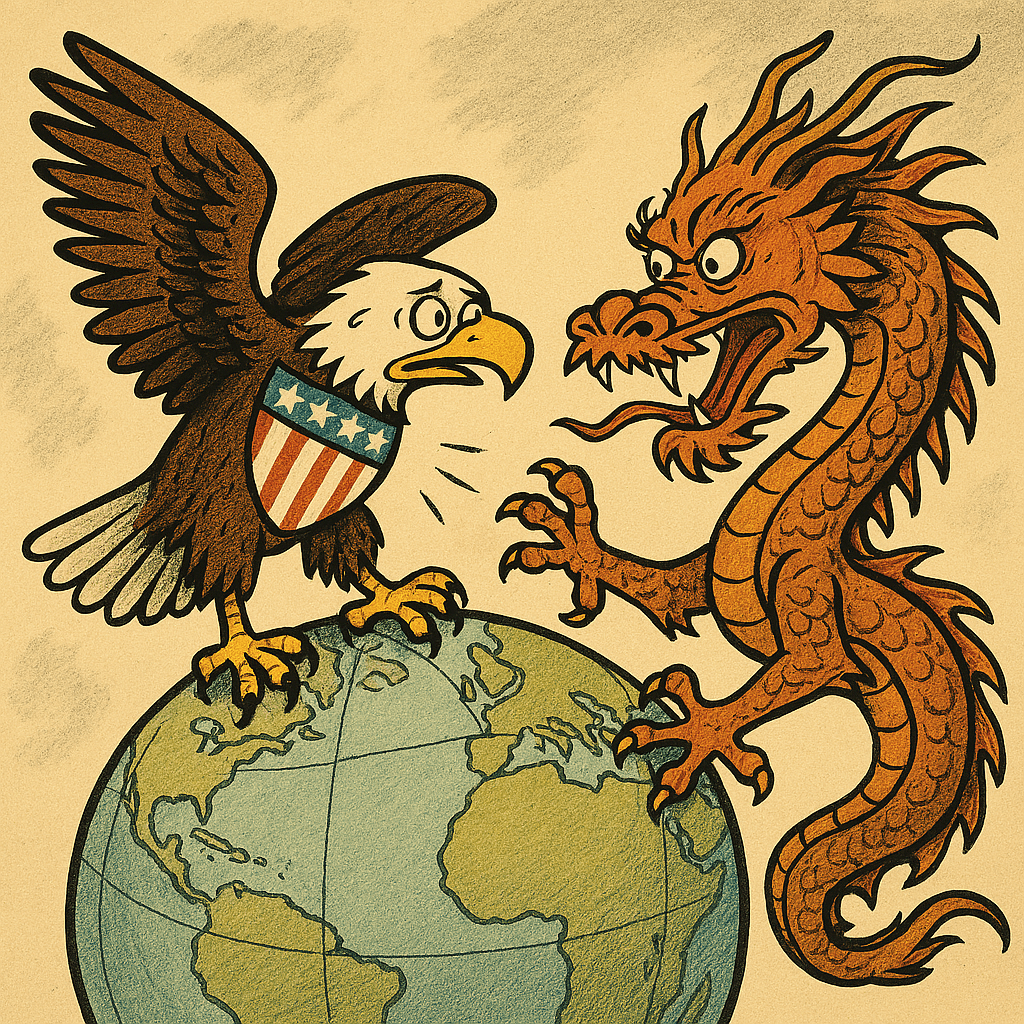
We know believe that the events that began on 24th February 2024 with the Russian invasion of Ukraine have unleashed a chain of events which will take years and decades to play out. The two opposed coalitions are too big to easily fail. The issues at stake are too profound to escape the debate of war. As a blog which is read all around the world, you might not want to us to take sides. Yet we have to be honest about where we stand. On the one hand the US, EU and their allies have many grievous faults. The other side-Russia, Iran, China and others, may indeed claim- we stress claim-to represent the relatively disadvantaged. However, we know one thing. We are free to write these words in our country, as we would be equally free to criticise our Government, or our allies. All know that we would not be if we were sitting in one of those countries opposed to us. Our Georgian ancestors, who gave up their comfortable lives to confront a similar peril knew that was the single, irredeemable difference between them and their foes. That is what makes our cause just. And one day, we will prevail.

[1]https://www.amazon.co.uk/War-Wars-Struggle-1789-1815-1793-1815/dp/1845296354

#ukraine #russia #china #usa #EU #canada #uk #australia #iran #peace #war #freedom of speech