Why Taxes are good for you #3: look what happened to China

One of the great disadvantages of low taxes is that you end up getting conquered. As China learned at terrible cost. In the eighteenth century Qing China had been one of the greatest states in the world:, rich and populous, with booming trade, advanced techniques in agriculture, and envied craftsmanship  Taxes were low, less than 5% of GDP it is estimated. So was military spending. And there was the problem. For nations in the west, like Britain for example, ran at much higher tax burdens, perhaps 15-20% GDP. With the result that they could pay for vast armies and fleets which captured all the world’s sea lanes and trade routes. It’s true that the most advanced western thinkers were classic Liberals like Ricardo and John Stuart Mill, who loudly proclaimed the virtues of low taxes and a minimal state. It was just that no one serious paid any attention to them. The result that these fleets and armies were eventually flung against China. The resulting Opium Wars were not only one of the most terrible crimes in History, they disgraced and destabilised China until 1949.[1] [2]

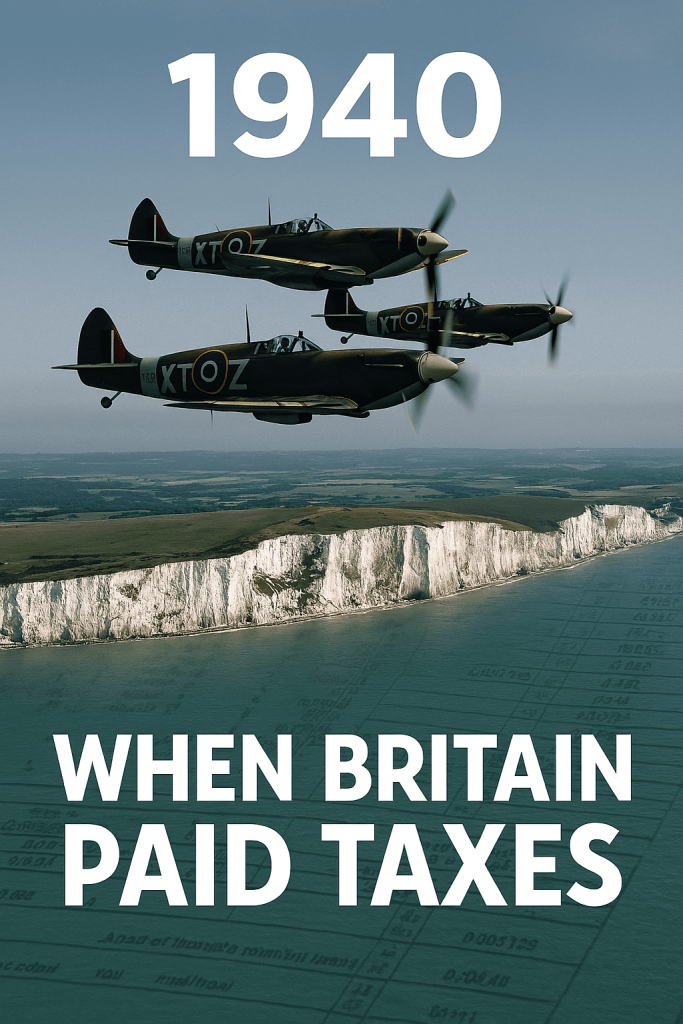
It was a lesson the British themselves had to relearn after the rise of Hitler forced them into frantic re-armament after 1937. After nearly two decades of orthodox economics like the Gold Standard and low taxes, suddenly the latter began to rise. Fast. All those Spitfires and cruisers and radar had to come from somewhere. So in 1938 the standard rate of income tax was raised to 27.5% (5s 6d in the pound) to help fund rearmament.   A 41% surtax applied to very high incomes (over £50,000 annually), targeting the wealthiest. Other hated impositions like death duties and PAYE *were imposed. And -despite what it says in the Daily Mail-it worked. Not only was just enough done to survive the perilous summer of 1940, by 1944 Britain was the most fully mobilised of all the wartime economies. Pride indeed.

Yet there is a little irony at work here . It is our lived experience that those who most loudly proclaim the greatest patriotism are also those who would avoid paying taxes wherever and when ever possible. It is their right to say such things. But ours also to at least doubt the sincerity of a patriotism which will not pay to uphold that which it professes to adore.

*Pay as You Earn

[1] Thomas Piketty Capital and Ideology

[2] David Ricardo Principles of Political Economy and Taxation

#taxation #economics #liberalism #free markets #imperialism #opium wars #china #britain

Why taxes are good for you: part #1 of a new series

Next to the arrival of immigrant persons, nothing so exercises the anger of our old friend Dave Watford and his mates at the Dog and Duck as the imposition of taxes. All taxes. Any taxes. Death duties, sales taxes, income taxes……the mere mention of the “t ” word is enough to unleash paroxysms of indignant wrath. As we have heard it so many times we think we can give a fair summary of their case, which goes like this

I’ll tell you what’s wrong with this country, mate —taxes. I work hard, and they just take it. For what? So some bloke in a suit can sit in an office pushing paper? I don’t see any of it. Roads are still full of ‘oles, the(expletive deleted) NHS is on life suppawt, and don’t get me started on foreign aid. They say it pays for schools an ‘ospitals—well I haven’t been in school for 40 years and I haven’t seen a(expletive deleted) doctor since ’98. Why should I pay for stuff I don’t use? And all these entrepreneurs, they’re the ones wots creating jobs. Government just gets in the way. If they cut taxes, we’d all be better off. More money in our pockets, less wasted on(expletive deleted) bureaucracy.

Dave, despite the obvious logical fallacies in your arguments. we respect you! We know you and your kind work hard and on the whole put in more than you take out. We know how your lives are centred on family and community, and that the world can seem a harsh, bewildering place. But can we, dare we, just take a short time to offer the counter-intuitive case? Just because every argument by its nature always carries a counter point.

For we believe that taxes and their imposition do more than pay for armies, police and courts (which they do). We believe they do more than generate economic growth (and we will show that they do indeed) That they create more stable societies-and we have strong evidence for that. But what we really believe is that the idea of taxes lies at the very beginnings of Civilisation, and are what made it possible to rise above the level of stone age farmers and grangers. It’s that profound. In the next few weeks we shall be running a series of blogs which explore these themes. If only for the sake of balance. In the meantime compare Finland (top tax rate 57.65%, rigidly enforced) with Chad (top tax rate 30%, barely enforced), and answer these questions:

1 Which has GDP per capita of a $53 189 and b which $1420?

2 which of the two boasts a universal healthcare, free education, strong infrastructure, low corruption. and which b Fragile institutions, limited public services, poor infrastructure, high corruption.?

3 Which of the two do you think has Higher life expectancy, lower infant mortality, combined with top global rankings in happiness and education?

ANSWERS TO QUIZ

1 a Finland b Chad

2 a Finland b Chad

3 Finland

#economics #tax #infrastructure #growth #GDP wealth creation

Is Globalisation over? Steve Schifferes worries what comes next

Recently the residents of the Canadian State of Ontario irritated US President Donald Trump by running a series of TV ads showing former President Ronald Reagan disparaging trade tariffs,. Why would such hero of the global Right have taken such a heterodox view? The answer is that Reagan thought that free trade was the best way to distribute prosperity as widely as possible. Under the hegemonic power of the United States of America of course. And he had good evidence for this belief, as Steve Schifferes makes clear in this article for the Conversation.

Schifferes is such a good writer. His sentences are always short and to the point, He keeps away from jargon. Which clarity allows him to range over the last 400 years or so of history tracking the rise and fall of the various powers-China, France, The Netherlands, Britain the USA all of whom aspired to the hegemonic position in world affairs. In the first of two such called The Rise and Fall of Globalisation: the battle to be top dog he comes to one overarching conclusion. Things go better, and the world grows when there is one such dog. The period of British dominance , roughly 1815-1914 was marked by ever closer union of world markets and ever greater flows of capital and people. The American hegemon, roughly lasting from 1944 to 2016 was a second such example. The great problem for the world was that, as Britain stepped down in 1918, the USA did not step up to the plate. Leading to two decades of deep economic and international stability that culminated in the most destructive war in History. This one we shall urge you to read, gentle readers. It not only describes, it explains.

And now? Populists everywhere not only proclaim that globalisation is dead, they actively seek to undermine it wherever possible. Tariffs, restrictions on free movement of goods and people, hostility to learning and science-all indicate the flow of history is one way. Yet populist nationalists can point to one overarching weakness in the globalists argument. The whole system when it worked, depended on the successful nationalism of one nation,the hegemonic power. Their nationalism was a good thing. From which many concluded “if nationalism is a good thing, we want some of it too.” So as the hegemon declines, as America now does precipitously, they will assert their own nationalisms more and more. World war Three anyone?

[1]https://theconversation.com/the-rise-and-fall-of-globalisation-the-battle-to-be-top-dog-267910

#steve sciffereres #history #economics #trade #USA #war #globalisation

Pity Rachel Reeves-but Britain’s problems are as dreadful as everyone else’s

Pity poor Rachel Reeves, Britain’s beleaguered Chancellor of the Exchequer (that’s what we call our finance minister). According to Larry Elliott of the Guardian, [1] she faces some agonising choices as she tries to prepare November’s Budget. Being a British Chancellor has never been all beer and skittles. And Larry’s dissection of the fiscal and financial constraints she faces , to say nothing of organisations like The Office for Budget Responsibility (OBR) or the Bank of England breathing down her neck is as succinct and percipient analysis as you will get of the economic landscape of Britain today.

Or any where else. All the advanced nations seem to be in dreadful trouble at the moment. The USA, France, Italy: even the once vaunted Germany and Japan seem be in the same mire of rising debt, financial constraint and  absolute inability to deliver the rising standards of living, education and health which their citizens had come to expect. Why do finance ministers suddenly seem so powerless?

They can still control some things of course: fiscal policy , debt issuance, regulatory frameworks and co-ordinating policy with Central Banks. What lie outside their control are immense things like global capital flows, stock market volatility, commodity prices and private investment decisions. At the time of writing over 80% of the world’s investment capital is in the hand of things like Hedge Funds, Sovereign Wealth Funds and Family Offices, as well as less shady entities such as pensions and mutual funds. And this has had very real consequences. For us Elliott’s key paragraph was this rather neat summary of the history of the world in the last twenty five years:

……..the big moves in inflation in recent decades have been globally rather than domestically driven. There was a long period in the 1990s and early 2000s when globalisation led to much cheaper imports, especially from China. More recently, the main reason inflation shot up above 10% was the sharp increase in gas and food prices caused by the war in Ukraine. Trying to hit a specific inflation target using the blunt instrument of bank rate is a mug’s game.

Which raises the question: is the Nation state still the best vehicle to deliver the thing its citizens really need? It’s a big question and the answer may not come down to a simple yes/no. But if it is to succeed, the nation must be immensely strengthened and reformed. Who will do it?

[1] Rachel Reeves is the face of this budget. But the really big decisions are not in Labour’s hands | Larry Elliott | The Guardian

#economics #history #inflation #rachel reeves #UK #Germany #France #finance #money #capital

Stock markets: a crash waiting to happen?

Predictions of imminent and terrible stock market crashes are as cheap and common as chewing gum. That’s why we wouldn’t take them seriously at all if they didn’t really happen sometimes. With dreadful consequences, like the ones of 1929 and 2007-2008 for example. And so when an expert as prescient as Larry Elliott of the Guardian offers a warning, we have to sit up and take notice. [1]

Elliott builds his case carefully, first noting that the chances of the next crash increase the further we move away from the last one. He points to slowing US job creation, rising unemployment and inflation as signs of underlying problems, while the stock market continues soaring away to record levels. We at LSS might have taken even that in our stride were there not so many worrying parallels with the situation in 1929 just before the Wall Street Crash. That summer the economy was starting to show signs of downswing too, while the markets reached giddy new heights Then, as now wealth was concentrated in relatively few hands, making the rich responsible for a disproportionate amount of consumer spending. As Elliott points out

30% of the wealth of Americans[is] accounted for by shares. Since share ownership is concentrated among the better-off, the US economy is relying on the Wall Street boom continuing, and for the rich to carry on spending their gains.

If they stop, the downturn will be very sharp indeed; as it was in 1929.

And this is where our take on Elliott’s article becomes slightly disquieting. He rightly notes that American policy is sharply divided over what to do. Jerome Powell and the Federal Reserve want to leave interest rates where they are, to bear down upon inflation. As President Trump rightly adduces, this could bring down the Stock Market at any time. However, although the President’s idea of cutting interest rates might preserve the equity boom a little longer, it risks dangerous problems with Bond markets as inflation takes hold. For US Treasuries are not just bits of paper. They are still the prime benchmarks for setting lending and borrowing rates around the world. If foreigners lose confidence in US Treasuries, their own bond and equity markets will fall too, In turn dragging Wall Street into the crash the President so badly fears. Damned if you do; damned if you don’t. We do not envy him his choices.

[1]https://www.theguardian.com/commentisfree/2025/sep/25/us-stock-market-trump-wall-street-financial-crisis-federal-reserve

#economics #finance #shares #bonds #wall street crash #markets #depression

If all the wealth in the world were shared out, what would happen?

Many decades ago, we often used to hear the argument “if all the money in the country were shared out, everyone would only get 20p” A tiny sum, which could not make any difference to daily life. This was the UK in 1973, Perhaps it was true then, there. Is it true of the world as a whole today?

The statement itself is a cognitive howler: because it equates wealth with money, carefully avoiding the inclusion of all the goods, capital infrastructure(IT systems, railways, etc.) and productive resources such as factories that make up the wealth of the world, which is best expressed as GDP. When we set out to find what that was, the best estimate was from the World Bank,[1] who put it at $105 trillion in 2023. Now, the population of the world is around 8 billion (8×10⁹) people. What would happen if we found a way to share that GDP among all of them? The answer is: everyone ends up with an an income of $13 125 a year. Which surprised us greatly. Instead of being insignificant, its actually quite a lot. Let us explain why.

That same world bank defines four categories of national income by GDP. Low: $1 135 or less. Lower Middle: $1 136-$4 465. Upper Middle: $4 466- $13 845. High: $13 846 and anything above. There is enough wealth in the world to raise everyone almost to the level of high income countries, certainly to the very top of the middle range.

Now there may be very good reasons why this cannot be done. Some are practical. Some are moral. But if it were done, what difference might it make to such issues as mass migration, educational attainment, and the overall level of demand in the world economy? Let alone health, security and basic nutrition. Just a thought.

[1]https://ourworldindata.org/grapher/gdp-worldbank

#wealth #GDP per capita #economics #inequality #migration #health #geography #economics

1st September 2025: the day world history changed forever(you did notice, didn’t you?)

Today, or yesterday (it’s all a bit muddled what with time zones, deadlines and so on) world history changed forever. Because the two biggest powers on the planet have started to come together. Making Asia potentially one huge zone of economic co operation. the true centre of economic and political power in the world. Yes, Mr Xi and Mr Modhi have started to talk about the joint efforts of 1.416 billion Chinese and 1.464 billion Indians. all increasingly prosperous and tech hungry. All of which trumps the 347 million Americans who so recently seemed to have the world game so utterly in their hands(anyone remember George W Bush?)

Ah, critics might say- but look at the GDP figures. America at $30.51 trillion is still comfortably ahead of both its enemies combined($23.4 trillion) But a Briton in 1900 could have pointed to similar figures which showed how rich they still were, ignoring the growth potential of rivals like the USA and Germany. And ominously, the current USA is in a bad position here, with 1.9% against China’s 4.0 % and India’s 6.9% The conclusion is obvious; the USA is fast on the way to becoming a regional, local power. It’s days of strutting the world like a colossus are over, or very nearly so.

And how has this come about? There have been long term trends of course. Growing inequality. political polarisation and corruption of its legal system have been in evidence since 2000 at least. The Iraq war of 2003 was an epic blunder and the crash of 2008 fatally undermined the rationale of the American order. But until recently America still represented an open democratic country Rational independent institutions. inalienable Rights , Something worth fighting for, both for its own people and for its allies. But now those allies are humiliated . [2] Others, not allies but still potential partners, alienated by irrational and erratically applied tariffs, rush to form their own blocs and trading systems. It was easy to believe that Mr Trump and his policies made sense at least from the point of view of their own country. Now the damage is not only deep, it is permanent. Welcome to a new world order.

[1]https://www.bbc.co.uk/news/articles/cp37e8kw3lwo

[2]https://www.independent.co.uk/news/world/americas/us-politics/trump-tariff-ass-kissing-nrcc-hannibal-b2729968.html

#china #india #usa #donald trump #narendra modi #Xi Jinping #geopolitics

Is all the money in the world running out?

Is the United States of America about to go bust, the way that previous empires like Spain and Britain did? Critics point to astronomical levels of government debt ( it’s now a whopping 123% of GDP) and ballooning trade deficits. Exactly the opposite to the US position just over one hundred years ago when it elbowed aside Great Britain to make Uncle Sam the dominant world player. “Ah”, counter the critics” if you have the world’s reserve currency you can issue as much debt as you like. And the fact that America has independent institutions makes its bonds the safest bet in the world for foreign investors”. So-no problem then? Perhaps. The trouble with debt is that it’s OK until it isn’t. As interest rates start to rise (as they have been doing for some time) the rising costs crowd out all sorts of fiscal flexibility. Especially on crucial issues like defence, health and education. As for the United States much vaunted institutions- recent events have put their independence in very great doubt indeed. [1]

But before we heap all the opprobrium on poor old America, don’t forget everyone else is doing it too, Japan is running debt at an eye watering 250% of GDP: while in France things are so bad , there are even rumours that they are flirting with an IMF bailout[2] If stalwarts such as they are in such deep trouble, what hope for less prosperous nations? The answer, chillingly, is not much. According to a report by Schroders [3] the levels of sovereign debt around the world are so high that they represent a real risk to future investment, growth and healthy trade. In effect the repayments will come to stifle most normal economic activity. Though the authors are careful not to go quite this far, what worries us is that if this activity slows, then there may be a real risk that many nation states may become structurally unable to ever repay their debt. If sovereign bond markets cease to function there is no real stable credit, In effect. all the money in the world has run out. The political, social and military consequences of that would be interesting indeed.

[1]https://edition.cnn.com/2025/08/29/economy/trump-fed-turkey-argentina

[2]https://www.theguardian.com/world/2025/aug/27/france-on-the-brink-political-crisis-economic-francois-bayrou

[3]https://www.schroders.com/en-gb/uk/institutional/insights/sovereign-debt-dynamics-the-alarming-backdrop-to-rising-geopolitical-risk/

#sovereign debt #USA #japan #france #economics #finance

Is Donald Trump A socialist? It’s really about tariffs

A few months ago we published a little blog(LSS 7 4 25) in which we wryly suggested that the policies of Donald Trump. especially on trade tariffs, more resembled those of socialists like Tony Benn than those of classic right wingers like Ronald Reagan. Our aim was less with ideology and more with practical matters: will the tariffs work? We even pointed out that, with advances in automated techniques like AI, it was pretty unlikely that huge numbers of jobs would be created in manufacturing, even if the tariffs really did change the pattern of trade in the way Mr Trump desires.

It’s view shared by professional economists of some standing, as this article by Steven Greenhouse for the Guardian points out. For example Ann Harrison of UC Berkeley, not only shares our thoughts on the automation thing. She also points out that to be successful, tariffs need steady application over decades. Trump’s wildly erratic “they’re on. they’re off” approach seriously impedes investment planning. And how long has he got anyway? Would a successor-perhaps JD Vance or a younger member of the Trump dynasty-have the same approach? While Michael Strain of the impeccably right wing American Enterprise Institute worries that all these tariffs will simply raise costs for most US manufacturers – a serious own goal if ever there was one. The various experts raise other questions too. Will the so called pledges of investment from other nations really materialise? Will the tariffs create an archaic automobile industry based on petrol, hopelessly unable to sell a single unit to a world which has long since moved on to electric? Frankly, are tariffs high enough to achieve their stated purpose(yes, that surprised us too) But all of these are laid out in Steven’s excellent article.

Tariffs are like many things. Sometimes they’re good and sometimes they’re not. If they were all good, then every nation would set them at 100%. If they were all bad, they would have been abolished long ago. The real mistake is to implement a good idea with insufficient care and attention. Now that really does resemble many socialist regimes of the past.

[1] https://www.theguardian.com/us-news/2025/aug/18/trumps-tariffs-manufacturing-resurgence-jobs

#donald trump #socialism #capita;ism #tariifs #trade #economics #american enterprise institute

G7 v BRICS: is this how the sides will line up for World War Three?

We know we started out as a science based blog, mainly devoted to the encouragement of more research into antibiotics. If our brief has widened a little, it is because we cannot ignore the wider world around us. If that world decides to spend more on weapons of mass destruction, and less on antibiotic research, it impinges directly on us and our readers. Which is why this pair of articles from the Guardian caught our eye. They strongly suggest that the sides for the next world war are lining up. And the outcome is by no means certain.

On the one hand are the G7 group of countries, led by the USA.[1] Thirty years ago they had the game in their hands. Immensely rich, accounting for an enormous slice of the global pie, their triumph over the Communist bloc had seemed to set them apart . They were the world’s bankers, the world’s policemen, the world’s shop keepers. Since when, hubris seemed to set in and it has been downhill all the way. Iraq, financial crash, tariffs, Brexit…………These words are shorthand, metanymies if you will, for a deep moral rot that is grounded in an almost childlike reverence for the supremacy of financial markets and the sorts of people who work in them. Now as the admirable Joseph Stiglitz and his colleagues observe, the once mighty G7 is in danger of being little more than a front organisation for the interests of large American multinationals. A position sure to alienate many around the world.

Among the alienated are a group which starting out as the BRICS (Brazil, Russia, India, China and South Africa)[2] has expanded to include rising stars such as Indonesia. It may not be morally perfect either(its stance on Ukraine, and the fact that many members are autocracies cannot be overlooked). But its members are united on one thing: they are tired of the whims and policy lurches of the US, particularly under such a nakedly self-serving President as the current one. They are ready to have done with the traditional instruments of US domination such as the Reserve Dollar. And they are developing the economic resources to make these ambitions feasible.

History has two lessons. The decline of one hegemonic power and the rise of another is usually a signal of impending war. Another is the formation of alliance blocks; as one small event triggers a chain reaction of consequences. Think Europe 1914 as the case example for both. And don’t expect the supply of antibiotics to go up any time soon.

[1]https://www.theguardian.com/business/2025/jul/02/the-g7-has-once-again-put-multinationals-profits-over-the-interests-of-people?CMP=Share_iOSApp_Other

[2]https://www.theguardian.com/commentisfree/2025/jul/13/the-guardian-view-on-brics-growing-up-a-new-bloc-seeks-autonomy-and-eyes-a-post-western-order?CMP=Share_iOSAp

#G7 #BRICS #China #USA #IMF #dollar #geopolitics #brasil #russia #indonesia