Why Taxes are good for you #7: but why you still won’t want to pay them

It’s time to wrap up our counter-intuitive series Why Taxes are good for you. We started it as a slightly cheeky riposte to the massively funded and relentlessly intolerant opposition who insist that taxes must be, always and everywhere, a despicable evil. In the first part we met the industrious but not very knowledgeable Dave Watford who expounded upon the best of their arguments from his post at the bar of the Dog and Duck. We went on to learn the rather chilling truths about life in a low tax nirvana, where their are no laws, roads nor health services and violent death lies around every corner. Part three considered the little known but incredibly well documented story of 18th Century China whose low taxes led it to be conquered by the tax- funded armies of ruthlessly hypocritical western nations. Whatever else they are for, taxes are good for your health as we showed in part 4. We felt that part 5, despite being a historical argument, was crucial. No taxes equals no economy. And if you really do want to get rich, the best chance of doing it is by starting from a well-taxed society, as our part six concluded. We provided lots of links and books and that sort of thing for you to read in order to draw your own conclusions. And so we said ” Quod erat demonstrandum

Except it wasn’t. Isn’t. And probably never will be. Because we forgot one thing. The benefits of taxes are long term, and require an immediate short term loss. Think how Dave Watford sees it. Money taken from his pocket to pay for armies, nurses, roads is not there now. Indeed, some of those hospitals, schools and museums may not even have been built yet. But Dave feels that loss of money very personally. Money which he could spend here, and now on, any number of Bright Shiny Things. And it is no good telling him “Dave-most of these Bright Shiny Things, that you covet so desperately, will have no value in the long term. Remember how you longed for an Austin Healey, a record by the Bay City Rollers, Watneys Red Barrel, a bottle of Hirondelle, a quadrophonic stereo? All good in their day, no doubt-but are they quite what they were, have not other things come along to take their places?

But Dave knows things that we do not. Has studied authors that we have never heard of. Like Thorstein Veblen who as long ago as 1899 showed that people buy Bright Shiny Things not because those things are useful, but to signal the wealth, status and sophistication of the buyer. To consume conspicuously, ostentatiously, vainly, and emptily. To doom themselves thereby to domination by rich men, and to conquest by foreign ones. Oh well. We tried to warn.

Veblen, T: The Theory of the Leisure Class: An Economic Study in the Evolution of Institutions (1899).

#economics #taxes # finance #history #veblen #consumer society #production #marketing

Why taxes are good for you #6: The best thing for an Enterprise Economy

As we approach the end of this series, we could not resist two more arguments which have always irritated the “taxes are evil” lobby. If only because we haven’t met one of them who has come up with a convincing counter argument. And the first should be beloved of all: taxes are a superb way to control inflation. As Britain and the US began to gear up for the Second World War the sheer enormity of the spending needed ran the risk of runaway inflation. It was Keynes in How to Pay for the War who saw the answer. Taxes, he argued would not provide the money; they would suck excess cash from everyones’ wallets , thereby keeping prices on a relatively stable trajectory. The US applied a similar philosophy in its own way [1] The economy grew at unprecedented rate, bringing prosperity to all. And there was a an even more significant side effect, which led to prosperity lasting for decades thereafter.

Because in both Britain and the US, vast defence spending contracts generated an equally vast ecology of institutions, government departments, University research labs and the rest. All beavering away at new discoveries, new ideas and shiny technologies. No wonder the years 1945 -1970 are remembered so fondly as times of progress and prosperity . Names like Rolls Royce, Boeing and McDonnell Douglas are just the tiniest iceberg tips. If you want to know more, trying kicking off from the site of the US’ famous famous DARPA[2] a seed bed for an almost fractal cornucopia of new ideas. Even things we use today like GPS, the internet, and advanced semiconductors are all horses from this stable. By contrast, the economic ascendancy of western countries only really declined after the tax and regulation reforms of the Thatcher-Reagan years when Proud Finance finally crushed Humble Industry.

Why does this all work? Because ultimately the State is able to take a risk which private enterprise capital cannot. We don’t blame them: this is not a moral failing, just a question of numbers and distributed risk. Its true that in some countries private banks have a much more supportive relationship with their local industries: but these tend to be lands where such innovations as Regulations and Industrial Planning are celebrated, and not seen as wicked socialist evils. Leave aside the fact that taxes pay for the roads, hospitals and schools which provide entrepreneurs with a ready supply of able workers. Their real benefit is to create a vast pool of opportunity in which enterprise can afford to reach losses and profits in turn, and keep coming back for more. After all-what use is a football club without a League to play in? We will be revisiting these and other thoughts in the last of our series. Hold on to your seats.

[1]https://www.federalreservehistory.org/essays/wwii-and-its-aftermath

[2]https://www.darpa.mil/research

#fiscal #tax #financialisation #keynes #second world war #inflation #research and development #history #economics

Why taxes are good for you #5: No taxes= no economy

Let’s go back to part one of this series where our old friend Dave Watford is leaning on the bar of the Dog and Duck. Complaining how the government takes all his money in taxes and” if he ditnt ‘av ter pay no (expletive deleted) taxes his wife wouldn’t ‘av ter (expletive deleted) work at all!” It’s a widely held view, assiduously promoted by certain very well funded “think” tanks. In fact it’s the exact opposite of how a real economy works. Or exists at all. All the evidence suggests that without taxation, and the government to enforce it, there could have been no economy.  Humanity would have frozen at the level of sheep grazers and dirt farmers.

It worked something like this Once there was a King somewhere in old Mesopotamia: and he invented something called an Urg, No one wanted it much at first. Until the King said: ”everyone has to pay ten  Urgs a year in taxation. Which I will enforce.” Suddenly the Urg had value because-everyone needed it to pay the taxes. They started to work and trade to earn and swap all the Urgs they needed to pay the King. Who helpfully kept the whole process going by creating more Urgs which he issued  to people in order that they could pay their taxes…….suddenly roads were built, trade networks flickered into life, and huge buildings like ziggurats started going up. “Ah!”. cry the detractors, “all these things were gong on before there was money!” It was Keynes who nailed this fallacy. Money is about much more than coins, and came much earlier, he said. Money is all about the network of obligations, debts and credits, which by their redemption make trade possible. The whole point of the king was to ensure that these contracts were enforced. Coins came much later in the archaeological record, as a convenient  technological advance to the system. . The electronic banking of their day, if you like.[1] [2]

We’ve talked before how kings use taxes to pay for armies and policemen and courts and other things to keep its citizens safe. But below that level, they are even more fundamental to the very existence of an economy. Without them there would be no Dog and Duck bar for Dave to lean on. He would depend on home brewed beer and home spun clothes. And, as it was mainly women who produced all those sorts of things (they do most of the work in agricultural societies), think of this Dave:-she would indeed ‘av ter work, mate. Innit.

[1] The History Of Taxation In Ancient Civilizations: A Comprehensive Overview Of Early Fiscal Systems And Their Impact

[2] The Shocking Origins of Money Hidden in 1,000-Year-Old Artifacts

[3] Kelton, S The Deficit Myth John Murray 2021  see especially pp 25 et seq

#archaeolgy #economics #history #taxes #money #coins

Why Taxes are good for you #3: look what happened to China

One of the great disadvantages of low taxes is that you end up getting conquered. As China learned at terrible cost. In the eighteenth century Qing China had been one of the greatest states in the world:, rich and populous, with booming trade, advanced techniques in agriculture, and envied craftsmanship  Taxes were low, less than 5% of GDP it is estimated. So was military spending. And there was the problem. For nations in the west, like Britain for example, ran at much higher tax burdens, perhaps 15-20% GDP. With the result that they could pay for vast armies and fleets which captured all the world’s sea lanes and trade routes. It’s true that the most advanced western thinkers were classic Liberals like Ricardo and John Stuart Mill, who loudly proclaimed the virtues of low taxes and a minimal state. It was just that no one serious paid any attention to them. The result that these fleets and armies were eventually flung against China. The resulting Opium Wars were not only one of the most terrible crimes in History, they disgraced and destabilised China until 1949.[1] [2]

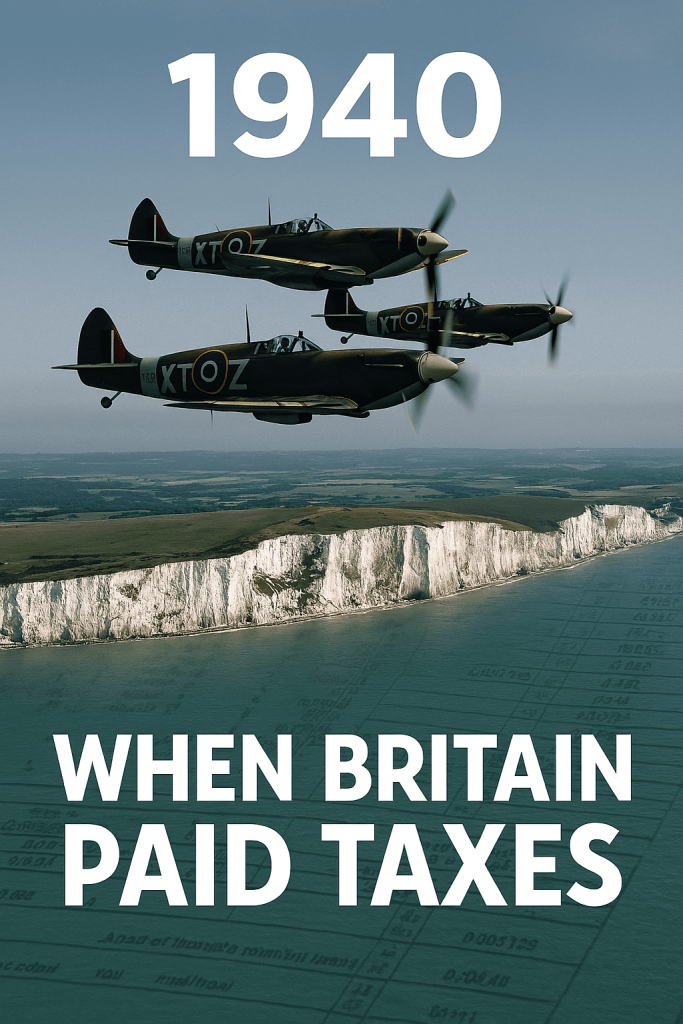
It was a lesson the British themselves had to relearn after the rise of Hitler forced them into frantic re-armament after 1937. After nearly two decades of orthodox economics like the Gold Standard and low taxes, suddenly the latter began to rise. Fast. All those Spitfires and cruisers and radar had to come from somewhere. So in 1938 the standard rate of income tax was raised to 27.5% (5s 6d in the pound) to help fund rearmament.   A 41% surtax applied to very high incomes (over £50,000 annually), targeting the wealthiest. Other hated impositions like death duties and PAYE *were imposed. And -despite what it says in the Daily Mail-it worked. Not only was just enough done to survive the perilous summer of 1940, by 1944 Britain was the most fully mobilised of all the wartime economies. Pride indeed.

Yet there is a little irony at work here . It is our lived experience that those who most loudly proclaim the greatest patriotism are also those who would avoid paying taxes wherever and when ever possible. It is their right to say such things. But ours also to at least doubt the sincerity of a patriotism which will not pay to uphold that which it professes to adore.

*Pay as You Earn

[1] Thomas Piketty Capital and Ideology

[2] David Ricardo Principles of Political Economy and Taxation

#taxation #economics #liberalism #free markets #imperialism #opium wars #china #britain

Why taxes are good for you: part #1 of a new series

Next to the arrival of immigrant persons, nothing so exercises the anger of our old friend Dave Watford and his mates at the Dog and Duck as the imposition of taxes. All taxes. Any taxes. Death duties, sales taxes, income taxes……the mere mention of the “t ” word is enough to unleash paroxysms of indignant wrath. As we have heard it so many times we think we can give a fair summary of their case, which goes like this

I’ll tell you what’s wrong with this country, mate —taxes. I work hard, and they just take it. For what? So some bloke in a suit can sit in an office pushing paper? I don’t see any of it. Roads are still full of ‘oles, the(expletive deleted) NHS is on life suppawt, and don’t get me started on foreign aid. They say it pays for schools an ‘ospitals—well I haven’t been in school for 40 years and I haven’t seen a(expletive deleted) doctor since ’98. Why should I pay for stuff I don’t use? And all these entrepreneurs, they’re the ones wots creating jobs. Government just gets in the way. If they cut taxes, we’d all be better off. More money in our pockets, less wasted on(expletive deleted) bureaucracy.

Dave, despite the obvious logical fallacies in your arguments. we respect you! We know you and your kind work hard and on the whole put in more than you take out. We know how your lives are centred on family and community, and that the world can seem a harsh, bewildering place. But can we, dare we, just take a short time to offer the counter-intuitive case? Just because every argument by its nature always carries a counter point.

For we believe that taxes and their imposition do more than pay for armies, police and courts (which they do). We believe they do more than generate economic growth (and we will show that they do indeed) That they create more stable societies-and we have strong evidence for that. But what we really believe is that the idea of taxes lies at the very beginnings of Civilisation, and are what made it possible to rise above the level of stone age farmers and grangers. It’s that profound. In the next few weeks we shall be running a series of blogs which explore these themes. If only for the sake of balance. In the meantime compare Finland (top tax rate 57.65%, rigidly enforced) with Chad (top tax rate 30%, barely enforced), and answer these questions:

1 Which has GDP per capita of a $53 189 and b which $1420?

2 which of the two boasts a universal healthcare, free education, strong infrastructure, low corruption. and which b Fragile institutions, limited public services, poor infrastructure, high corruption.?

3 Which of the two do you think has Higher life expectancy, lower infant mortality, combined with top global rankings in happiness and education?

ANSWERS TO QUIZ

1 a Finland b Chad

2 a Finland b Chad

3 Finland

#economics #tax #infrastructure #growth #GDP wealth creation

If all the wealth in the world were shared out, what would happen?

Many decades ago, we often used to hear the argument “if all the money in the country were shared out, everyone would only get 20p” A tiny sum, which could not make any difference to daily life. This was the UK in 1973, Perhaps it was true then, there. Is it true of the world as a whole today?

The statement itself is a cognitive howler: because it equates wealth with money, carefully avoiding the inclusion of all the goods, capital infrastructure(IT systems, railways, etc.) and productive resources such as factories that make up the wealth of the world, which is best expressed as GDP. When we set out to find what that was, the best estimate was from the World Bank,[1] who put it at $105 trillion in 2023. Now, the population of the world is around 8 billion (8×10⁹) people. What would happen if we found a way to share that GDP among all of them? The answer is: everyone ends up with an an income of $13 125 a year. Which surprised us greatly. Instead of being insignificant, its actually quite a lot. Let us explain why.

That same world bank defines four categories of national income by GDP. Low: $1 135 or less. Lower Middle: $1 136-$4 465. Upper Middle: $4 466- $13 845. High: $13 846 and anything above. There is enough wealth in the world to raise everyone almost to the level of high income countries, certainly to the very top of the middle range.

Now there may be very good reasons why this cannot be done. Some are practical. Some are moral. But if it were done, what difference might it make to such issues as mass migration, educational attainment, and the overall level of demand in the world economy? Let alone health, security and basic nutrition. Just a thought.

[1]https://ourworldindata.org/grapher/gdp-worldbank

#wealth #GDP per capita #economics #inequality #migration #health #geography #economics

Is all the money in the world running out?

Is the United States of America about to go bust, the way that previous empires like Spain and Britain did? Critics point to astronomical levels of government debt ( it’s now a whopping 123% of GDP) and ballooning trade deficits. Exactly the opposite to the US position just over one hundred years ago when it elbowed aside Great Britain to make Uncle Sam the dominant world player. “Ah”, counter the critics” if you have the world’s reserve currency you can issue as much debt as you like. And the fact that America has independent institutions makes its bonds the safest bet in the world for foreign investors”. So-no problem then? Perhaps. The trouble with debt is that it’s OK until it isn’t. As interest rates start to rise (as they have been doing for some time) the rising costs crowd out all sorts of fiscal flexibility. Especially on crucial issues like defence, health and education. As for the United States much vaunted institutions- recent events have put their independence in very great doubt indeed. [1]

But before we heap all the opprobrium on poor old America, don’t forget everyone else is doing it too, Japan is running debt at an eye watering 250% of GDP: while in France things are so bad , there are even rumours that they are flirting with an IMF bailout[2] If stalwarts such as they are in such deep trouble, what hope for less prosperous nations? The answer, chillingly, is not much. According to a report by Schroders [3] the levels of sovereign debt around the world are so high that they represent a real risk to future investment, growth and healthy trade. In effect the repayments will come to stifle most normal economic activity. Though the authors are careful not to go quite this far, what worries us is that if this activity slows, then there may be a real risk that many nation states may become structurally unable to ever repay their debt. If sovereign bond markets cease to function there is no real stable credit, In effect. all the money in the world has run out. The political, social and military consequences of that would be interesting indeed.

[1]https://edition.cnn.com/2025/08/29/economy/trump-fed-turkey-argentina

[2]https://www.theguardian.com/world/2025/aug/27/france-on-the-brink-political-crisis-economic-francois-bayrou

[3]https://www.schroders.com/en-gb/uk/institutional/insights/sovereign-debt-dynamics-the-alarming-backdrop-to-rising-geopolitical-risk/

#sovereign debt #USA #japan #france #economics #finance

Calling all Billionaires: Please read this blog

John Caudwell[1] is no fool. Anyone who has started a company like Phones4U and turned it into a multibillion pound company must be pretty well endowed in the brains department. Yet he has one particularly intriguing belief. He believes in meritocracy: he is deeply suspicious of the idea of inherited wealth. If you want to know more about why you can hear home talking to Tony Hawks in this podcast [2] Tony Hawks is Giving Nothing Away on the BBC. But essentially Caudwell thinks that in the long run his children will lead healthier, happier lives if they have to make their own way. Like he did.

We don’t know about individuals. But we know societies function better if the follow Caudwell’s prescriptions. Old LSS hands will recall our long time advocacy of the works of Thomas Piketty [3] and Wilkinson and Pickett. [4]Who show that societies with more equal economic structures have better health outcomes, lower crime, more scientific innovation and much higher social mobility, than less equal peers. One of their key findings was that wealth hoarded into family dynasties is one of the key blockers of healthily mobile societies.

Which is why Caudwell has joined the Giving Pledge. [5]No it’s not a marxist commie plot: it’s run by some of the richest people on the planet. In the words of the organisation’s own website:

Pledgers support a wide array of issues in every corner of the globe and give in a multitude of ways. What unites them is a shared promise and a commitment to creating an impact.

Wealth can be spent in two ways. It can be wasted in endless competitions as to who drinks the best bottle of wine, drives the fastest Rolls Royce or has the biggest yacht. Or it can be re invested like this creating a healthier better world, with-who knows?-maybe even enough antibiotics. if you really want to spend your money to make your children safe, this is the way to do it. If you are a billionaire, thank you for reading. If you are not-find one gentle readers, and press the works of the Giving Pledge into their hands.

[1]https://en.wikipedia.org/wiki/John_Caudwell

[2]https://www.bbc.co.uk/sounds/brand/m002fj92

[3] Thomas Piketty Capital in the 21st Century Harvard University Press 2014

[4] Richard Wilkinson and Kate Pickett The Spirit Level Penguin 2009

[5]https://www.givingpledge.org/pledger/john-caudwell/

#john caudwell #the giving pledge #economics #philanthropy # equality #social mobility

Why a falling population will solve most of our problems

Back in the 1970s we used to worry about rising population the way we worry about antibiotics now. Problems like pollution, energy shortages and even climate change were being discussed in the better pubs in the area where we grew up. Birth rates were soaring around the world. Everyone agreed that by 2010 there were going to be far,far too many people for the planet to support (and you wondered why you weren’t invited to more parties?-ed)Since when the situation has changed. Rulers, particularly of the more authoritarian sort, are fretting that their populations are actually starting to fall. The reason this keeps them awake at night, they asseverate, is that thereby there will not be enough young workers to keep pensioners in the style of living to which they have become accustomed (although we privately suspect they have darker motives) “Make women have more children!” is their cry. How about “the pram is the tank of the Home Front!” Or has that one been used already?

The reality is rather different as Larry Elliott points out so limpidly in this short piece for The Guardian [1] A falling population means less pressure on oceans, air and land. Less need for antibiotics! More seats in cinemas and restaurants! And, quite quickly, a rising GDP per head of population. As for the economic thing: a single modern worker produces and consumes far more GDP and products than a hundred medieval farm hands. To keep the economy growing you just need to raise the standard of living, you don’t need more workers

But as committed feminists we have another sort of worry. If you really want women to have more children, you will have to take them out of universities and higher education generally. Re- structure the wage market so men are again the main breadwinners. Recreate ideologies of patriarchy and submission, a bit like those currently popular in Afghanistan. is that what you really want?

[1]https://www.theguardian.com/commentisfree/2025/jul/02/britain-falling-birthrate-economy-politics

#feminism #pollution #population #economics #ecology

No that last blog does not make us a bunch of Communists

Every so often one of our blogs engenders some intriguing feedback . Alongside the usual welcome comments with all their nods and frowns, we occasionally get one that is a little-uh- longer, yet expresses its views with passionate clarity, to push euphemism to its limits. Such was the case today, when a reader alleged that our criticism of fossil fuel and tobacco companies was a sure sign that we were under the influence of Communists, who aim to tear down the free market system and replace it with a “nightmare of bureaucratic state socialism” of the sort found in places like Venezuela and North Korea. In particular the reader observed:

What you’ve got to remember is that markets not governments are best at allocating resources. Intervening in fossil fuel markets is crypto socialism- it will only distort price signals, stifle innovation and lead to unintended consequences”

When we asked if this was true for immigration control as well, they replied

“Absolutely! Free markets mean the free movement of labour. Anything else is protectionism in disguise.

So, where does that leave us at LSS? Having worked for many years in the Government Employ and thereby known the ways of Civil Servants, we can more and more share the view that Free Markets really do work better. No, it’s the “unintended consequences” that pulls us up. Free markets can have those too. Totally unregulated sales of tobacco produced an epidemic of cancer. We suspect that over enthusiastic marketing of certain foods and drinks will one day produce an epidemic of obesity. As for gushing out vast quantities of poisonous mineral oil and burning it with heedless abandon-well we wish people had been better informed before this was started. To call for better product information, and to ask that consequences of free markets are cleaned up, or at least controlled, does not make one a Communist. Or anything like it.

Thanks for the feedback, and we appreciate that in view of this respondent’s employment, they must remain anonymous

#climate change #free markets # global warming #immigration #communism #socialism #capitalism #hayek #marx