
Simon Kuper on how to Make the Transition to Intelligence and Wisdom

One of Saturday morning’s great pleasures, an hour or so before Spanish class, is to settle down in Costa with a coffee and a hard copy of the Financial Times. And one of the best writers in that journal is Simon Kuper. He’s clear, he’s brief, he deals in the currency of short sentences and defined concepts. He’s also a polymath, covering subjects as diverse as politics, urban planning and football(he’s even done a very workmanlike guide to the affairs of Barcelona FC . [1] In fact, he’s exactly the sort of writer we ought to showcase here, because he believes in our core LSS values of evidence, reason, and reserved judgement.

How appropriate therefore that his last column was called Seven Intellectual Habits of the best thinkers., for there can be no better short guide. [2] The problem is that access is behind a paywall. As LSS is such an important institution, and our readers so avid for wisdom, we rang the Editor of the Financial Times a to demand that this be lifted as a Special Case., and that he/she/ they might like to buy us lunch to discuss the matter further. The young person on the switchboard thanked us very much and promised they would call us back. So far they have not done so(that was three days ago) but doubtless there were other callers. So, while we are waiting, we thought that we could offer you a distilled reproduction of Simon’s thoughts:

1 Read Books ” Their complexity is a check on pure ideology” People who simplify the world are the ones who fall for conspiracy theories or the offers of charlatans.

2 Don’t use screens much Apparently, biochemist Jennifer Doudna, who invented CRISPR technology gets her best insights when she’s out weeding her tomato plants. Obviously you have to use screens a bit, or you couldn’t read this! But we get Simon’s drift: a little screen time is a lot.

3 Do your own work, not the world’s The same Doudna got a gig at Genentech, leading their research. She lasted two months before hightailing it back to Berkeley where the true intellectual freedom led her to the Nobel Prize. We agree: people who spend all their time on office politics actually accomplish very little that is either interesting or of value.

4 Be multidisciplinary Kuper cites the examples of Hayek, Godel, Van Neumann and others who all studied one thing, trained in another and did their best work in a third. Daniel Kahneman is cited as another multi-disciplinarian polymath of formidable intellectual power. Rather worryingly, our AI system has set his book as homework for us. Where’ are John and Sarah Connor when you really need them?

5 Be an empiricist who values ideas Kuper cites the case of Isaiah Berlin and his marvellous work the Hedgehog and the Fox , a masterpiece of political philosophy. Incidentally Winston Churchill got him mixed up with Irving Berlin and invited the wrong one to dinner.”My British Buddy” as Berlin himself would later remark in song.

6 Always assume you might be wrong Yep: in this country we are still trying to repair the effects of the blissful certainties of Brexit. You will doubtless have examples from your own lands

7 Keep learning from everyone “Only mediocrities boast as adults about where they went to University at 18.They imagine that intelligence is innate and static. In fact people become more or less intelligent through life depending on how hard they think. The best thinkers are always learning from others, no matter how young or low status” We quote Kuper rather fully here as the first part seems one of the most admirable and accurate summaries of the sorts of people one met on a daily basis during long decades in the Scientific Civil Service. Now there’s intelligence indeed.

[1]https://www.worldofbooks.com/en-gb/products/barca-book-simon-kuper-9781780725543?sku=NGR9781780725543&msclkid=6c7699156a7f1cc4c9f2f1238

[2]https://www.ft.com/content/c42cb640-a03c-441b-868f-d1a92d78bcb7

#wisdom #intelligence #FC Barcelona #isaiah berlin #daniel kahneman #thinking #financial times #simon kuper

Another big Thank you-and a small musing

Another big thank you to readers, commentators, and the indefatigable ideas people including our researchers and fellow members of the Editorial Board. We are indeed getting mote readers, more followers and above all more likes and comments. All of which keep us in mid season form, as Wodehouse would have it: full of the joys of nature’s second season, with the old ginger whacked up absolutely to the top of the tank.

If you can bear it, we thought we’d throw away a couple of lines on who is reading, and about what. Unitedstatespersons make up the biggest contingent. Odd when you think this stuff is tapped out in England. Astute readers will not be much surprised to note that English speaking countries such as the United Kingdom, Canada, Australia etc joining the line up roughly in proportion to the old demographics. By the time we get down to the more far flung outposts however, the figures do not look so good. Why so few responses from St Helena or Pitcairn Island? We don’t know. But we’re working on it. As for the rest of the world: India always big- a country on the rise with a strong science base, and a large number of English speakers. We had hoped for more from the Spanish Speaking world. Sadly our command of that language is not quite good enough to write articles in it. But if any of you amigos want to comment in the language of Cervantes, we’d love to hear from you. After that, many countries. China figures above the random level; we’d love to know which latter day Kong Qiu peruses our offerings, and where they work.

And what are you reading? The one where we suggested that the President of the United States was a closet Socialist is cantering in at the top of the field everyday. It was meant to be more wry and ironic than a serious discourse on Political Economy. But some like it- a lot. After that- human evolution seems quite popular. Our own idees fixees of antibiotic resistance and climate change are high in the betting, but not always favourites. We need to do more there, we think.

Overall, since we started-progress. Like that new bloke they have at Manchester United, who is being given time. Give us some more too, The world is a big bad place, and once again to paraphrase the Immortal Wodehouse; we thinking Johnnies need to stick together.

THE BOARD

#United States #United Kingdom #China #india #antibiotics #climate change #science

Friday Night Feast of Fun: VE day

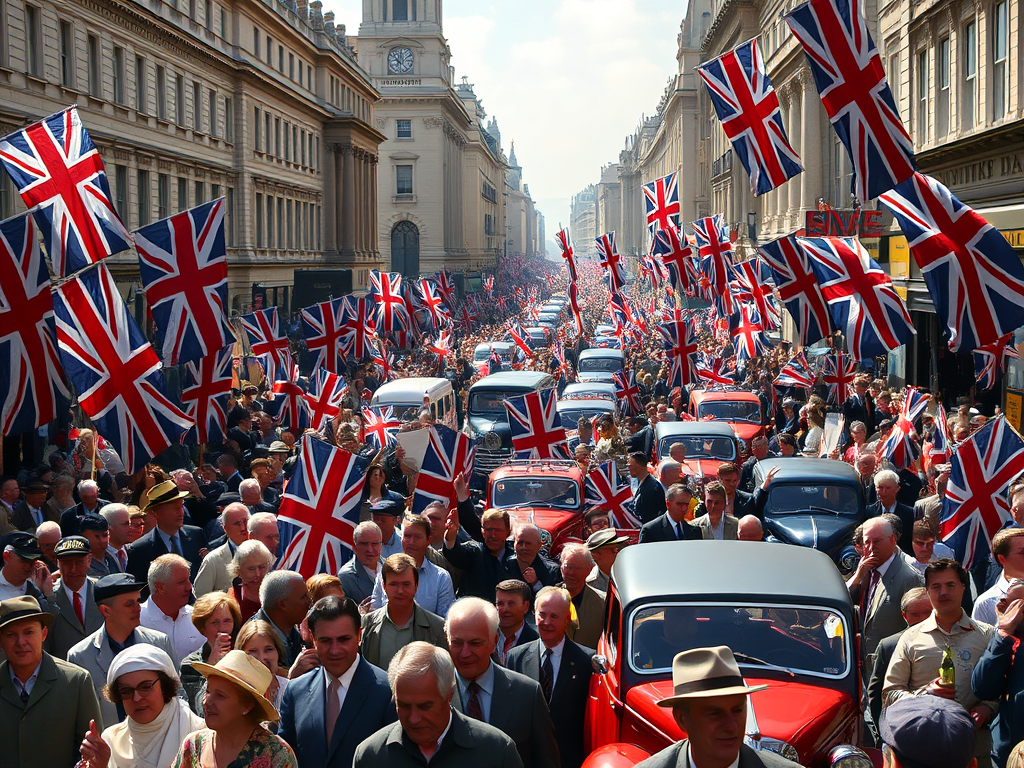
The 80th anniversary of VE Day has bought an immense outpouring of celebrations. Millions who were not there will tell you how they long to put on a zoot suit and jive the night away to Vera Lynn, or roam the streets of London getting up to goodness knows what with perfect strangers on bomb sites (wasn’t it a bit cold?-ed)

But-how much would you have enjoyed it? For those who advocate free markets and liberal trade as the best cures for human ills, the Second World War makes very difficult reading indeed. The Government seized control of the nation’s food supplies in 1939,introducing an utterly comprehensive system of rationing, backed by bulk buying and ruthless imposition of standards. By VE Day on 8 May 1945 the nation was thinner, heathier, fitter and better fed that it had ever been before. Or would be ever again. But Civil Servants are not chefs, and the menus available on that famous date may seem very spartan indeed to the modern palate. We thought we’d offer the kinds of things which might have been served up. With the help,naturally, of one of the most likeable books in our collection: The Ration Book Diet [1] And follow it up with what you could drink.

First Course There isn’t one Both shipping and fuel were in short supply, making this stage a superfluous luxury. Now you know why they were so healthy. Wanna try it?

Main Course In their spring section, Brown et al suggest recipes for Kidney with Mustard and Madeira Gravy(p76) Vinegar and mustard baked chicken(p78) or broad beans with minted salsa verde (p80 ) Other things served up might have been Ham and pickle pie monkfish and bacon casserole or salad of some sort. Everything grown locally, or sourced form the nations own fields and fishing grounds. Should we go that way again?

Dessert They would probably have called it “afters” or “pudding”. Apricot compote , rhubarb bread pudding or rhubarb fool might have graced many a VE Day table . For treats as the night drew in: oatmeal scones. And that really is it. There were things about like spam, corned beef and even cheese(heavily on the ration) But you’ll have to read the book iof you want to know more about them.

Happy so far? Let’s pour a drink , or go to the pub

Popular beers of the day included Bass, Guinness and Trumans At home, these would have come in bottles. There were no fridges of course. The Ministry had strained every nerve to ensure the pubs were well stocked with much the same. We also found a cocktail list from a site called Bistrot Pierre. For us, the Gin Fizz stands out as an iconic component of the war-time vocabulary. At least from the films and TV programmes we’ve seen.

And wine? Oh come on. It all came from the continent, which had been under enemy occupation for four years. You had about as much chance of finding a mobile phone as bottle of chardonnay in London in 1945.

Still want to go there?

[1] The Ration Book Diet Mike Brown Carol Harris CJ Jackson The History Press 2010 https://www.amazon.co.uk/Ration-Book-Diet-C-Jackson/dp/1803993448

[2]https://www.bistrotpierre.co.uk/propeller/uploads/2020/04/VE-Day-cocktails.pdf

#food #drink #VE day #world war two #diet #health

Academia has its Robbers Caves too, you know

Here at LSS we’re always praising the learned. Exalting the scientists, doctors and philosophers who would unleash a trouble-free prosperous world, if only we were given the chance. Instead all those nasty hypermacho builders, farmers, football supporters and military types have imprisoned us in a hopeless nihilistic trap of warring tribes which we called The Robbers; Cave(LSS 1 4 2025)

There may be some truth in it. But before we hand over the world to a bunch of Professors and nerdy Civil Servants, let’s flag down a large black cab and ask it for a journey to the Reality Hilton Hotel. Because, we ask-are all these brainy types so immune from Robberscavism, to coin a phrase? Anyone like us who has followed Arts, Sciences and Letters for fifty years or so will notice at once how its practitioners have a tendency to divide themselves into warring camps, like so many followers of certain East London Football teams. Back in the Middle Ages there were the Nominalists versus the Realists. In economics you get Behaviouralists going toe to toe with the Rational Choice Theory crowd, while Linguistics seems to have more warring schools than practitioners. It’s the same for us fans of the Neolithic revolution, where opinion is hopelessly divided too. One lot asseverate that the Neolithic way of life was carried out from the fertile crescent by a single contiguous culture, who replaced(exterminated?) those unfortunate hunter-gatherers who got in the way. Their opponents counter that farming, sheep herding and all those Neolithicky -type things were learned, picked up by enthusiastic locals from traders and traders and adopted with the enthusiasm reserved for certain types of computers and mobile devices in our own age. And the truth? According to studies by the learned Drs Javier Rivas and Alfredo Cortell, writing in the Conversation, [1] it was a bit of both. At one place, at one time the incomers seem to have bludgeoned in and extirpated the natives, as the English did in Tasmania. Elsewhere the locals seem to have picked up the new hoes, made better ones and then jolly well got on with life down on the farm.

And the moral in all this? For practical people, especially those who hand out grants and bursaries, always take one step back. Sometimes you have to make decisions(think of Courts and Forensic Scientists here) But the real joy of learning isn’t in constructing theories and and then fighting to impose them on everyone else. It’s in the journey of discovery itself: gathering the facts, weighing the evidence and above all talking with the people you meet on the way. The ancient virtues of humility and suspended judgement are the most settled and non controversial of all.

[1]https://theconversation.com/how-human-connections-shaped-the-spread-of-farming-among-ancient-communities-254852?utm_medium=email&utm_campaign=Late

#learning #science #neolithic #academic controversy #tribalism #robbers cave experiment #whig

Is Donald Trump a Socialist?

Is Donald Trump a socialist, or is he just governing like one? For a man who made his money in the freewheeling and dealing Manhattan property market, it seems an odd term to use. And doubtless he and his supporters would reject it vehemently. But let’s go back to first principles and look at what he does, not what he says.

The very essence of a socialist policy is that an economy should not be run by free market methods. It can and should be run on others, designed to support the welfare of all the groups living in it. If they are poor, money must be found through taxes to alleviate that. If their communities depend on certain industrial conglomerations. such as steel making for example, then money must be found to sustain those industries, to avert the social damage which would ensue/ In Britain the key exponents of this view were people like Arthur Scargill and Tony Benn, who felt public money should be found to support the mining industries, even if those industries operated at less than optimum economic efficiency. In the 1970s Benn went further, suggesting a siege economy protected by tariffs as an alternative to joining the European Community, forerunner of the EU.

The alternative view was pioneered by thinkers such as Adam Smith and David Ricardo. The unhindered operation of free markets, with the lowest possible levels of tax and tariff would facilitate the best possible social outcome. Ricardo developed this in his theory of comparative advantage. By which countries or regions specialising in different products would trade in these to their mutual benefit. His example was Britain and Portugal, which mutually traded manufactured goods and port wine. The same principle holds today.

The key political exponents of this view were Ronald Reagan and Margaret Thatcher, whose most memorable declaration was “you can’t buck the markets”. As we write, Mr Trump’s policies seem to be doing exactly that. Unlike others, we judge him to have an honesty of purpose: he is trying to protect the communities that voted for him. Communities whose social structure and very identity depend on the old smokestack industries around which they cluster. Time will tell if he will be successful. But two things worry us. Firstly even if factories are attracted back to the rustbelt, it is unlikely that modern automated plants will need many factory hands. And second: the last twenty years or so of the Communist bloc were spent trying to keep these same sort of plants going. History did not judge that enterprise kindly.

#free markets #socialism #communism #adam smith #david ricardo #margaret thatcher #donald trump #united states of america

Heroes of Learning: Colin Renfrew

Anyone with the slightest interest in early civilisation must pay tribute to the work of Professor Colin Renfrew. That fascinating period spanning the Neolithic to the early Iron Age witnessed the transformation of humanity from hunter gatherers subsisting barely above the animal level to the first technological civilisations, deploying writing, building, pottery, roads and all the other appurtenances that set us above the beasts. This was Renfrew’s territory. And it encompassed a vast sweep from Cycladic figurines to the immense migrations of the Indo European speakers and the changes they wrought With a few Anatolians thrown in for good measure

So today we throw this blog open to the likes of Nature Briefings (see below) and Wikipedia [1] to tell you about his life and accomplishments. For Renfrew had all the marks of the true scholar. His learning was vast, his methods empirical, his conclusions provisional. He knew the real value of learning to is prompt further investigations, not to provide easy answers. If someone had provided clear and unequivocal evidence that the Indo Europeans had originated in Sutton Coldfield and not the Steppes, he would have been the first to agree. If ever you have travelled the sunny lands of the Mediterranean or Levant, gazed in wonder at the ruins still there, or tried to understand the guide book, remember :you are in Renfrew territory. Tread with respect.

Archaeology’s Closest thing to a household name Colin Renfrew, who helped to transform archaeology as a scientific discipline, died last November, aged 87. In the 1960s, researchers discovered that tree rings from bristlecone pines (Pinus longaeva) — which are among the oldest living things on Earth — could be used to redate artefacts in Europe. Prompted by these developments, Renfrew helped develop a fresh understanding of how European and Near Eastern civilizations developed, alongside new models for how societies change. “Renfrew’s ideas were decades ahead of available computational modelling power,” writes his colleague, archaeologist Cyprian Broodbank.Nature | 5 min read

[1]https://en.wikipedia.org/wiki/Colin_Renfrew

#colin renfrew #neolithic #bronze age #iron age #fertile crescent #middle east #indo europeans #archaeology #language

Heroes of Learning: Peter Ramus

Due to difficulties with the Word press site we are unable to bring you images. We hope to resume this function soon

Remember your first textbook? Your first real textbook, when you’d left school and started to learn something which you really wanted to? It could have been one on  Accounting, Zoology, Economics or something altogether more useful like Nursing or Housing Studies. OK,  It wasn’t light reading, exactly. But here was real serious learning, laid out by experts, divided into chapters, references, sections, with questions and answers. The very essence of professional: but, sometimes, there was wonder in there too, as it made you think. And how far would you have got without  this guidebook, comfort and, above all, friend? RP Littlewood, Living Spanish , that was our personal favourite. They’re still publishing it today, much updated of course.

Well what if we told you that all this was down to one man. He is called Peter Ramus in English, but he was one of those typical polymathic polynational scholars that the Renassance was always throwing up. There were brighter and better scholars at the time. But Peter had one insight which made his contribution to our progress as good as any of theirs . He realised that knowledge had to be organised, systematised and arranged into an orderly manner, enabling students to access it far more quickly, freeing up new time for creative thinking and discussion. And so he invented the Textbook. It was a force multiplier of immense power. Combined with effective use of the new printing technology it allowed learning to spread quickly and effectively in many fields. No single textbook or edition is ever perfect. They must be updated every few years as new  discoveries ensue. But the method and layout guarantee a sure design which has lasted, as its easy transference to the internet shows. An so we hail Peter Ramus as a true hero of learning, who helped make us what we are today.

Our link today comes from the BBC , the UK’s publicly funded source of news and information. It is rigorously objective and independent, and as such is hated by private purveyors of news of all sorts . Please support it where you can.

[1] https://www.bbc.co.uk/sounds/play/m0026vst

[2]https://en.wikipedia.org/wiki/Petrus_Ramus

#textbook #learning #teaching #renaissance

The Stupidest Idea we ever had-and how we dismissed it

Here’s a killer quote, if ever there was one:

when reason and emotion collide, emotion invariably wins”. The right was much more skilled on this terrain, weaving compelling human stories while its opponents tended to take refuge “in reciting their best facts and figures, as if they were trying to prevail in a high school debate tournament”.

It’s from an article by John Harris for the Guardian, [1] quoting the work of Drew Westen, a sagacious political philosopher whose work The Political Brain explains more than most about why progressives keep losing. ( Declaration of interest: Harris is on our list of all time top journalists because he actually goes out and talks to real people)

From which we deduced that the answer to all the world’s problems must be to create a Political party to obtain representation for The Intelligent and Educated. You know, the way working people in the UK set up the Labour Party in the nineteenth century, because they felt that the Liberals and Conservatives did not represent their interests? Spotted the flaw yet? We went on to point out to ourselves that we did all the science and doctoring and lawyering and wrote all the movies and……still not spotted the the flaw? And no, we had not been drinking, we’re on a diet at the moment; but we do not need to drink heavily to make huge blunders. We’re amazingly good at it, even when when sober . Last chance: have you spotted our fault?

OK here’s the answer. This morning we had coffee with a wonderful elderly neighbour who spent most of his life as a fisherman on the Sussex coast. In the course of a long, pleasant conversation we learned much of the Perils of the Sea. Storms, wrecks, unpleasant colleagues, conger eels, that sort of thing. For example, what do you do when you haul up a 1000 lb German torpedo and get it tangled in your nets in a strong wind and a heavy sea in the shipping lanes, and it is threatening to explode/capsize your boat/ slow you into the path of a 200 000 tonne supertanker? The answer is to think. Very quickly, very profoundly and very thoroughly, in a way that landlubber University Professors and keyboard wannabees never, ever have to.

And suddenly it crossed our minds. Who’s intelligent now? What price all your books and theories when you have to face existential crises like that one? And still have to calculate the economics of the fishing business-pay for fuel, pay the crew, keep alive, sell the fish, etc? And another lesson became even clearer. Until we in the Centre, on the Left, Liberals, Whigs, Progressives, Greens or whatever we want to call ourselves take very seriously-very seriously indeed- the feelings, emotions and opinions of those who actually do the work, we will be lost at sea indeed.

[1]tps://www.theguardian.com/commentisfree/2024/dec/01/labour-relaunch-government-nigel-farage-donald-trump?CMP=Share_AndroidApp_Other

[2] Drew Westen The Political Brain Business News Publishing 2007

#john harris #inshore fishing #politics #government #progressive #conservatives

Six insoluble mysteries which may end us all

Occasionally we come across websites with lurid titles like “10 UNSOLVED MYSTERIES TO GIVE YOU THE HEEBIE JEEBIES!” And it’s all to do with odd bits of old stone or dodgy claims about flying crockery. Which made us think of a few everyday mysteries about Homo sapiens which are enough to give anyone the aforesaid Heebies, with a few jeebies thrown in for good measure. Because if we do not develop the cognitive capacity to solve them, we could well be heading for the biological equivalent of the junkyard,

(1) Where is the line between the individual and society? Countries that go too far towards prizing the State end up economically stagnant, as the society is captured by a small self-serving elite who grab all the resources. (Think USSR or Venezuela) On the other hand societies with no idea of the common good, where untaxed individuals run around doing what they like, not only end up without worthwhile armies or roads. They also get captured by an elite, this time billionaires, with almost identical outcome to the deluded Commies. No one has resolved this tension in any stable way.

(2) Emotion utterly dominates reason. All the technological and scientific advances that make life worth living (you really wanna give up soap, huh?) are formed in the reasoning part of the brain. Yet most people are driven by deep tides of emotion welling up from the subconscious. These rarely lead to anything profitable, and are the principal causes of most of the obsessions, addictions and generational hatreds which form such an immense drag on progress. Why is logic so weak and blind passion so strong?

(3) The drive to divide into hostile groups We often allude to this one; think football supporters and the Robbers Cave experiment. The American writer James Baldwin saw identity as a serious trap, denying us our own better nature. It may take all the AI in the world to solve this one

(4) The constant need for persecution of others, particularly the weak or disabled. Anyone still deluded about “the moral superiority of the oppressed” could learn from what happens to disabled neighbours in cheap housing estates, and how the noble proletarians make their lives utter hell. Why does everyone want justice, but only for themselves?

(5) The local and the trivial Why do so many people spend so much time learning about the lives of celebrities in tacky media outlets, when they would profit much more from reading magazines like The Economist or Science?

(6) An utter inability to change minds Most people are really rather deft and clever about what is around them; the hierarchies around their neighbours, families, jobs, and so on. But most of what they learned about bigger things like science or society was laid down decades ago. And the habits of mind formed in youth seem impossible to change, even when the survival need to do so becomes clear. This may ultimately be the most dangerous mystery of them all.

No species, however successful it seems at its peak, can long survive the competition from a better-adapted one. Our predecessor Homo erectus had evolved into top predator, and colonised three continents. Before it was utterly outclassed by the more intelligent Homo sapiens in its various subspecies. A newer, more intelligent form of human, perhaps incorporating elements from artificial intelligence and genetic engineering should be able to solve the above cognitive problems with ease. If that happens, there will be little enough space for the predecessor, and no motive to preserve us either.

#climate change #learning #cognition #human evolution #unsolved mysteries

A very special French ’75

We know Friday Night Cocktails got dropped a few months ago (on orders from the top). But that won’t stop us from bringing you searing, cutting edge journalism when we think a story is much in the public interest that it must be broken. Even if it upsets The Great and the Good, the Powerful, and the Establishment, assuming that members of any of these groups read LSS. So, anyway, such was the case with the French 75 which we discovered at Cote, Brighton, last Saturday night before dinner.

Now, before you reach for your lawyers: we do note get any money for this. We have no commercial, financial ,commercial nor personal connection with Cote nor any of their staff. But when we, in the company of a companion visited that outlet at the end of a hideously long and dry January, we were more than in the mood for a little pick-me-up. And so it proved. Naturally we have adapted the details a bit, as we soon found ourselves a bit hazy about their precise nature. But the following will suffice:

The beauty of the French 75 is its simplicity. Refreshing simplicity, that fruity, slight sour quality we always look for in a great cocktail. Take a simple champagne flute; add a small quantity of sugar. Now add 1/2 measure of lemon juice and one measure of white gin. Cover all with cold white bubbly- Champagne, Cremont, Prosecco or cava, any of these will do. Top off with a slice of lemon peel to add that extra piquancy such ingredients demand. Now sit back and savour.

So, if you are Great, or Good, or Powerful-or just an ordinary Joe like us, here is a recipe which we hope all of you will enjoy. It’s going to be a bust weekend-so goodbye for now.

#french 75 #cocktail