Friday Night: Cocktails on the Queen Mary

Let’s take a trip back in time. It’s May 1961 and you have decided to cross the Atlantic from Southampton to New York on the Queen Mary. Forget being crammed into one of those poky little jets that are starting to fill the sky, you’ve got enough time and money to do the thing in style. It’s six o’ clock on a Friday night, your first day out at sea, and you have just settled into the cocktail lounge and clicked your fingers at the waiter. LSS has the document to take you right there.

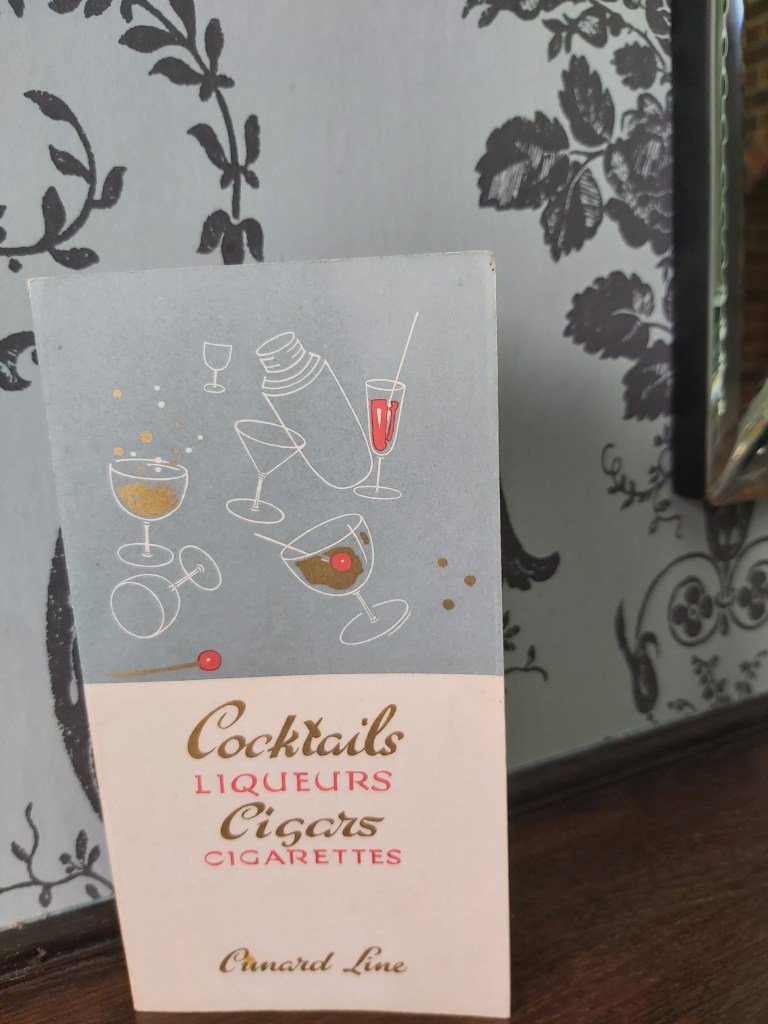
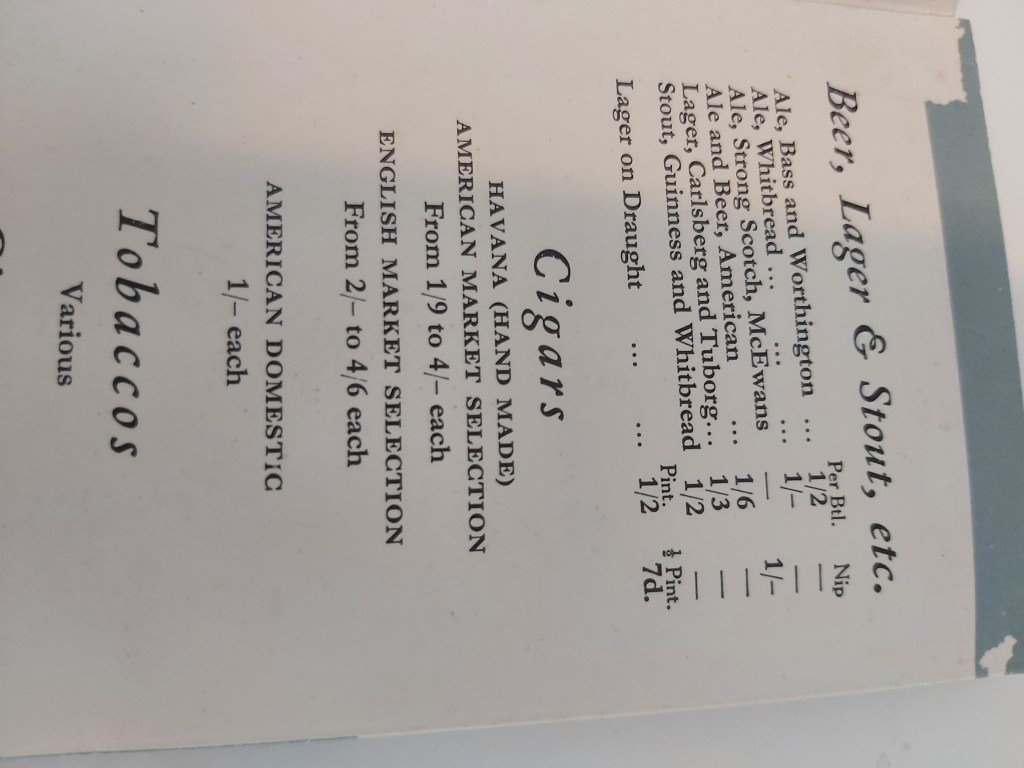
It’s the Queen Mary cocktail menu from May 1961. Have a look at the top left photo, because the design stands at a unique point in time. The stuffy, formal fifties are just starting to give way to the more fun sixties (although the colours and layout are still a bit Festival of Britain). That said, let’s open up and go inside. The first thing to surprise is that all the prices are in shillings and pence! A courvoisier brandy will set you back 2/3d. A Martini will be 3s. To buy a White Lady will cost you 3/3d. This is ten years before decimalisation, but a shilling was about 5p. We suspect that this was the second class cocktail bar, because humbler tastes and pockets are catered for as well. A bottle of Worthington or Bass ale was a snip at 1/2d; thrifty Scots could knock back a McEwans for 1s; the future lay in lagers like Carlsberg and Tuborg at 1/3 a bottle.

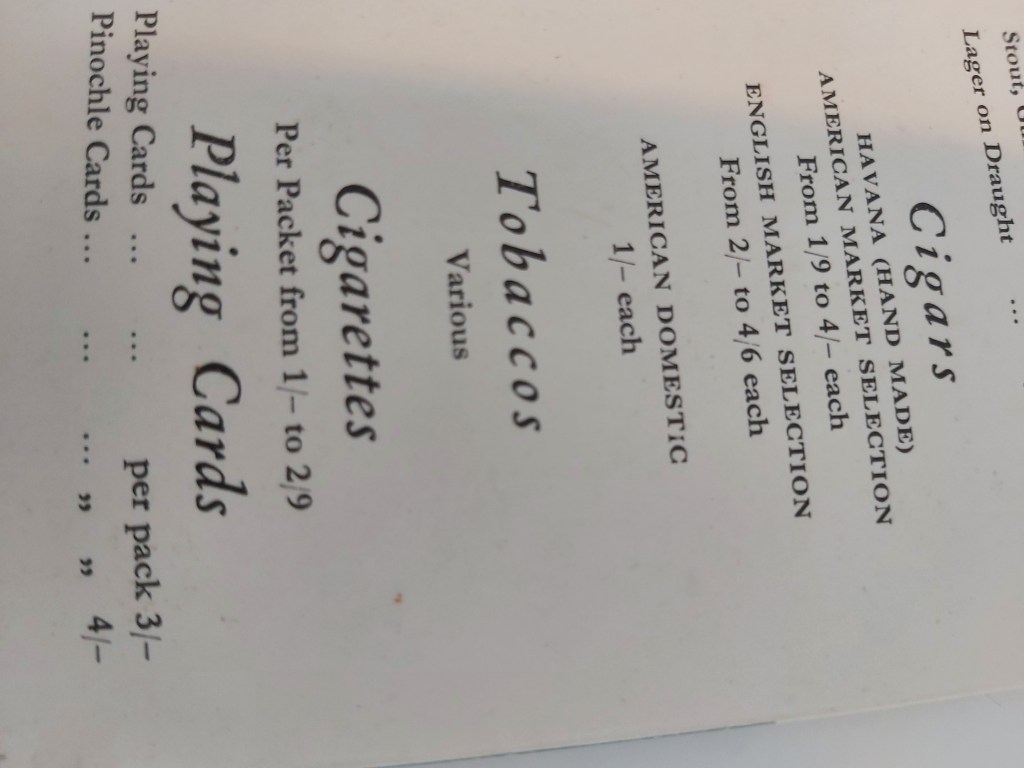
But the biggest shock of all is the casual way that cigars, cigarrettes and tobaccos were hawked around without a care in the world. We think this bar must have been as smoky as the three glorious funnels towering over the ship.What was it like to sit next to a huge American puffing away on a 4s hand made Havana, the best for sale on the ship? What music was playing? Who else were you sitting near to, and what did they talk about? Mr Kennedy? Tottenham Hotspurs? IBM computers?

Well now the Queen Mary sits immobile in Long Beach, Ca. All regular transit services are in the air now, and cruising is not really the same. But the great liners marked a certain point in style and elegance, and what’s the harm in us cocktail sailors indulging in a little nostalgia on a Friday Night?

#cunard #queenmary #cocktails #poundsshillingspence #smoking #liners
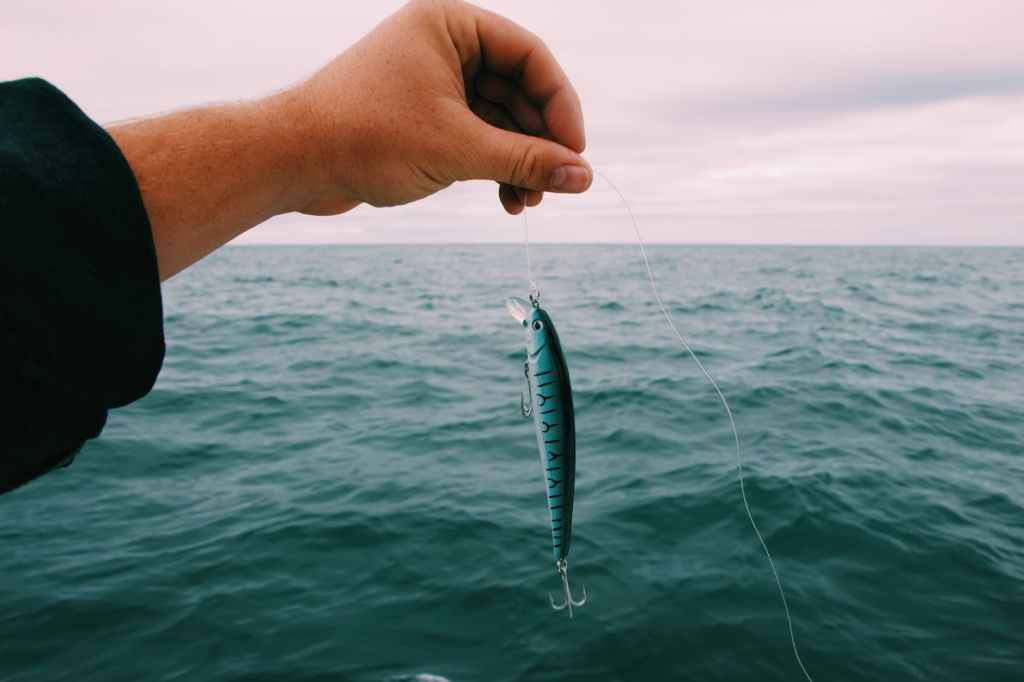
Jersey Fishing dispute-reaching the limits of ethno nationalism

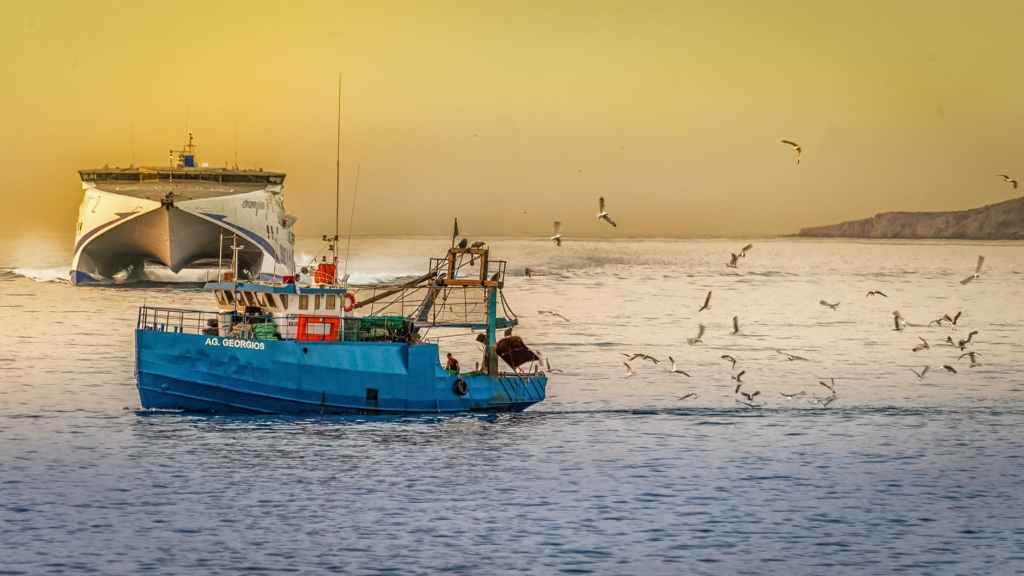
News that the fast-dwindling Channel stocks of fish are being fought over again by British Jerseymen and French fishers shows the limits of ethno nationalism as a philosophy. Why? Let’s go back to basics.

The ethnonationalist view means that one’s own group must always come first, and therefore must win. It compels its adherents to believe that any gain for the other party to a negotiation is a loss to its own. So, front line players and negotiators first job is to make the folks back home feel strong and dominant, not necessarily to obtain the best outcome. Nowhere is this mindset more destructive, and long term self-defeating than in disputes over resources such as fish.

As we write, the world’s oceans are becoming ever more depleted, polluted and degraded.* As a glance at the map will show, British and French fishermen are a tiny part of this. Huge fleets from bigger, better armed nations are currently sweeping the seas of every living thing, and every maritime nation jealously squabbles over stocks of things like tuna and cod. And who can blame them? Better to take up every last haddock and kill the stock rather than let the hated enemy take them!

We at LSS genuflect to ethnonationalism as a driving and inescapable force in the the human psyche. But there are more powerful forces, such as nature, facts, and reasons. The problems of the world , such as pandemics, climate change, sexual and economic inequality are now so great they they will destroy us quite soon. The only hope lies in solutions agreed by all.

Take fisheries as one example. A world fishing authority, comprising scientists, oceanographers, economists and fisherpersons’ representatives could manage stocks so that they could last forever. And maybe even lobby to clean up the seas a bit, who knows? It’s the sort of thing we in the Rational Community have been advocating for years. And our time must surely come.

Our links today are from two of the very finest Enlightenment, Rationalist and Educated websites you will find WWF and Wikipedia. Apart from the fact that both begin with W, both could do with a little cash. Could you find it in your heart to help them? We at LSS have done. John Locke would have been proud of you.

What is Overfishing? Facts, Effects and Overfishing Solutions (worldwildlife.org)

Overfishing – Wikipedia

#uk #france #overfishing #marinedepletion #ethnonationalism #enlightenment #rationality #jersey #normandie

Are women better listeners?

Warning-somewhere in here is a little pun, to test if you have really understood this blog. Can you spot it?

A philosophically-inclined correspondent of ours recalls an interesting difference in the behaviour of men and women, encountered while he was a Training Manager for a large financial services corporation and recruiting new employees:

“we sent detailed instructions stating that the essential requirement was to teach us something, anything. in twenty minutes” he recalls

Some candidates, particularly women, read their briefs and managed to teach the interviewers something. they hadn’t known. Others, mainly men, emphatically did not. They went into long presentations, taught nothing, and became indignant when they were closed down as their time ran out.

All of which got us thinking. Are women better listeners than men? Are they better readers too? Have you ever come up against a really bad listener? The type who completes your sentences for you before you have finished? Who interrupts, stating that you haven’t understood what you are saying? Or, if you met a man with three legs, he will undoubtedly know one who has four?

We suspect that many of the world’s disputes will only be resolved when people learn to listen better. We’ve got two lovely links for you, which we hope these will get you started.

Audrey Nelson of Psychology Today takes on the women v men problem. * Trying to get beyond first impressions, she suggests the sexes may be listening in different ways. There’s a nice summary of what good listening skills might look like. Which leads us in to a more general discussion in Persuasion by James Borg. * It’s one of our favourite books in the management/self help genre and we honestly recommend that you try it, as there’s a lot more in there besides.

And so, gentle readers, we leave you with this age old thought :why do people so often hear, but so rarely listen?

James Borg Persuasion Pearson 2004

Are Men Really Lousy Listeners? | Psychology Today

#management #psychology #menvswomen #listening #communications

Antibiotic Resistance-more immunity, please

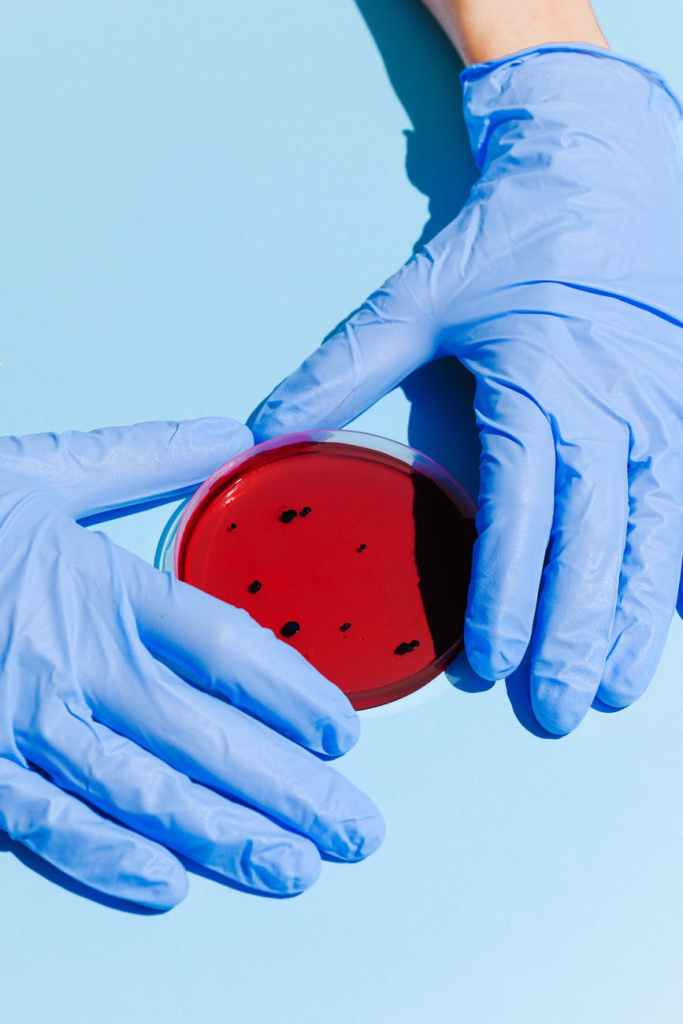
After Covid-19 declines and everyone goes back to parties, holidays and festivals, and start committing all the health-sapping things associated with such events, the problem of of antibiotic resistance will remain. As this little blog often reminds, we are going to need all sorts of new antibiotic molecules, vaccines, bacteriophages and researchers equipped with the latest IT. Up to now our treatments are based on a simple, one -dimensional model: put in A and wait for effect B, which hopefully consitutes a cure. Now a new study tries to look athe complicated, iterative interactions of bacteria, antibiotic and immune system.

Rachel Wheatley and Julio Diaz Caballero, reporting in The Conversation, looked at the how the bacteria Pseudomonas aeruginosa, which causes lung infections, develops its resistance to antibiotics in real time. They showed that the best time to “send in” the antibiotic helper is when the patient’s immune system is in full cry. And that later, even if antibiotic resistant bacteria come back ,curses, the immune system may be able defeat them. You can read the link we have posted below.*

The implications are thought-provoking. Maybe the timings of antibiotic doses are just as important as the dose strengths. Maybe the immune system and its capacity to “learn” and modify could be fruitful areas for more research. In which case, it will be important to look very carefully at things like at signalling, information and stimulation. Perhaps the research teams should be recruting a few Information Scientists alongside microbiologists and chemists.

#antibioticresistance #covid-19 #bacteria #infection #health #medicine #informationscience

Manchester United and Cornwall both point to deep questions

At first glance the troubles of Cornish villagers and the followers of Manchester United may seem far apart indeed. But recent events make us suspect they may be connected-and point the way to bigger troubles in future.

Firstly, the background. For those not totally hooked on Line of Duty, yesterday saw fans of Manchester United riot so comprehensively that the club’s fixture with arch-rivals Liverpool has had to be postponed. Commentators talk of long-standing grievances against the rich American Glazer family that owns the club, which were accentuated by the latter’s flirtation with the recently mooted European Superleague. *

Meanwhile down in beautiful Cornwall tensions are running high in the village of Feock * near Falmouth. It’s the same old story as in other areas of natural beauty, such as Wales. Impoverished locals are infuriated by rich outsiders who move in with big wads of cash, buying up properties, changing shops and generally acting, it is alleged, with a swagger and panache that goes with economic superiority.

We do not imagine that Football fans or Cornish villagers are Communists or Socialists to any particular extent. Both are heirs of the final victory of Capitalism in 1991, and would welcome its freedoms to travel and trade across the widest possible areas. Yet both are (relatively) disadvantaged groups who see their traditional customs and social structures deeply disturbed by the action of these same market forces and the much richer individuals that ride them. Both sides have some deep questions to answer. Do free markets always guarantee the happiest outcomes? If not, and you start to tamper with them, where does that end? If you join a free market zone, do you thereby allow strangers the same rights in your community as you have?

It is issues like this where nationalist parties gain their first footholds. We note that Mebyon Kernow are now involved in the travails of Feock the way that Plaid Cymru and the Scottish Nationalists learned to fish in troubled local waters back in the 1970s. Could there one day be a Cornexit from the UK, mirroring the recent Brexit from the EU? What about Quebec, and Corsica and California? As we have said before, local and national feelings run deep and should never be dismissed or mocked. We may be at the beginning of their consequences.

both stories today are from the Guardian, but you will find them well covered in other media

https://www.theguardian.com/uk-news/2021/may/03/real-thuggery-cornwall-boats-vandalised-amid-incomer-tensio

https://www.theguardian.com/football/2021/may/03/fans-frustration-must-be-understood-says-minister-after-m

#cornwall #feock #manchesterunited #football #capitalism #socialism #inequality

Saturday Round up-Rafts, helicopters and more Scotch

Things that made us genuinely intrigued in this week’s news and feeds

Humans weren’t the first sailors– How on earth did all the different animal species end up in such curious spots? Especially ones like mammals, who evolved as the continents were splitting up? Incredibly, a new study suggests they may have survived on natural rafts, making their landfalls in new areas and evolving rapidly into new forms. . We say the jury’s out,but an intriguing and imaginative piece of work nevertheless Here’s The Conversation:

https://theconversation.com/one-incredible-ocean-crossing-may-have-made-human-evolution-possible-157479?utm

Phages surprise again– We at LSS are big fans of bacteriophages, hoping against hope that they might help kill antibiotic resistant bacteria. Now they show an intriguing new angle. Their DNA is subtly but significantly different from the standard DNA that most organisms possess. Is this a hint of earlier types of DNA back at the origins of life? Has DNA itself evolved? Thanks to Nature:

Some viruses that infect bacteria have ‘Z-DNA’, which uses a genetic alphabet different from the As, Ts, Cs and Gs in the DNA of nearly all other organisms. Dozens of these bacteriophages (or ‘phages’) write their genomes using a chemical base called 2-aminoadenine, Z for short, instead of adenine. Now, two teams have spelled out how the system works. These phages use specialized enzymes to make genes with an alternative nucleobase. “It represents the first discovery of a ‘shadow biosphere’ since [Carl] Woese identified the Archaea a half century ago,” says synthetic biologist Steven Benner.Nature | 6 min read

First flight on Mars-We wanted our blog to record the amazing achievement of powered flight on Mars, just so we can look back in five years and say we were there. Sort of. One thought has always puzzled us-why not use hydrogen ballons so fly on thin atmosphere planets? Can some clever reader tell us about this? Thanks to Nature and BBC.

Ingenuity, the helicopter that has made the first powered flight on another world, has shared its own perspective of Mars. It snapped a photograph of the Perseverance rover, which carried the tucked-up drone on its belly on the journey from Earth.BBC | 3 min read

Expensive Tastes– Yesterday we pointed out that Whisky conoisseurs will pay out large sums to enjoy their favourite tipple. The prices on the Master of Malts site will make the average shopper at Lidl and Aldi blanche. We were once shown the difference between £20 Scotch and £65 scotch, andwe accept it. But, please, what is the difference between £65 Scotch and £1000 Scotch? Have a good weekend finding out!

#whisky #NASA #bacteriophages #animaldistribution

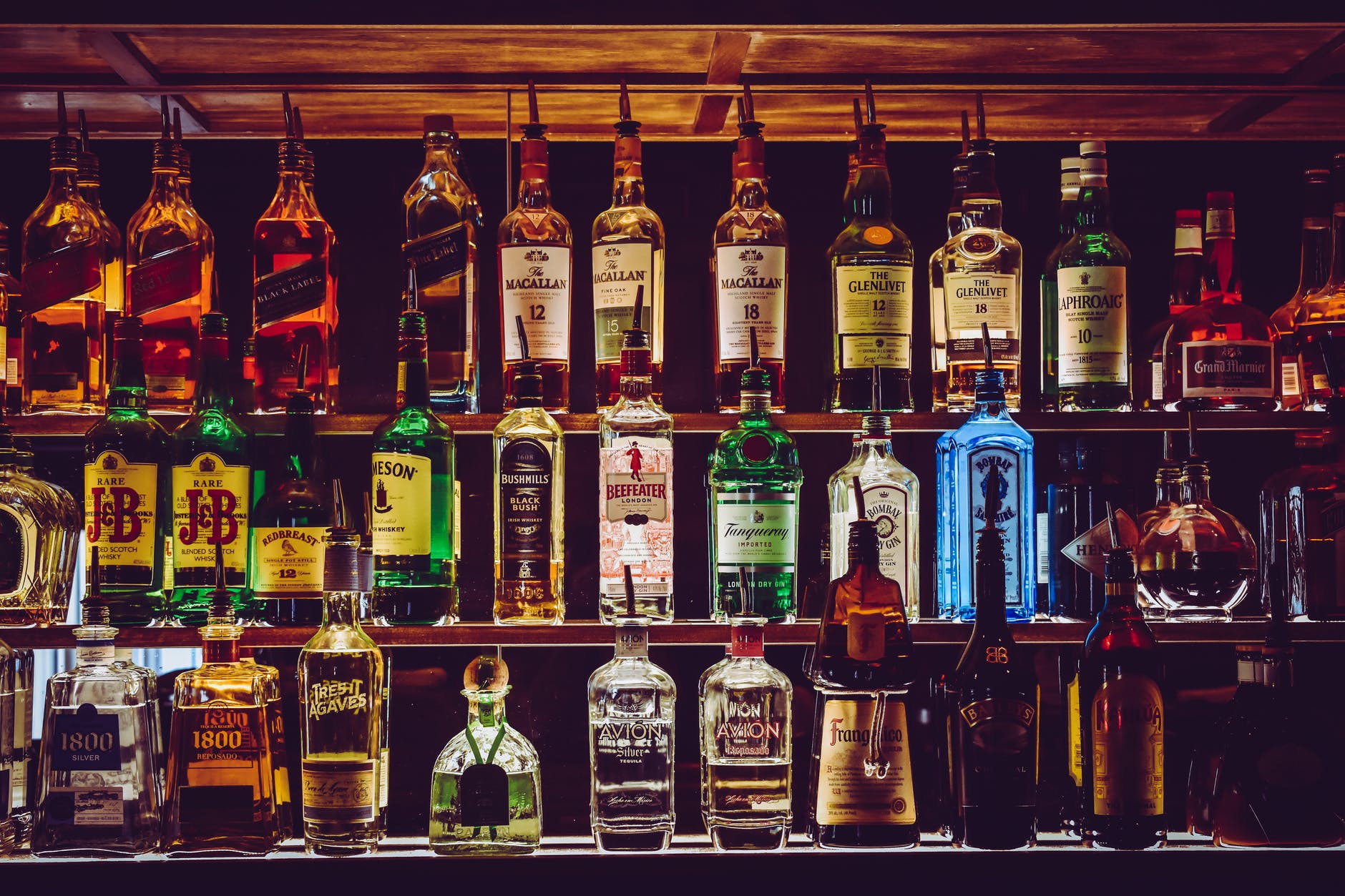
Friday Night: Whisky

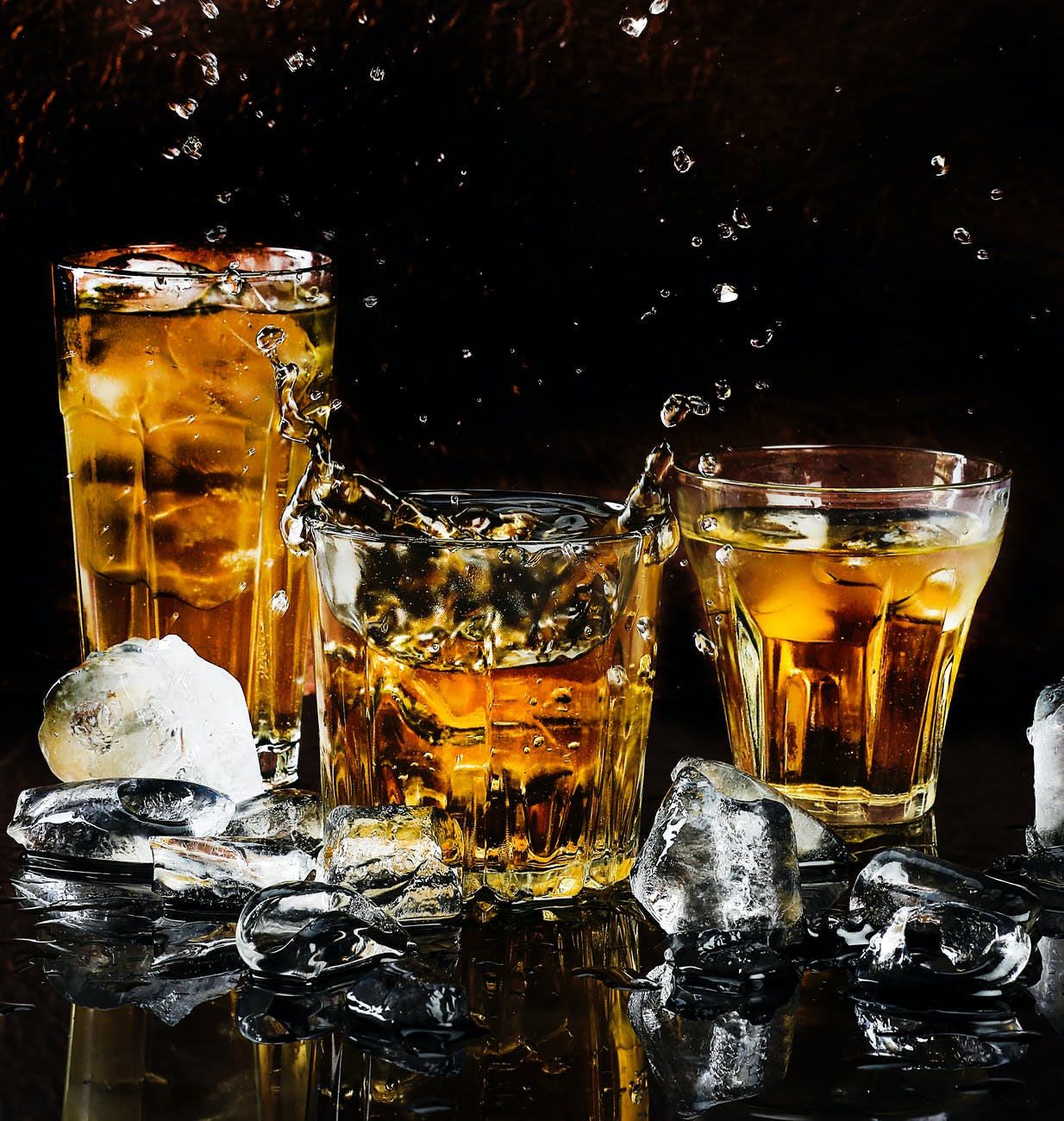
Fans of the film The Lion In Winter will recall how on Christmas Day 1183 King Henry II of England (Peter O’Toole) and King Philip Augustus of France (Timothy Dalton) start a bad boys’ one upmanship contest about whose country distils the best spirits. Funny-but was that possible?

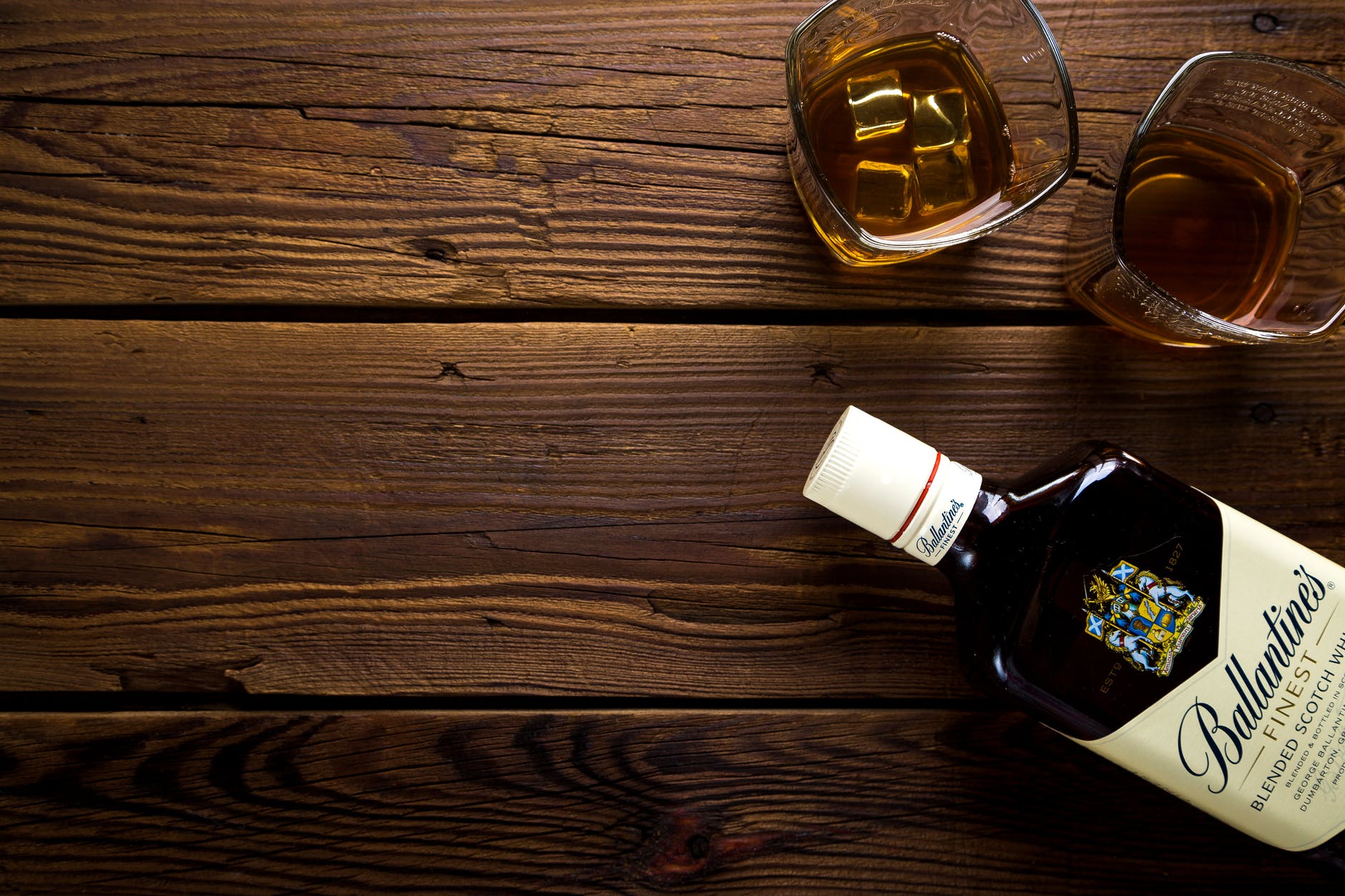
Wikipedia * traces the origins of distilling spirits to the thirteenth, not the twelfth century. Perhaps the real Henry and Philip missed by a generation. But once it got going, there was no stopping humanity. Since then we have invented brandy,gin, vodka and rum-but most agree that whisky is the real king of spirits. We can’t resist the amazing origins of the word, here summarised by Wikipedia: *

The word whisky (or whiskey) is an anglicisation of the Classical Gaelic word uisce (or uisge) meaning “water” (now written as uisce in Modern Irish, and uisge in Scottish Gaelic). This Gaelic word shares its ultimate origins with Germanic “water” and Slavic “voda” of the same meaning. Distilled alcohol was known in Latin as aqua vitae (“water of life”). This was translated into Old Irish as uisce beatha, which became uisce beatha in Irish and uisge beatha[ˈɯʃkʲə ˈbɛhə] in Scottish Gaelic. Early forms of the word in English included uskebeaghe (1581), usquebaugh (1610), usquebath (1621), and usquebae (1715).[

Since when the drink has cropped up in books, films, songs and advertising the world over. Who can forget the two doomed Japanese officers musing over a looted bottle of Johnnie Walker in Letters from Iwo Jima? Malcolm Macdowell’s desperate tippling in Aces High? Talking of Timothy Dalton, James Bond loved his Scotch, as the link from The Gentleman’s Journal makes clear.*

Even though it’s made all around the world, somehow it is inevitably associated with that strange thing called Scottishness. You know-golf, shortbread, mist, mountains, tartan, aberdeen angus, and a monster sporting in the grey waters of the nearby loch. You can pay anything from thousands to a few dollars for a bottle. But real experts advise a good mid-price brand, something like Highland Park or Glenfiddich, and sticking to it. Mainly they drink it neat, or with a little soda and ice. And we are largely going to respect that. But, as this is ostensibly a cocktail column, we’ll leave you with one recipe, the whisky sour, adapted from that great book The Bartender’s Guide by Peter Bohrman (Greenwich).

In a shaker add five icecubes and 1.5 measures of whisky. Add juice of 1/2 lemon, and two teaspoons of sugar syrup. Finally three drops of Angostura bitters. Shake vigously and pour to a chilled cocktail glass, sans ice. Decorate with slice of orange and 1 maraschino cherry.

Enjoy your Friday Night!

Whisky – Wikipedia

Here’s every whisky James Bond ever drank | Gentleman’s Journal (thegentlemansjournal.com)

#whisky #whiskey #cocktails #scotland #lochnessmonster #gaelic #highlands

India-was the Barrington declaration not so great?

“Listen to others, however much you dislike their opinions.” That’s what Bertrand Russsell counselled, and it’s what we try do at LSS. Last year the Covid-19 epidemic was in full swing, there were no vaccines-and economies were in meltdown. This was the background to the Great Barrington Declaration which tried to assemble a scientific case for letting the virus rip, and trying to protect the highly vulnerable as best we could.

Before readers go into meltdown about who was behind the Barrington Declaration, and about some of the signatories-we acknowledge that! You can read it for yourself in our Wikipedia link below. * And now we admit that the tragic cases of India and Brazil do seem to suggest that the medical experts got it right and the Barrington folk seemed to have erred, as Michael Head explains for The Conversation.*

But just because someone is rich and powerful does not mean they may not, sometimes, be telling a truth. Maybe the Declaration’s authors relied too much on a scientific case, when their real point was economic. We still have to pay for this mess. And how is that going to be done? On smoking, on climate change,even sweatshops-you should listen to the other side. Your own case will be stronger in the long run

https://en.wikipedia.org/wiki/Great_Barrington_Declaration#:~:text=The%20Great%20Barrington%20Declaration%

#covid-19 #sars-cov-2 #greatbarringtondeclaration #pandemic #herdimmunity #india #manaus

Will democracy last?

In the long ago days of the 1990s, following the collapse of the Soviet Union, the triumph of democracy was taken for granted. Its truths were taken to be self-evident. Freedom of expression kept a lid on corruption, ensuring economic efficiency. Alternation of parties kept rulers honest, and largely free of homicide. Open flows of information led to better scientific progress. There was much better shopping, and more fun parties.

The experience of the last twenty years has shown all of these assumptions to be hopelessly naive. The basic assumption of the democratic process is to give people information and allow them to make a choice. David Feldman in Psychology Today has a readable article on Why People believe things that aren’t True. If you’ve ever had experience of this, David goes into some of the neural and psychological mechanisms why.

Ivor Gaber looks at how these problems work out in practice. His examples are from Britain, but they apply to every open-information society in the world in Strategic lies: deliberate untruths used as a political weapon from The Conversation.

We at LSS will venture a little heresy. It is very easy now to decry the work of Sigmund Freud. Alright, maybe this humane, essentially decent man got a lot wrong. Maybe he wasn’t always very scientific. But he has performed one great service; he pointed attention fairly and squarely at the subconsious. About how its unacknowledged grievences, its unspoken desires, slights and wounds are the real drivers of so much belief, and so little real reason. We think that until political and constitutional systems evolve that address these needs, then democracies can expect to fail in the long term. And that certain people in certain countries can’t wait for this to happen.

Why Do People Believe Things That Aren’t True? | Psychology Today

https://theconversation.com/strategic-lies-deliberate-untruths-used-as-a-political-tactic-new-study-159723?utm_m

#politics #democracy #authoritarianism #freud #subconcious

All Roads lead to Rome-or do they?

“The Roman Empire and its decline and fall remains to this day the dominant historical event of Europe and the Near East…” So wrote DM Low in the introduction to his masterly abridgement of Gibbon’s Decline and Fall. The Roman Empire is like a ghost, whose presence haunts every development since the real one breathed its last. Charlemagne, the Reniassance and Enlightenment are inexpicable without reference to its cultural and political legacy. The modern world is haunted by pillars, columns, priests, senators, sports amphitheatres, drains, empires and elections. Romans still sell books, films, tv shows and games by the wheelbarrow load. Was their Fall a Good Thing or a Bad Thing?

Some like Isaac Asimov and Lord Clark came down unhesitatingly on the bad side. The centuries after Rome were indeed a land of derelict towns, lawless violence and unlettered ignorance, especially in the former western provinces. Gibbon himself seems to deplore it, but at the same time points a gleeful finger at Romans forced to suffer the consequences of their own degeneracy all the way to the fall of Constantinople in 1453. Some scholars denied much happened at all, seeing the whole sorry tale as one of transformation. Now along come Walter Scheidel,Catherine Kennedy and Daniel Grossman on the aeon website,who aver that, however inconvenient the Fall of Rome was to contemporaries, it has overall been a blessing, especially for western peoples. It cleared the way, they say, for the developments of freedoms in thought and enquiry which were unknown to the subjects of tyrannical empires in places such as China, the Middle East and India and of course, Byzantium. These freedoms in turn lead to much higher standards of western achievement in things like science and economics.

At this point The Devil whispers in our ear “Oh, Really?” Was China always under a single monolithic empire? Did they not invent a couple of things to teach western barbarians like printing and silk? Do we not recall the Islaamic Calpihates as the real guardians , researchers and above all teachers of knowledge through many centuries, and who possessed trading and banking systems which left the muddy inhabitants of Francia bewildered? Anyway who was more significant-Constantine or James Watt? But away with that. The best histories are always polemical, for they elicit thought. No one now thinks that Henri Pirenne, Karl Marx or even Edward Gibbon said the last word on anything. But their provocative works stimulated learning and research on an industrial scale. So it will be with these authors. For westerners, Romans are like parents, like family. By asking about them we are asking about ourselves. The results will be interesting.

we thank Mr Peter Seymour of Hertfordshire for drawing outr attention to this provocative essay

https://aeon.co/essays/how-the-fall-of-the-roman-empire-paved-the-road-to-modernity?utm_source=pocket-newtab-global-en-GB

Edward Gibbon The Decline and Fall of the Roman Empire

isaac Asimov Foundation Trilogy see especially vols 1 and 2

Kenneth Clark Civilisation see chap 1

Henri Pirenne Mohammed et Charlemagne

#romanempire #edwardgibbon #history #china #islaam #abbasid #omayyad