Johnson and Cummings: when friends fall out, they do it big

Overseas readers may accuse us of navel gazing, but the human dramas of UK affairs may have universal relevance. Or so we fondly believe. So the news that former special advisor Dominic Cummings has launched another venomous attack on Prime Minister Alexander de PfeffleBoris” Johnson fills us with curiosity: why do old buddies fall out?

In December 2019 this accomplished pair had the world at their feet, or at least the British bit of it. Having recently won the earth shattering Brexit referendum they then achieved a trouncing win in a General Election. They complemented; the one a tactician of something like genius, the other a shrewd communicator who deeply resonates with the key elderly C2D voters who shape British national life. Both belonged to the same ruling-class background-prosperous families, private education, Oxford, then thriving in the well financed ecology of British Conservatism-journalism, think tanks, “advisory” roles- before pushing their way into the top jobs. Both might have been forgiven for yelling “The future belongs to me!” on that distant winter morning. So why, oh why, the big bust up? We can’t be sure. But history offers us some intriguing parallels.

Brotherly Love However close you started out, however much you went through together even the closest relationships can come under strain. The well-documented travails of the Gallagher brothers of Oasis fame or the Windsor brothers Harry and William (they of the eponymous castle) show that even the bonds of DNA will snap in time. What bond then in strangers, especially when the fruits of success must be delivered? Which leads us to:

The Pressure Cooker The old saying of the 49ers on the trail to the west was that three weeks cooped up a waggon, coping with the conflicting pressures of Indigenous Native Americans, wolves, desperadoes, poor weather. baked beans and non existent cellphone signals, were enough to make you want to murder anyone, for any transgression, even your own wife. It is easy to write columns, and blogs, about what Governments should do. Just as it is easy to walk along a wooden plank laid out conveniently on a garden lawn. Try walking the same plank across Niagara falls. You will find that the mood alters somewhat.

The woman The oldest triangle in history is the King, the Queen, and the Chief Advisor. Augustus had Livia, who saw to the extermination of Agrippa and his line. Edward II had Mortimer and Isabella. Fans of the Barchester Chronicles will recall how Mrs Proudie engineered the downfall of the oleaginous and double dealing Mr Slope, up to then her husband’s right hand man. Can we carry this analogy further, without weak puns?

We got it all wrong What do you do when the act is no longer pulling the crowds, or The Project has gone all wrong? The bust up between Judas and Jesus has been fairly well documented. But what about Marshall Bernadotte? Until 1810 he was one of Napoleon’s Main Men. But realising the little guy was starting to get it seriously awry, he jumped ship, got himself a plum job as King of Sweden and spent the next few years stabbing his old chum in the back. Even closer to our time, remember how former pals Hitler, Goering and Himmler fell out when the events in the war panned out “not necessarily to Germany’s advantage”? Worms turn, but trust is not like gold-you can’t buy it back at any price.

Our prediction For now Johnson still has the support of the papers, which still bring their crucial constituency of voters with them. Cummings can be dismissed as an embittered loser. But a careful reading of Government newspapers shows evidence of growing doubts. For now these are mild and coded. But a Prime Minister, especially a Conservative one, is there to protect the economic interests of the English landed and monied classes. If these start to be seriously threatened, then Cummings’ scribblings will be revived. With glee.

#borisjohnson #dominiccummings #covid-19 #brexit #conservativeparty #primeminister #josef goebbels

News so good it made us break our Sunday Embargo

That’s right, good readers, this news is so encouraging that we broke our own Sunday embargo to bring it to you, as you’re always telling us that you like a bit of hope. And it’s extra easy for you today, because we found the same article by Anthony King in both Spanish (El Pais) and English (Horizon) 1,2

The once-disparaged phages are now coming up fast on the rail. A company called Pherecydes, 3 led by the intriguingly-named Guy-Charles Fanneau de la Horie is pioneering the use of phages against the so called deadly three that plague our hospitals. Astute readers will know we refer to Staphylococcus aureus, Escherichia coli and Pseudomonas aeruginosa, whose resistance to conventional antibiotics will soon make surgery and hospital care almost impossible. The team are just starting to trial their discoveries in a limited number of patients in Lyon and hope that licensing will let them go large as soon as possible.

Over in Dublin Siobhan McClean and Bactivax 4 seem to have found a weak spot in Pseudomonas. They think this is in the protein it uses to attack our cells, and hope to develop a vaccine so the body can fight it without the need for antibiotics.

We at LSS are no microbiologists. But the way that intelligent people are thinking differently, and above all trying, fills us with hope. The ignorant and the superstitious seem be having their day during these last few years. But their way of thinking can offer nothing compared to these scientists, and one day we shall be back.

1Las bacterias resisten a los antibióticos, pero los virus y las vacunas podrían ayudar | Ciencia | EL PAÍS (elpais.com)

2 More bacteria are becoming resistant to antibiotics – here’s how viruses and vaccines could help | Horizon: the EU Research & Innovation magazine | European Commission (horizon-magazine.eu)

3 Pherecydes Pharma (pherecydes-pharma.com)

4 Bactivax

#antimicrobialresistance #bacteriophage #vaccine #hospital #infection #gramnegative

Phew what a scorcher! And Metpersons say there’s more to come for Cocktail fans

We’ve waited a long time to use that headline, but with temperatures soaring in southern England from where this blog originates, we thought that the time had come. So with the help of Hamlyn’s The Ultimate Cocktail Book, here’s a list of long cool refreshers to get you through the ordeal ahead.

Summer Cup: Take a large clean cocktail bowl and add 1 bottle of cold Reisling, 1 bottle of red wine, 75ml of Drambuie, then 750 ml of cold lemonade . Next slice up some sweet apples, an orange or two, and some diced strawberries. Mix in with as many ice cubes as Spartans fell at Thermopylae and serve to chilled glasses. Great to kick start the atmosphere at a barbecue Ms RS of Southend on Sea asked us if the washing up bowl would do. No, it won’t.

Havana Beach Ok the current situation in Cuba isn’t one to delight Trotskyists and other assorted Lefty chums. But those Cubans can still knock out a mean cocktail, provided there’s enough electricity for the blender! Cut up a lime into pieces and put into the said blender, along with 2 measures of pineapple juice, 2 measures of white rum, 1 teaspoon of sugar and blend to smooth. Put ice into a hurricane glass, and pour the mix over. Now top up with cold ginger ale. Serve with an eco-friendly paper straw and decorate with a slice of lime or lemon.

Frozen Pineapple Daquiri Where drinks meet desserts, you might say, so spoons at the ready! Wash out that blender and refill with crushed ice, 3 slices of pineapple. 1/2 measure of fresh like juice, 2 measures of white rum and 1/2 measure of Cointreau. Add 1 teaspoon of sugar syrup and blend to smooth, as before. You can pour to a cocktail glass or one of those funny shaped daiquiri glasses with the sticky-out bits round the sides. Either way, a pineapple slice makes a good decoration.

There’s many more ideas in Hamlyn, The Bartenders Guide and of course our new acquisition, the Savoy. So whatever you choose, mix well and enjoy as as the delicious barbecue aromas waft into the evening sky , and savour the restrained sounds of JS Bach, or even Camila Cabello, which means “hair” in Spanish.

#marxism #cocktails #fruit #summer drinks

Weekly Round up: Infinity

Our weekly collection of stories that we think will still be relevant in years to come

The Size of infinity: Infinity can be a frightening thing, particularly if you have to face your e-mail in box on Monday morning. A new report in Nature tells us just how bad it really is: Maths Proof hints at the true nature of infinity

A landmark mathematical proof seems to disprove a long-standing hypothesis about the nature of infinity. The upshot is that there are many sizes of infinity: all the ‘real’ numbers, all the ‘natural’ numbers… I could go on. The new result strengthens the case that an extra size of infinity sits between the first and second infinitely large numbers. Still, things are far from settled — and that’s the fun part. “It’s one of the most intellectually exciting, absolutely dramatic things that has ever happened in the history of mathematics, where we are right now,” says mathematical logician and philosopher Juliette Kennedy.Quanta | 13 min read
Reference: Annals of Mathematics paper

Richard Lewontin, A Man for All Reason The 1970s was a squalid little decade, when entirely provisional science results were hijacked to give justification for a nasty ideology of utter selfishness, tax-dodging and hyperconsumerist neuroses. One man who stood against the tide of simplification was the humane and decent Richard Lewontin. Here’s Nature again on his life and times. A geneticist who fought for justice

Richard Lewontin, a geneticist best known for bringing molecular tools into evolutionary biology, has died aged 92. Lewontin wrote and campaigned extensively against the use of biology to justify racist ideology, especially with regard to IQ testing, writes historian of science Michael Dietrich. Lewontin also disliked biography and its celebration of the individual. When asked how he’d like to be commemorated, “He pulled out of his desk a list of every graduate student, postdoc and visitor at his laboratory — more than 100 people — and said I should write about all of them,” writes Dietrich. “They were his greatest source of pride as a scientist.”Nature | 5 min read

Space Tourism, on the large We wish Branson, Bezos and co. well, but their few minutes of sub orbital ride cannot equal this breathtaking footage of Jupiter and Ganymede, captured by the Juno probe. The inimitable Stacy Liberatore covered it for the Mail like this:

NASA’s $1.1 billion Juno spacecraft snaps ‘starship captain’ view images of Jupiter and Ganymede | Daily Mail Online

for more on matters extra terrestrial, NASA has a great website of its own:

NASA

We think that’s enough for one weekend. Sympathies to our European readers who have suffered so badly from climate change. It could be any of us, anywhere, in any season

#NASA #space #mathematics #genetics #sociobiology

1972: The Canary and the Wolf

It is July 1972. Donny Osmond tops the UK pop charts with his best selling single Puppy Love. Britain is gripped by a major docks strike, while in London the first Gay Pride March is planned. The best selling car of the year is the Ford Cortina Mk 111: we can’t find its fuel consumption, but we doubt that was a prime user requirement in those far-off days. If you wanted to escape all the politics, the top film is John Boorman‘s Deliverance, with its notoriously different take on the road movie genre.

In the midst of all this you could have been forgiven if you missed a report from the prestigious MIT which predicted a total societal breakdown by 2040 if we continued with our present ways of hyper-consumption was wastrel living. It looked at ten key indices including food production, industrial output and population. All would tend to peak around 2030, followed by sudden crashes as resources ran out. Gloomy reading: but was it the famous boy crying wolf or the canary in the mine, truly singing of impending disaster? You can see the graph here in an excellent Mail piece by Stacy Liberatore, whose excellent work we have showcased before in these pages. 1*

Support for the canary comes from a re-examination of the MIT work by Gaya Herrington of KPMG, no less. Who are hardly a hotbed of lefty green ideas. Running the data again through more advanced models showed that basically MIT had it spot on. The canary was in the mine, right back there in ’72.

One of the distinguishing features of science is that it makes predictions which can be tested. So that when they come true, you have to take them seriously. When societies suffer ecological collapse, the results aren’t vey nice as both Romans and Mayans found out. Conclusion: we can’t go on like this. Perhaps the only hope came from Johnny Nash, then sadly only at number 5: I can see clearly now.

*1 MIT’s 1972 prediction of the collapse of society is on track to happen by 2040, study reveals | Daily Mail Online

Official Singles Chart Top 50 | Official Charts Company

#globalwarming #ecology #climatechange #MIT #stacy liberatore #alternative energies #green

Foreign Aid Cuts: Penny Wise, pound foolish

News that Britain is to cut its foreign aid budget by £4bn from 0.7% to 0.5% will be popular at home. But what do thoughtful people, the type who read LSS blogs, think about it? (overseas readers,this is not navel-gazing, as these discussions have relevance for your own country)

At first sight, the case seems strong, if you see the world in accounting terms. Stricken by Covid and with the loss of its main overseas markets, the UK economy is in for a deep and long period of retrenchment. It makes sense to balance the books as far as possible, to bring money home, and let pesky foreigners stand on their own two feet. Such an approach is rooted in Britain’s cultural DNA. Napoleon called Britain a nation of shopkeepers, but perhaps accountants would have been nearer the mark.

The trouble is that we have been here before. Common sense, man-in- the- street calls to reduce the Land Tax in the eighteenth century led to weakening the Royal Navy and the loss of the American Colonies. The nearer parallels are in the twentieth century. The interwar years saw two disastrous rounds of cuts-the Geddes tranche of 1922-23 and the huge cuts bought in by the National Government in an attempt to respond to the financial crisis of 1931. Cuts were drastic across the board. For example, Geddes cut defence spending by 41.5% in a single year. The knock on effect in the defence sector in terms of purchasing, recruitment and research was incalculable.

Because foreign eyes were watching. As Britain’s Imperial commitment waned, they moved into British markets, sea lanes and spheres of influence. Dictators such as Benito Mussolini and Adolf Hitler especially noted a weakening Royal Navy and Intelligence Sector and made their plays accordingly.

Foreign Aid is not just about money. It buys influence, and opportunities for all kinds of marketing and intelligence gathering. When one power stops doing it, another moves in. Britain has left the European Union, never to return. The only rationale for that was to make Global Britain a world power again. Cutting your sales and intelligence opportunities is not the way to go about it.

#globalbritain #foreignaid #cuts #eu #russia #china #usa #japan

Avoiding Foolish Opinions 2: Susan Stebbing

On of the biggest mistakes we have made has been to ignore the advice of intelligent women. One such woman was Susan Stebbing (1885-1943). Until her life was tragically cut short by cancer, she was a pioneering philosopher of clear thinking, and scrupulous attention to logic. Although a contemporary of thinkers like Bertrand Russell, and did achieve a chair in philosophy, her light has been eclipsed by her male peers, as so often happened to women in those days.

Yet now she has been rehabilitated. In an excellent short piece for The Conversation, Peter West extols the simple clarity of her work, which she distilled into a book called Thinking to Some Purpose . We could say a lot more, but her trick was to make thinking so simple that anyone could do it. See our links below, but her basic rules are: Question your cherished beliefs; Beware special pleading; Avoid emotive language. It’s an excellent adjunct to our little post on Russell (LSS 30 9 2020)

Stebbing published in 1939. By that time the world had already abandoned the advice of thinkers. The emotional and the believers were about to plunge humanity into its bloodiest conflict yet. But if we try to understand her now, we may yet avoid the next one.

Susan Stebbing – Wikipedia

Thinking to some purpose: A manual of first-aid to clear thinking, showing how to detect illogicalities in other people’s mental processes and avoid them in our own. by L. Susan Stebbing (goodreads.com)

#susanstebbing #bertrandrussell #criticalthinking #foolishopinions #sceptic

Drinks for the Big Match

Few can ignore the titanic clash of those footballing giants Italy and England at Wembley Stadium this Sunday 11th July. To get into the spirit , we’d like to suggest a few refreshing beverages to keep your throat moist as you do all that cheering. As we have done the England drinks theme rather to death lately (LSS passim),we shall concentrate on matters from an Italian perspective. After all, you can drink these too if you’re English, or neutral.

Beers The Italian ones we like are Peroni and Moretti. Although now owned by a giant international booze combine, Peroni dates back to 1846 and is still stylish, cool and refreshing. Whereas we just love the guy on the Birra Moretti bottle-who is he? A Tyrolean clock maker? Roberto Mancini’s great-grandfather? A Hit Man relaxing after a difficult slaying? Check out links to both companies below.

Peroni Beer – Everthing About Italian Style In A Bottle (alcoholvolume.com)

Home | Birra Moretti

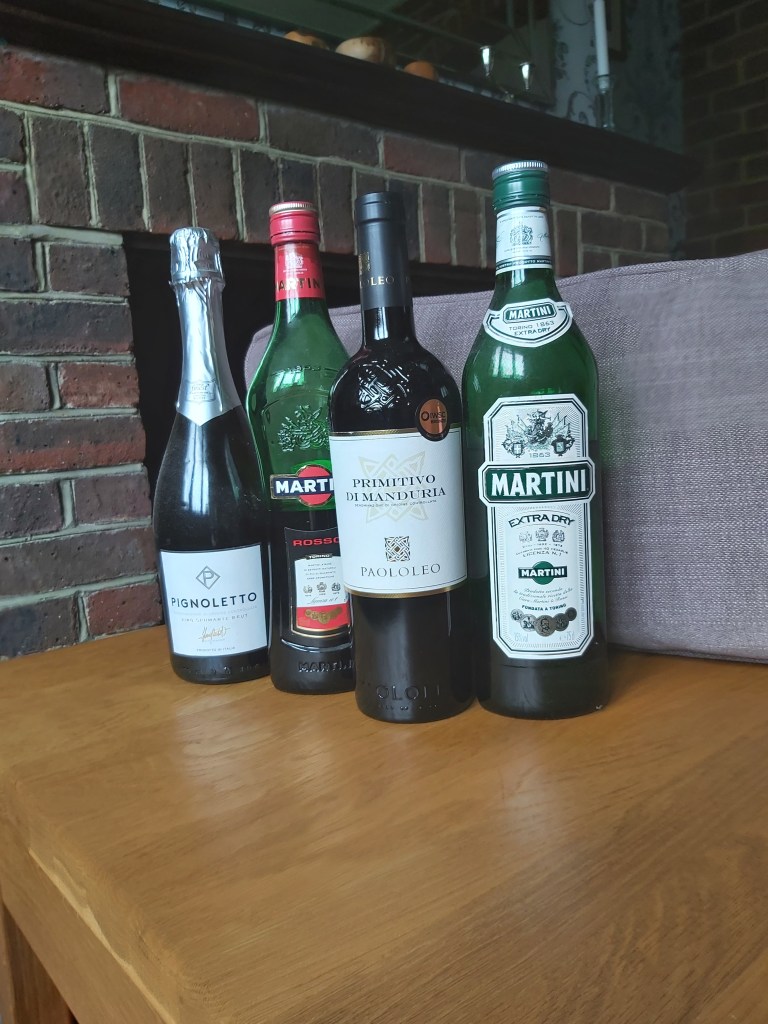
Wines Italian wines probably predate the Roman Republic, and a role call of their names reads like a to-do list for civilisation, sunny holidays and the odd drop into a conveniently nearby museum. We can’t begin to do justice to all this, so here’s a little personal tip: Primitivo. Although it hails from the southern tip of the peninsula, experts believe the grape is identical to its famous American cousin, the Zinfandel. We’ve a link below, but get this; our regular dining companion reports that, unlike so many red wines, this one doesn’t give her a headache. Gotta be worth a try.

The complete guide to Italian wine with maps and tasting notes (independent.wine)

Learn About Primitivo: Wine, Grape, History, Characteristics, and Pairings – 2021 – MasterClass

Battle of the Vermouths Anyone who survived the 1970’s will recall two inimitable TV Commercials. The one for Martini showed Bright Young Things on a curious hovercraft-like contraptions racing over some dubious looking marshes, while the singer belted out:

Try a taste of Martini/the most beautiful drink in the world/It’s the bright one/it’s the right one/that’s Martini

Whereas their great rivals Cinzano created some of the most hilarious TV ads ever, the ones starring Leonard Rossiter and Joan Collins. Ms Collins still tags these on her live roadshows, so well have they stood the test of time.

Well, we’re not going to push you to one nor the other. Both come in bottles of various shades of red, pale yellows and pinks and are superb on their own, mixed with things like lemonades and ice, or as the components of many, many cocktails. So they have to be worth a punt on your next trip to Lidl or Waitrose.

Martini | The Original Vermouth Since 1863 | Martini Global

cinzano.com

All in all we think that enough ideas to keep you thinking through the long hours of the build-up, match and analyses. Enjoy, and may the best team win!

#UEFA #football #vermouth #wine #beer

Weekly Round up: Management styles, electric cars and multishaped humans

some stories which intrigued-and might even point to the future

Management Styles Ask a refugee from the nineteen-eighties about football managers, and the picture that emerges is a cigar chomping, whisky-swilling alpha male who made big decisions, gave orders and was generally in charge. It was type common across business at the time. We knew a few women managers like it too, come to think of it. But England manager Gareth Southgate appears to be pioneering a different, collegiate style. And we can see how it has got some results. For more details, try reading Andre Spicer of The Conversation:

Extreme Weather and climate change One of the most invidious tactics of climate change deniers was to deny the link between extreme weather events and climate change. Like the evidence on the probable causes of lung cancer and smoking, there was always just enough wiggle room for those who didn’t want to believe to continue in ignorance. Perhaps they did us a favour; statistical techniques are now so strong, the link is undeniable, as this piece in Nature shows. Climate change made heatwave more likely:

The chance of temperatures in North America’s Pacific Northwest coming close to 50 °C has increased at least 150-fold since the end of the nineteenth century, found a rapid analysis conducted in response to last month’s heatwave. “This heatwave would have been virtually impossible without the influence of human-caused climate change,” says climate scientist Sjoukje Philip. “It was probably still a rare event, but if global warming might exceed two degrees, it might occur every five to ten years in the future.” Canada’s highest-ever temperature — 49.6 ℃ — was recorded in Lytton, British Columbia, on 29 June. The next day, the village was almost completely destroyed by out-of-control wildfires.Nature | 4 min read

Current concerns about the future If we are not really careful, there could be real problems as the batteries of electric cars wear out. Here’s Emma Woollacot of the BBC. It just goes to show:nothing is ever the complete answer, not in technology, politics, religion science or football.

Electric cars: What will happen to all the dead batteries? – BBC News

we thank Mr Gary Herbert of Buckinghamshire for this story

Pleistocene humans were plasticine One of the problems bedevilling the study of really modern humans, by which we mean anybody born after 700 000 BC, is the bewildering array of different species. Homo sapiens, denisovans, neanderthals, red deer cave folk, hobbits…. You name it, before someone else does. As ever, the Devil whispers in our ear “what if there was one species, and other factors made them just different enough for someone to give them a different name, just to make them stand out ?” Now a fascinating study suggests things like climate may have been driving all these different body shapes. Think of tigers. Siberian ones are much bigger and heavier because they live in a cold climate, while the Sumatran ones are altogether smaller and lighter. But they’re all still tigers. Here’s Charlotte Burton in The Guardian

Human body size shaped by climate, evolutionary study shows | Evolution | The Guardian

Well, that’s it for this week. Think differently-and look at the evidence

#tiger #climatechange #humanevolution #electric cars #management styles

At last, real hope from Laura Spinney

Writing as someone who is about to witness the beautiful county of Sussex carpeted over with concrete, to produce a dreary landscape of housing estates, shopping malls and car showrooms, it is heartening to note that the real cause of this destruction may be weakening. For world population may at last be falling. And we’ll all be better off as result, according to Laura Spinney of The Guardian.

There has always been a school of thought, usually associated with first year undergraduates and the inmates of certain lavishly funded think tanks, that a rising population is somehow associated with greater prosperity. Apart from the very rich, that has scarcely ever been true. Since the Industrial Revolution it has been laughably false, as one machine can outproduce any number of human workers. Laura is right on the money when she reports:

Demographer Ron Lee of the University of California, Berkeley, and others have shown that GDP per person, and hence living standards, are highest when fertility falls just below replacement level (around 2.1 births per woman) – to 1.6 or even less.

In other words, lower fertility is good for men as well as women. And then there’s the environment to think about, as readers in the western parts of North America must be acutely aware. Maybe we won’t all live to see it, but it is nice to know that one day the vast soulless deserts of modern cities will give way again to clean air, space-and a better life for all.

Why declining birth rates are good news for life on Earth | Laura Spinney | The Guardian

#population #fertility #environment #climatechange #gdp