


Just when you thought we were becoming too gloomy we cheerfully present a story of sunny optimism which we hope will lighten your day. It’s via the work of Simon Kuper of the Financial Times, [1] a writer we have showcased here before. Like many FT writers, Simon’s work is behind a paywall. So although we believe that crossing that wall is well worth the cost, we have provided a summary of Simon’s main points. Followed by our own riff, which you will note has been carefully kept separate so that we do not ascribe meanings where none were intended by today’s source author.
SIMON SAYS
The advent of cheap reliable solar panels, and efficient batteries to store their produce, is working wonders in poor countries. Imagine cash-strapped villagers who have waited generations for their -ah, malfunctioning– States to provide power grids and generators suddenly witnessing the arrival of cheap reliable panels! Suddenly everyone gets a fridge, a phone charger, and goodness knows what else at prices all can afford. At once their country leapfrogs all those installations like pylons and dams which our GCE Geography books told us were essential, and bounds into the 21st century. Proof positive is in the pricing. The cost of panels is down a whacking 99% on what they were in 1975 and 95% on 2007. Being clever sorts of fellows, sub-Saharan Africans imported 60% more panels last year alone. OK, solar isn’t quite so hot for industry, as Simon notes. But when it comes to everything else-transport, everyday things like computers, it’s utterly feasible. Which must be a start on at least reigning back the vertiginous rise in emissions which is still the most pressing threat to our survival. (sorry to antibiotics fans everywhere)
LSS SAYS
1 Why bother with nuclear fusion down here when there is a huge nuclear fusion reactor for free a handy one astronomical unit away?
2 Solar panels are following the exact laws of economics everything else new did: colour tvs, cars, computers, cameras, fridges(OK that’s enough devices-ed) Once the research is completed and mass production starts, costs fall away.
3. This also casts an interesting retrospective light on the warnings of past decades: that solar was too expensive, wouldn’t work in hot countries, or could never be stored, etc etc. etc. Our legal team has advised us not to speculate about anyone’s motives or affiliations, so we won’t. Even the most honest and well‑meaning people can be mistaken: we’ll leave it at that.
4. And finally: whatever anyone says now, the implications are clear. Renewables are on track to dominate. Those who oppose them may find themselves stranded on a cultural and technological shoreline, like so many ageing Miss Havishams. Good luck with that.
THE REFERENCE {1]
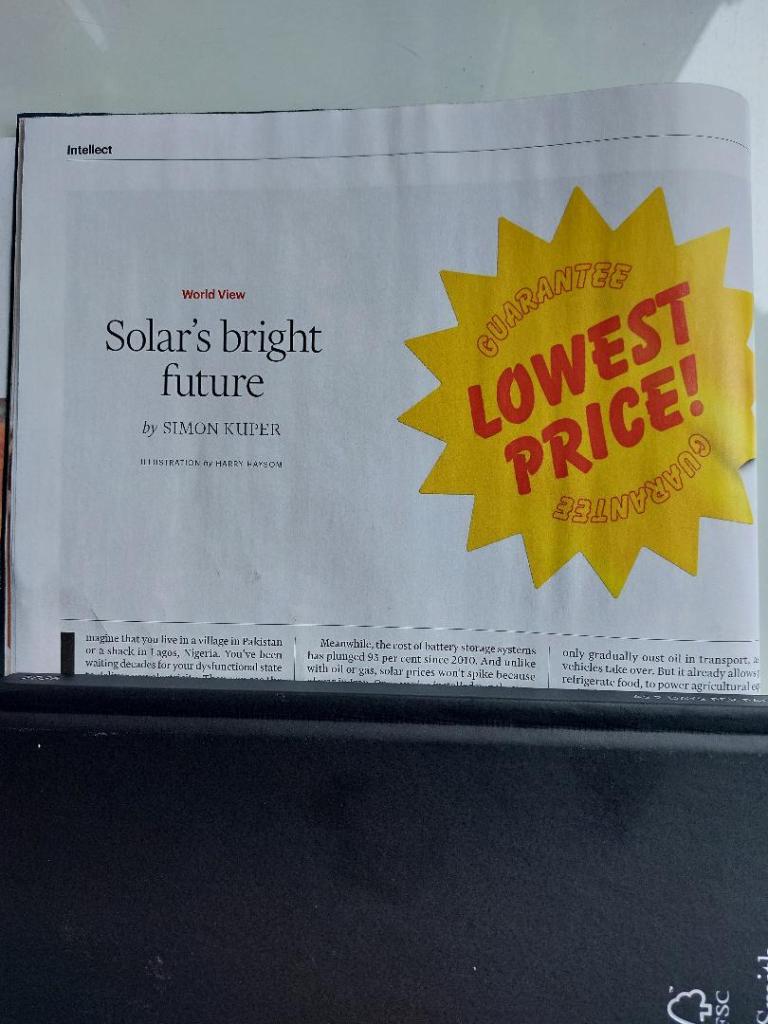
Because the showcase article is behind a paywall, the best we can do is show you a picture which may serve in a good search engine such as Google. From there you may access via the paywall if you wish. Once again we strongly urge that you do: because the FT is a great source of quality information, with many, many other good writers. We get no money whatsoever for this, we just honestly believe it.


 Learning, Science and Society