The Fisher King: an ancient legend for our sad modern times

I sat upon the shore/Fishing, with the arid plain behind me/Shall I at least set my lands in order?

Thus TS Eliot sets out his stall: The Waste Land  (1922)is all about the legend of the Fisher King. His take on a world trying to recover from the traumatic wounds of World War. The what King? What’s a modern shiny AI powered  science-and-business blog like LSS doing with some crusty old Medieval legend, reworked not only by the saintly Eliot but by such questionable characters as Richard Wagner? The answer is very much indeed. For if we do not confront the message which the King encodes, all our technology will bring us to less than nothing indeed.

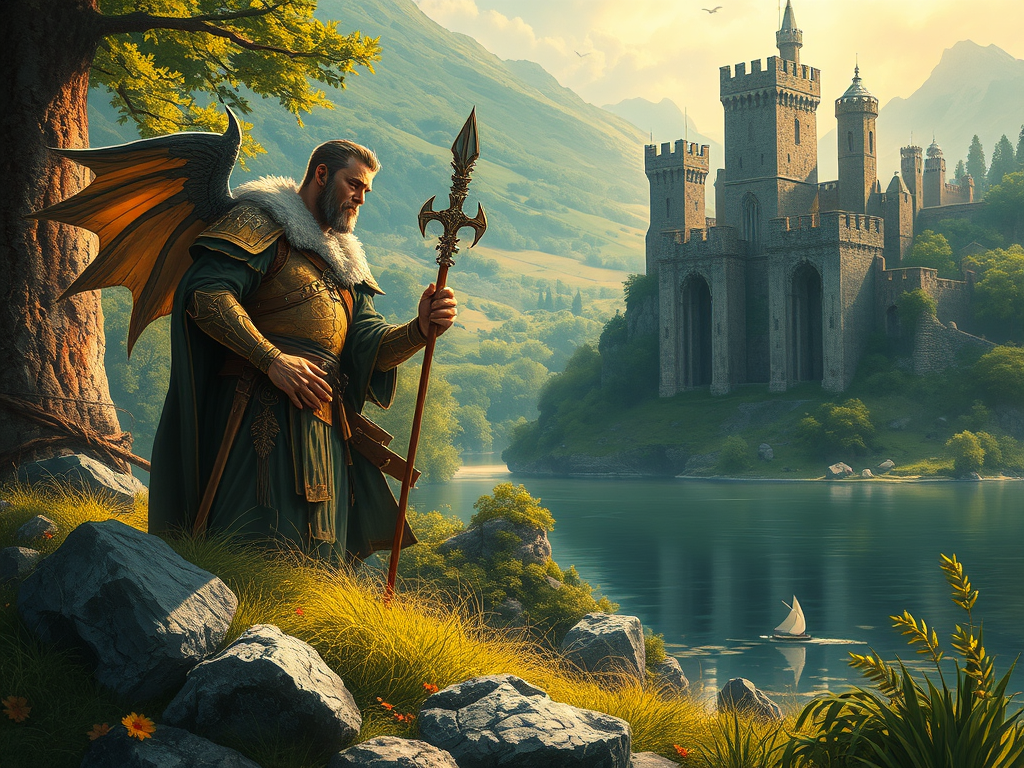
For all its tellings, the central myth of the Fisher King hasn’t changed much The King is a wounded guardian of the Holy Grail whose injury renders his kingdom a barren wasteland. He cannot heal himself, and his land suffers with him—infertile, desolate, and spiritually dry. He spends his days fishing, a symbol of passive hope and suspended vitality. According to Grail legend, only a pure-hearted seeker(Parsifal) who asks the right question can heal the king and restore the land. The myth embodies themes of spiritual  paralysis, inherited trauma, and the redemptive power of inquiry and compassion.

Festering trauma, unhealed wound. There must have been lots of those around after the First World War, as Freud knew well. And we have plenty  today. As money moves at light speed across the world, dragging goods and people after it, familiar landscapes are shattered. Shops close; factories are shuttered and streets fill with strangers. All too many suffer a psychic wound like the Fisher King’s.   Trauma that renders the  landscape barren. The soul, unable to heal itself, turns to ancient identities, mythic lineages, and cultural relics as if they were sacred springs. Or Fentanyl. And the name of that wound is Loss. Of empire, of power, of innocence, identity: of the essence that they were.    But nostalgia kills the future, and with it all hope. The healer must come, and find the right words, soon. For the next war is very close. Perhaps it will feel, briefly, like these other words from The Wasteland

What is that sound high in the air/Murmur of maternal lamentation

Who are those hooded hordes swarming/Over endless plains, stumbling in cracked earth?

Ringed by the flat horizon only/What is the city over the mountains?

Cracks and reforms and bursts in the violet air?/Falling towers

Jerusalem Athens Alexandria Vienna London

Unreal

All quotes from The Poetry Foundation a marvellous source of learning and wisdom if ever there was one

.

[1]https://en.wikipedia.org/wiki/Fisher_King#:~:text=The%20Fisher%20King%20%28French%3A%20Roi%20P%C3%AAcheur%3B%

[2] The Waste Land | The Poetry Foundation

##economics #politics #poetry #parsifal #TS Eliot #Wagner #The Fisher king #legend

The Best time to have been alive #4: Al-Andalus

Des kand meu Cidello venid/ton bona al-bishaara /com ray de shol yeshed/fi waad al-hiraaara*

When my Lord Cidello comes, what good news! He shines like a ray of sun on Guadalajara

When someone suggested we tackle Muslim Cordoba at its peak (roughly, the Emirate and Caliphate, 750 -1031 AD  in the western calendar), we were unprepared for the cornucopia of historical  riches that awaited. But, as both frequent holidaymakers in the Iberian peninsula, and speaking a smattering of Spanish at least, here goes anyway.

The story starts with Abd al-Rahman I, the “Falcon ” who fled a purge in Baghdad  and founded the Emirate of Córdoba in 756. His survival story—crossing the Euphrates, losing his brother, and arriving in al-Andalus as a lone prince—is cinematic. He united fractious Muslim territories and laid the groundwork for a multicultural society. Córdoba became a haven for Muslims, Christians, and Jews, with Arabic, Berber, Romance, and Hebrew spoken in its markets and courts. The Great Mosque (Mezquita), begun under his reign, symbolized this fusion—its horseshoe arches and layered aesthetics echoing both Damascus and Iberia

Under Abd al-Rahman III, who declared the Caliphate in 929, Córdoba reached its zenith. The city boasted paved streets, public baths, and over 400,000 catalogued books in al-Hakam II’s library. Irrigation systems turned Andalusian soil into a breadbasket, exporting silk from Toledo, leather from Córdoba, and steel from Damascus- Scholars like Ibn Masarra and later Ibn Hazm flourished, while Jewish thinkers such as Hasdai ibn Shaprut advised the Caliph and translated medical texts. The court at Madinat al-Zahra shimmered with diplomatic prestige, hosting envoys from Byzantium and the Holy Roman Empire.

But all golden ages come to end. After the fall of the last strongman, Al Manzor, the Caliphate quickly declined into petty little kingdoms called taifas, each jealously guarding its privileges and rights. Easy prey indeed for the larger Christian states to the north. Yet the legacy of convivencia—coexistence—echoed through European Renaissance thought. Andalusia wasn’t just a place, but a possibility. A cultural experiment in coexistence, beauty, and intellectual ferment[2] which  makes it a contender for one of history’s “best times to be alive.”

[1] Al-Andalus – Wikipedia

[2] The Ornament Of The World by Maria Rosa Menocal | Waterstones

*Yehuda Halevi  celebrating Yosef ibn Ferrusiel   in a kharja ending a muwashshah c 1100 AD

* Kharja attached to a muwashshah attributed to Yehuda Halevi c 1095 AD

 #al-Andalus #islaam #abd-al-rahman #Cordoba #Caliphate #Emirate #Spain #Portugal #Arabic

When was the best time to have been alive? Start of a new series

When was the best time in History that you could have lived in? With all the problems facing us now, like climate change, rising xenophobia, faltering economies-it’s natural for the mind to wander to other times and other places , where they had it good, in ways that we just can’t seem to manage.

It’s easy to idealise bits of the past when you didn’t have to live there and use the toilets. It’s also easy to make mistakes. “Bliss was it in that dawn to be alive!” declared Wordsworth, while on a tour of Revolutionary France. He just got out with his life, as did many other deluded middle class intellectuals. And even the Nazis tried to drum up a cultural vibe, what with Leni Reifenstahl and all that modernist architecture. That duly said, it is possible to pick out certain periods when the humans really did seem to be doing better for a while. Like a football team putting together a run of successful results. We will try to identify those times using the following criteria, if you will forgive us, gentle readers.

There has to be peace, or general political stability, over a wide area. We”ll illustrate this with a counter example: Beethoven and Schubert wrote some pretty good music during the Napoleonic wars, but you wouldn’t have wanted to have lived through those wars would you?

Learning is advancing, preferably big time : despite all the wars and coruuption, Big Stuff was happening in Renaissance Italy- arts, sciences, architecture, you name it. By that criterion. all those Cardinals and Condottieri have to be in with a shout

Trade must boom According to the great Professor Davis, this is the great sine qua non of civilisation

The staging must be right The backdrop of islands and temples etc gives the Classical Greeks an enormous leg-up before they even take the pitch. Whereas Lancashire in the Industrial revolution? You mainly died at thirty, after a lifetime of bracing hard work. Although it probably felt like much longer.

There must be a long running cultural movement No one sat down one day and declared “OK chaps, it’s the Bronze Age and humanity stands on the edge of a bright new frontier. Put away all those stone tools and mammoth skins, and let’s start living in cities!” The periods we refer to must be embedded in a long movement of progress and general moving forward.

And all too often they come at the end of it. The swinging sixties ended in strikes and inflation. The Renaissance city states were leaned upon, terminally, by much bigger places like France and Spain. The long peace of Rome degenerated into the Crisis of the Third Century. But we are nothing if not triers here. And so our first try in the next blog of the series will be China in the Tang dynasty 618-907 AD, using the western calendar. Let’s see if they were really, really, like, cool?

#renaisance #history #china #greeks #learning #science #society

Heroes of Learning: Steven Rose (and why things are never simple)

No book ever tore through the calm assurances of progress through co-operation like Richard Dawkins’ The Selfish Gene. [1] It wasn’t so much the book itself. That was an attempt to popularise, albeit sometimes in colourful language, the discoveries of an important group of evolutionary theorists such as William Hamilton and EO Wilson. It was the use made of it by political activists, zealous propagandists of the Free Market, to prove that every attempt at co operation, collective action and sharing resources was against the basic laws of nature. “Out upon your Trades Unions, your Keynesian economics” they thundered in a thousand articles in places like the Daily Mail “we are nothing but animals. Your only purpose is to pass on your DNA to make copies of yourself. Look at them lions. mate! When one of them takes over a pride he kills all the cubs and mates wiv the females to make sure his genes get frough! Go and do like wise!” It was not an experiment we felt disposed to try. Compete, for the other fellow is your genetic enemy was their credo. All barriers to that competition were both evil and deluded.

It was simple, it was seductive, it was based on some facts. It played well in the broken restless zeitgeist of the 1970s when the pillars of the old prosperity- high taxes, demand management for the common good, collective institutions like the IMF and UN seemed ineffective. It sold by the million; and swept ever more voters into the booths for one Margaret Thatcher in 1979, whose own simplistic and reductionist nostrums seemed to chime so well with those of the book.

One man did not buy. His name was Steven Rose, a remarkably accomplished scientist who spent most of his work in neurobiology and biochemistry [2] This obituary summarises his work better than us. But it was his insistence on complexity and the irreducible flexibility of the human mind, that still allowed hope for a way out from the genetic prison in to which we had been so neatly incarcerated

He wrote: “It is in the nature of living systems to be radically indeterminate, to continually construct their – our – own futures, albeit in circumstances not of our own choosing.”

Look at that carefully, then leap with us to another part of the scientific forest. Where the BBC showcases a new technique to rid the world of the scourge of inherited mitochondrial disorders [3] Basically you take a fertilised ovum from a normal male-female coupling, but put it as the nucleus in the egg of a different female. Which then develops as a normal embryo until nine months later a healthy baby emerges[3] A three parent child? Sort of. Two parents get to pass on their DNA, no doubt to the blissful delight of Dawkins’ more extreme followers. And a different mother sends her mitochondrial DNA cascading down the ages, which rather complicates matters for some. Now look at the Rose quote again what was that about continually constructing?

At the time of the great Dawkins controversy the old BBC Horizon programme ran a show in which the quoted one of the wiser and more humane scholars in the Selfish Gene camp. His name was John Maynard Smith. And he ended with this thought “humans are not just animals- we are not prisoners of simple genetics” At the time it seemed a forlorn hope. It has just been proved triumphantly real.

[1]https://en.wikipedia.org/wiki/The_Selfish_Gene

[2]https://www.theguardian.com/science/2025/jul/10/steven-rose-obituary

[3]https://www.bbc.co.uk/news/articles/cn8179z199vo

#richard dawkins #sociobiology #biochemistry #medicine #DNA #mitochondria

When a culture turns away from science, its decline begins

Fans of the old Jacob Bronowski TV series The Ascent of Man will recall a key episode. In the early seventeenth century the Catholic Church decided to persecute aspiring scientist Galileo Galilei. In 1633 the Inquisition even put him on trial for having discovered that the Earth goes round the Sun. Using the threat of torture, they forced him to deny this simple reality. Bronowski’s take on all this was to assert that this was the key step which sent the Catholic part of Europe (hitherto the dominant bit) into decline. Scientists and scholars fled to the more tolerant environment of Protestant Europe, whose economies benefitted accordingly. The few Catholic thinkers of note remaining (Descartes and Pascal spring to mind) But they were like the last rays of a setting sun, before darkness and superstition suffocated all.

A one off? Special pleading? History suggests otherwise. From about the 8th Century to the 13th of the Christian Calendar (apologies to Islamic readers, but let it do for now) the Islamic world was dominant not only in trade and war, it was supreme in all the skills of learning and science. Thinkers such as Al Khwarizmi, Ibn Sina (known as Avicenna in western lands) and Al Birani made contributions to human learning which will last forever. Yet, starting about the middle of the twelfth century CE there was a slow but steady trend away from reason and science towards deeper religious orthodoxy as Hilel Ofek explains in his essay Why the Arab World rejected Science [1] Slowly the northern nations began to close the gap and eventually move ahead. Nearer our own time Corelli Barnett showed how Britains decline began as abstract studies of things like Latin and Greek came to dominate the Universities, while subjects like science and engineering were accorded second rate status. [2] [3] The values of a well entrenched landed aristocracy won out over the more plebian instincts of the middle class . With long term disastrous consequences for Britain’s place in the world

And the relevance of all this? Across the western world, there is now a strong, growing and incredibly well-funded movement against science and objective evidence. [4]It’s felt in policy debates on economic questions, university funding, on vaccines, and above all in the swirling brawls around climate science and global warming. The temptation is to put all this down to the ebbs and flows of political debate. But that is to miss the point. Questions of science are not political. They are not open to understanding by the mental tools developed for political and religious debate. A nation, a whole culture is being continually weighed in the balance, and can fall at any time. Is this now happening in the so called “advanced ” western nations.

[1]https://www.thenewatlantis.com/publications/why-the-arabic-world-turned-away-from-science

[2]Corelli Barnett The Collapse of British Power 1972

[3[ Corelli Barnett The Audit of War 1986

[4]https://www.theguardian.com/commentisfree/2025/mar/20/kemi-badenoch-net-zero-brexit-right-clima

#science #global warming #climate change #reason #history #christianity #islaam #british empire

The article we have attached contains everything you need to know(almost)

The Fall of the Roman Empire and the rise of Christianity are the two dominant events in Western Civilisation. For they form the framework of our entire intellectual approach to belief, to art. to science and to politics and society. The doings of Gregory the Great, Charlemagne, St Francis Xavier, Napoleon, the Founding Fathers of the USA, and many others were all entirely conceived and framed in that meta-narrative, The Renaissance, Enlightenment, and Christianisation of vast areas were due to those who still avidly studied Greek and Latin, or spoke daughter languages such as French, Spanish and Portuguese. How did the Roman Empire transform so quickly? And then collapse?

Dr Jonathan Kennedy[1] thinks he has the answer. Following closely the work of Professor Kyle Harper, a scholar we have often cited in these pages (LSS 13 5 24,24 6 21 10 3 21) he sees the plague of Cyprian of the mid third century as the key tipping-point. There had been a terrible plague before: the Antonine one of the late second century, but somehow, like a groggy fighter getting up off the canvas, the Empire had recovered. This time was different. This was the time that the Old Gods failed. They lost the people’s hearts forever to a new God, who, until then had not been doing notably well. And anyone with even a casual acquaintance with Roman History will tell you, the whole feel of the Empire changed in those fifty crucial years. A citizen of Alexander Severus(d 235) inhabited a world of temples, philosophers, the agora and open towns in a vast trading network, which would have been recognisable to Cicero, or even Plato. A subject of Diocletian(reigned 284-305) saw a world of Churches, walled towns, command economies: the Middle Ages in the bud. The Plague of Cyprian sits right across these years, although Professor Harper also cites climate change, as old LSS buffs know well.[3]

So- most of what you need to know? Well, yes, today more than ever. Once again a society that imagined itself to be prosperous and enlightened sees its very foundations threatened, The old open trade routes are rapidly giving way to protectionism. Massive climate change hovers in the wings. We have already had one pandemic, and it almost wrecked our economies. Others threaten. As we write these words news comes that avian flu has once again jumped the species barrier, wiping out a valuable collection of rare cats in the State of Washington in the USA.[2] If not this influenza, there will be others. Is our world about to be transformed again, forever?

[1]https://www.theguardian.com/commentisfree/2024/dec/25/birth-jesus-plague-roman-empire-christianity

[2]https://www.bbc.co.uk/news/articles/clyvx4d1n4vo

[3] Kyle Harper The Fate of Rome Princeton University Press 2018

#plague of cyprian #christianity #roman empire #pandemic #economics #society