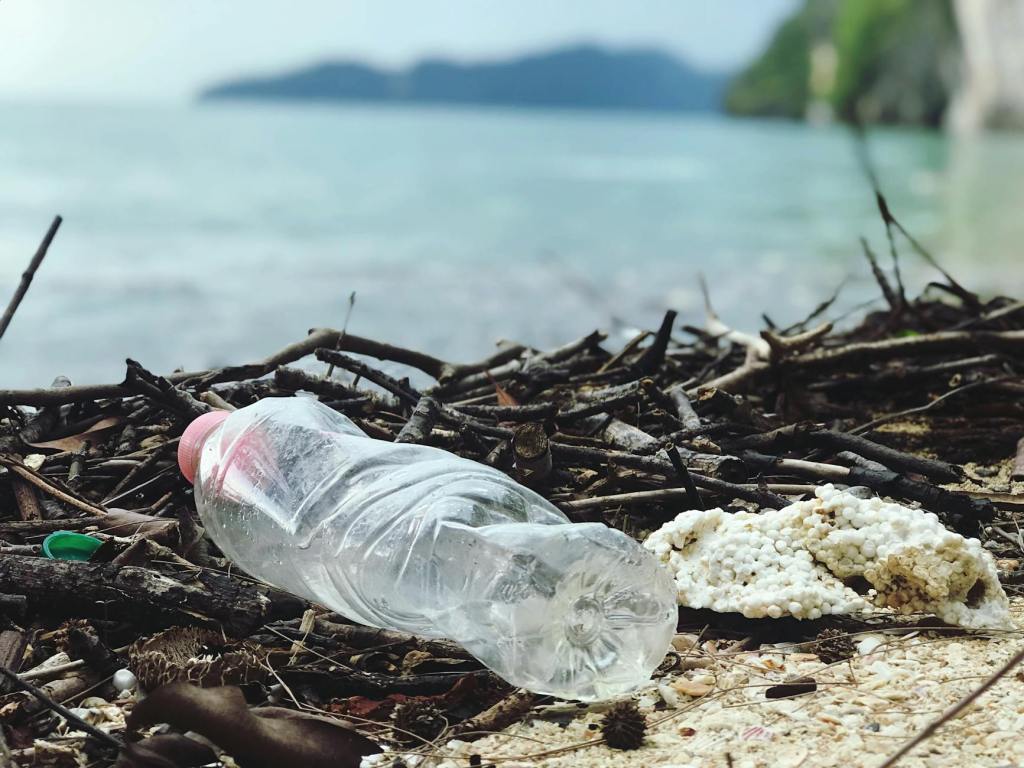
So-are all our bodies full of microplastics, ready to reach out their oily hands and strike us all down with heart disease, tumours and goodness knows what else, or not? It’s a story we’ve covered before (LSS 9 4 24) and to be fair we even approached it with a certain moderation (LSS 12 3 25)
But who are we to advise you, when we can point you at once to the works of science journalist Debra Mackenzie, writing in the Guardian? [1] Not only is the science interesting. She also gets to the heart of why scientific controversies arise. In the case of microplastics, because one lot of researchers (medical folk) are approaching the problem one way. And another lot (analytical chemists) come from somewhere different, with other methodologies And this is ominous: as we have seen time and again, with CFCs, with tobacco and with fossil fuels, there could be interested parties who will be waiting to pounce on those disputes , to use them to allege that the science is not certain, that no action is needed. To quote one of the more chilling passages of Debra’s article
The plastics industry is more powerful than the CFC-makers were, and it has friends who know how to manufacture doubt. (Researchers I spoke to said that their papers have been denounced to journal editors by chemical industry figures who were not analytical experts.)
Now we at LSS are not medical experts. gentle readers. We do not know where the truth lies, although we may suspect. And, as in many scientific debates, there may be actors with differing levels of enthusiasm about where the evidence ultimately points. In any case, you should read Mackenzie’s article. You will learn a great deal more than just about plastics..
Most errors stem from unconscious habits of the mind—ways of thinking picked up in work, education, family and public bar. Teachers and lecturers are not exempt. Their lives largely consist in imparting information to the ignorant, then correcting its assimilation through marking essays and test papers. As their students readily comply, driven by ambition, cupidity or fear of ambitious parents, the teacher concludes that learning has occurred, and approves his own methods accordingly.
But the world outside the groves of academé is a very different place. Violent, short term and full of festering resentments such as class, race and the bitter memories of forced attendance at the knees of some pedagogue for whom they entertained neither liking nor respect. Here decisions are based on quick instinct, not measured reflection. Judgements depend upon on habit, emotion, and identity, not fact and logic. So when the educated set out blithely to explain complex issues such as climate change, interethnic tensions, or pandemics they expect the same compliance, the same reverence, as they received in school. Forgetting that most minds have long since been locked against reason, and barred to the entry of all but the smallest facts. Why else is it so hard to convince people to give up smoking, gambling, or drinking? A second’s reason revealed the harm: and the educated repeated the admonitions for decades, until partial success was achieved. Now we begin to understand the terrible fate of Cassandra, doomed to be forever right, and forever unheard.
Unless the educated-among whom we include the followers of this humble blog, gentle readers- can learn to adjust this fatal psychic flaw, the world will continue to slide towards climate catastrophe, pandemic disaster, and war. Oh, we almost forgot-your former pupils now have nuclear weapons
Veteran students of Britain’s national decline keep returning to a single motif: it’s our education system. For too many years the United Kingdom has tolerated appallingly low standards of literacy, numeracy and vocational skills which have left it trailing far behind the field of comparable developed counties. The reasons adduced include: a two-tier system of private versus public education, with all the opportunities rigged in favour of the former: under investment , with education ever in the firing line of the latest round of Treasury penny pinching: an atrophied system of vocational training with an overemphasis on bookish academia. Well do we remember the personal experience of a teacher who told us “in a one hour lesson I spend the first twenty minutes trying to calm them down and pay attention: in the next twenty I might get some teaching done; the last twenty is spent trying to maintain order as they await the end of the lesson” That was thirty years ago; but the experience is relevant today. Incidentally, we make that two thirds of the budget spent on every lesson wasted: but then, we were never very good in maths class.
Don’t take our word for it. Believe the words of Andrew O’Neil a heroic figure who pens a regular column for the Times Educational Supplement. Contrary to all experience, still believes something can be done. [1] He is honest about the problems: poor retention of teachers: endemic violence and above all an unwillingness to confront these issues until they break into total catastrophe, with the murder of a teacher by a disgruntled pupil, although quite often they do it to each other as well. His learning is vast, his interest multifaceted. Oddly he actually sees signs of hope for our poor land:
There are promising signs of change. In Bridget Phillipson, we now have a secretary of state committed to long-term solutions rather than short-term firefighting. Her emphasis on system design, fairness and early intervention marks a departure from crisis-led reform
Travelling on holiday, on business or whatever, we became used to a sort of condescending pity from foreigners whenever the subject of education came up. is there just a chance that, for once our appalling national system might be mitigated, or even turned around altogether? Could we actually start to catch you up?
One of Saturday morning’s great pleasures, an hour or so before Spanish class, is to settle down in Costa with a coffee and a hard copy of the Financial Times. And one of the best writers in that journal is Simon Kuper. He’s clear, he’s brief, he deals in the currency of short sentences and defined concepts. He’s also a polymath, covering subjects as diverse as politics, urban planning and football(he’s even done a very workmanlike guide to the affairs of Barcelona FC . [1] In fact, he’s exactly the sort of writer we ought to showcase here, because he believes in our core LSS values of evidence, reason, and reserved judgement.
How appropriate therefore that his last column was called Seven Intellectual Habits of the best thinkers., for there can be no better short guide. [2] The problem is that access is behind a paywall. As LSS is such an important institution, and our readers so avid for wisdom, we rang the Editor of the Financial Times a to demand that this be lifted as a Special Case., and that he/she/ they might like to buy us lunch to discuss the matter further. The young person on the switchboard thanked us very much and promised they would call us back. So far they have not done so(that was three days ago) but doubtless there were other callers. So, while we are waiting, we thought that we could offer you a distilled reproduction of Simon’s thoughts:
1 Read Books ” Their complexity is a check on pure ideology” People who simplify the world are the ones who fall for conspiracy theories or the offers of charlatans.
2 Don’t use screens much Apparently, biochemist Jennifer Doudna, who invented CRISPR technology gets her best insights when she’s out weeding her tomato plants. Obviously you have to use screens a bit, or you couldn’t read this! But we get Simon’s drift: a little screen time is a lot.
3 Do your own work, not the world’s The same Doudna got a gig at Genentech, leading their research. She lasted two months before hightailing it back to Berkeley where the true intellectual freedom led her to the Nobel Prize. We agree: people who spend all their time on office politics actually accomplish very little that is either interesting or of value.
4 Be multidisciplinary Kuper cites the examples of Hayek, Godel, Van Neumann and others who all studied one thing, trained in another and did their best work in a third. Daniel Kahneman is cited as another multi-disciplinarian polymath of formidable intellectual power. Rather worryingly, our AI system has set his book as homework for us. Where’ are John and Sarah Connor when you really need them?
5 Be an empiricist who values ideas Kuper cites the case of Isaiah Berlin and his marvellous work the Hedgehog and the Fox , a masterpiece of political philosophy. Incidentally Winston Churchill got him mixed up with Irving Berlin and invited the wrong one to dinner.”My British Buddy” as Berlin himself would later remark in song.
6 Always assume you might be wrong Yep: in this country we are still trying to repair the effects of the blissful certainties of Brexit. You will doubtless have examples from your own lands
7 Keep learning from everyone “Only mediocrities boast as adults about where they went to University at 18.They imagine that intelligence is innate and static. In fact people become more or less intelligent through life depending on how hard they think. The best thinkers are always learning from others, no matter how young or low status” We quote Kuper rather fully here as the first part seems one of the most admirable and accurate summaries of the sorts of people one met on a daily basis during long decades in the Scientific Civil Service. Now there’s intelligence indeed.
“The trouble with racism is that it means second-rate people in first rate jobs.” These words, once spoken casually to us, are the real basis of our opposition to discrimination of all kinds: It’s inefficient; it’s not in the long term interests of the oppressor. All societies suffer from hierarchy and ethnic hatreds, But was saddest of all to see the United States of America, born in such enlightenment, to be so disfigured by this most ancient weakness of the human mind. One attempt to counter this was the establishment of Historically Black Universities and Colleges, which aimed to provide some higher education for students who were excluded from white institutions. They have been around for a long time, and you would have thought by now that the penny would have dropped: “this is a fantastic source of underused potential which could benefit us all, especially now that China is treading on our cowboy heels”. Well, read this and think again: Unshackle Historically Black Universities in Nature Briefing
Historically Black colleges and universities (HBCUs) in the United States “are producing world-class research and record numbers of Black scientists with one hand tied behind our backs and shackles on our ankles” because of “consistent, drastic underfunding” compared to institutions established to educate white students, writes evolutionary biologist Joseph Graves Jr. “For example, my research group alone has produced more Black women with PhDs in microbial evolution in the past five years than the rest of the country has in the past five decades.” Graves calls on industry, philanthropists and individuals to shore up weakening government support for HBCUs, minority-serving institutions and tribal colleges and universities.Nature | 10 min read
It’s not that we especially like black people ,or white people, or any ethnic, religious or social group . Quite the opposite, most of the time, for most of them. Nor are we especially compassionate or just, as far as we know. But we do regard all forms of generalised prejudice as a debility of the human mind, like the propensities to gamble, drink to excess, or indulge in concupiscent and promiscuous sexual practices. (that’s a polite way to put it!-ed) All of these errors waste time and money which in the long run would make us wiser, happier and safer. Let’s see if anyone does anything about these colleges.
An epidemic of childhood obesity. Lonely, de-socialised children spending endless hours on their phones and computers. Anxiety, depression, anorexia…….it’s every parent’s nightmare scenario and for once everyone agrees it’s true. The solution seems obvious. Let them out to play! To have real fun, burn off a few calories and above all learn the social skills which will last them for life. Sadly it’s not that simple, as every responsible mum knows. Leave aside all the perverts and gangsters( we’ll come to those another day). There is another more terrible monster out there. It’s far more common, far more dangerous and it hasn’t even got the decency to hide in plain sight. It’s called The Car. It runs down children, maiming or killing them. It fills the air with toxic gases and noxious particles both of which represent colossal hazards to childrens’ health and mental development.
Now an exciting new movement called Playing Out [1] has taken the initiative. Incredibly, they hope to reclaim the streets as safe spaces for children to play in Read their mission satement here
Our aim is for playing out near home to be a normal, everyday part of life for all children, as it once was. This means safer, less traffic-dominated streets and more connected communities. It means children having clear permission to play out in the spaces around their homes. It means no ‘No Ball Games’ signs. It means putting children first and protecting their right to play.
It’s already being tried in Leeds, a City in the north of England, and you can read about it here [2]
It is comforting to imagine that children of the future might be saner and healthier than they are now. But it’s also rather hopeful. You see, gentle readers, we at LSS get a bit melancholy about the fact that people are losing faith in their ability to shape their own lives. Which is why they turn from rational progressive parties to charlatans out on the fringes. Yet this movement is not only grass roots, it directly addresses a major issue in everyday lives. Above all it offers agency again, that magic elixir of hope that is essential to a sustainable society. Now, the stories we’ve retold today are about places in England. That’s because we’re based there. But hope can travel. What if you went out and tried something like this for your kids?
Due to difficulties with the Word press site we are unable to bring you images. We hope to resume this function soon
Remember your first textbook? Your first real textbook, when you’d left school and started to learn something which you really wanted to? It could have been one on Accounting, Zoology, Economics or something altogether more useful like Nursing or Housing Studies. OK, It wasn’t light reading, exactly. But here was real serious learning, laid out by experts, divided into chapters, references, sections, with questions and answers. The very essence of professional: but, sometimes, there was wonder in there too, as it made you think. And how far would you have got without this guidebook, comfort and, above all, friend? RP Littlewood, Living Spanish , that was our personal favourite. They’re still publishing it today, much updated of course.
Well what if we told you that all this was down to one man. He is called Peter Ramus in English, but he was one of those typical polymathic polynational scholars that the Renassance was always throwing up. There were brighter and better scholars at the time. But Peter had one insight which made his contribution to our progress as good as any of theirs . He realised that knowledge had to be organised, systematised and arranged into an orderly manner, enabling students to access it far more quickly, freeing up new time for creative thinking and discussion. And so he invented the Textbook. It was a force multiplier of immense power. Combined with effective use of the new printing technology it allowed learning to spread quickly and effectively in many fields. No single textbook or edition is ever perfect. They must be updated every few years as new discoveries ensue. But the method and layout guarantee a sure design which has lasted, as its easy transference to the internet shows. An so we hail Peter Ramus as a true hero of learning, who helped make us what we are today.
Our link today comes from the BBC , the UK’s publicly funded source of news and information. It is rigorously objective and independent, and as such is hated by private purveyors of news of all sorts . Please support it where you can.
Teaching English in England was always different. You weren’t just instructing in the language; you were delivering a handy survival guide to our ancient, entrenched class system, and what all those words, pronunciations and signifiers meant in the hierarchy. In this land, small cues in voice, dress, hair, clothing and vocabulary mark harsh and zealously-policed lines of demarcation. Crossing them can mean social exclusion at best or serious physical harm at worst.
It is rooted in our aberrant education system.* Which allows anomalies like the output of the top 9 most expensive schools, representing 0.15% of pupils produce 10% of the entries in Who’s Who, our Establishment’s self- regarding house manual. [1] That people who hold our top jobs are five times as likely to have gone to private schools than state ones.[2] We must leave it to you to surf the waves of links which we have provided, gentle readers. They are but the tip of a mighty iceberg.
No nation can survive at the top for long if it continues to fish for talent in a smaller pool. And Britain’s decline since 1900 has been precipitate. Why then do British people in general and English ones in particular, continue to acquiesce in a system which so stultifies their life chances? Nostalgia for the times of lost dominion? Fantasy wish fulfilment? Money worship? An understandable suspicion of the destructive capacities of many “reforms” proposed by Left wing activists who laughably described themselves as “educationalists”?
None of us who care for the future of our island ever wanted to abolish Private education. But we always knew this quasi-apartheid must end one day. The way to achieve that was to make State schools so good that it would be economic madness for a family to choose any other. Signs that this may at last be happening are found in this intriguing article by Joanna Moorhead. She and her husband were solidly Private: but are entirely satisfied with State for their own offspring. You may read why here.[3] For anyone English, this change is seismic: practical economics has started to trump considerations of status, class and tribe. If this continues, it will be welcome.
* Handy note for foreigners Public school=Private school State School= publicly funded school Gottit?
“What is Truth?” Pilate is reputed to have asked Jesus at the latter’s trial in long-ago Jerusalem. Yet it is a question of neuralgic importance today. For we live in an era of angry competing claims, where everyone asserts that their particular fact-set is equal to anyone else’s. Opinions are simply hurled against each other, like children throwing stones. No learning, no judgement is possible at all. How can we, that tiny group of intelligent people who must somehow carry Civilisation forward find some sieve to winnow truth from opinion? Professor David Spiegelhalter may have some answers.
Spiegelhalter is a statistician. Fans of Covid-19 may recall him popping up on telly a lot during that pandemic. Look out for him during the next one. Yet his list of criteria (derived from the work of Bradford-Hill and Doll) may be applied to any scientific hypothesis. as a first step to get sort out wheat from chaff. . We decided to apply it to global warming today, so here goes:
Direct Evidence
1The effect is so great that it cannot be explained by any random variable: The planet is undeniably heating up fast and this has become statistically significant
2There is a close causal proximity between cause and effect We’ve been pumping out enormous quantities of fossil fuel gases since about 1840
3The “dose” causes a response and it is reversible This comes from medical science, but if the “dose” is waste gas, then compare the fossil fuel emission pattern curve with that of temperature That it is indeed from coal, oil etc is demonstrated the well-known changes in C12 C13 and C14 ratios in the atmosphere
Evidence of mechanism
4 There is a plausible mechanism, explicable from known science, which explains the effect Carbon dioxide and methane are known to trap heat. Quite a lot of it.
Parallel Evidence
5 The effect fits in with what we know from other studies Consider what has happened in the atmospheres of Mars and Venus by comparison to Earth.
6The same effect is found when the study is repeated Many peer reviewed papers have validated the early evidence; none have found against.
7 The effect is observable in very different studies and phenomena Studies as diverse as ice core samples, temperature measurements in oceans, land and atmosphere and the rising intensity of weather patterns only confirm the predictions of the first discoveries
The above list could be applied to any study of economics, social science, marketing or politics as well as the hard sciences, In fact Bradford Hill and Doll derived it from their pioneering work on the link between cigarettes and cancer. Any fairground huckster or well-funded corporate journalist can make claims. We hope the above will help you, gentle reader, to be a little more confident as to the veracity of those.
[1] Spiegelhalter, D: The Art Of Statistics Penguin 2019
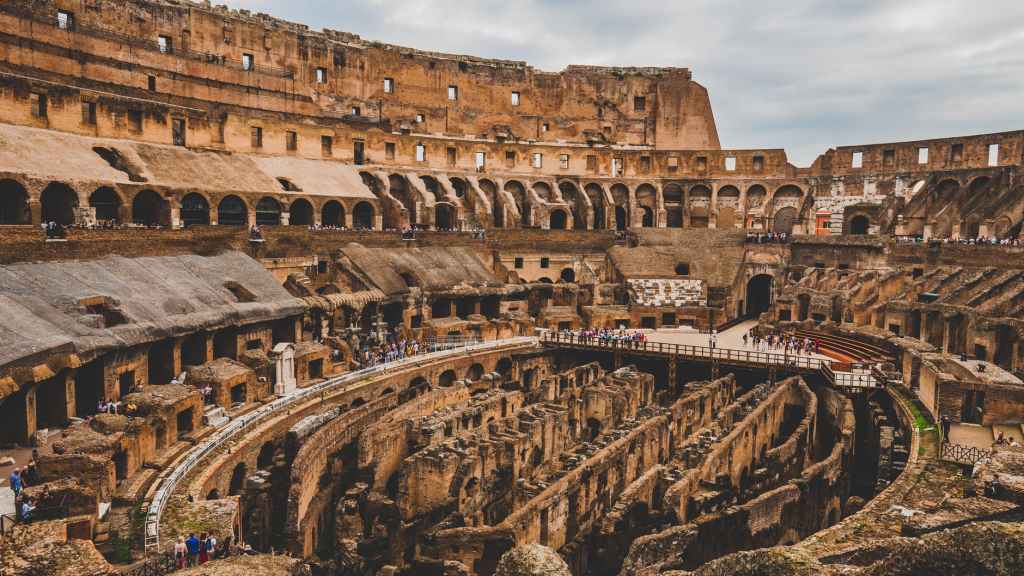
Followers of football often discuss the fate of Manchester United FC. A once hugely-successful club, awash with money that is now desperately underperforming, despite an endless stream of new mangers and fresh starts. Some compare it with the fate of Rome (the Empire of that name, not the football club). But there may be an another comparison, more recent and much closer.
Why is the UK so desperately underperforming? Why is the state of its mental health so very poor, when compared to other countries? Why have peoples hopes and expectations stagnated? Why is the health service so bad? Housing so squalid and insecure for so many? Especially as all the terrible social and economic problems were tackled so ably, especially in the years between 1945 and 1975? One intriguing set of ideas has been presented by George Monbiot. [1] [2] Intriguing because they link together so many disparate observations. Refreshing, because they challenge existing orthodoxies of Right and Left. For George, the culprit is Neoliberalism, which he defines as a cultish ideology based on a relentless cutting of the state, privatisation, low taxes and the freest possible flows of taxes and people. (the latter certainly explains why we couldn’t see the pictures in the Uffizi galleries in Florence)
Of course, it’s a contribution, not a panacea. But it touches on the same sort of themes as Thomas Piketty, Wilkinson and Pickett, Hutton and others whom we have referenced on these pages from time to time. That the endless competition by individuals for wealth and status will end up by leaving all of us poorer. Except the very rich, who own all the media by which we are told what a great idea all of this is. And as for the UK and poor old Manchester United? Perhaps both of them need to take a very long, cool look at the fundamental causes of their unhappy states. Before worse happens.
















 Learning, Science and Society