We’re up to our necks in Smoot Hawley here

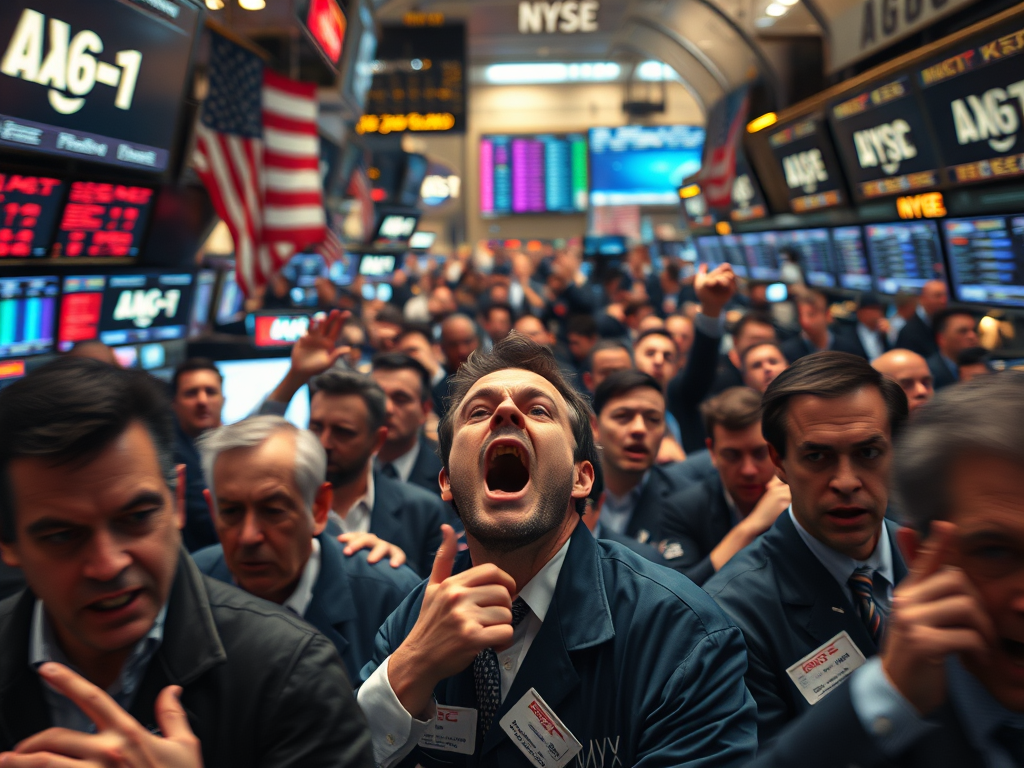
God knows, we don’t like to blow our own trumpet here. The pictures of the Conceited Ape and the Man Blowing His Own Trumpet (both generated with AI) are entirely coincidental. But attentive readers may have noticed how we have been pushing the dangers of the Smoot-Hawley Tariff of 1930 and its parallels to the policies of Mr Donald Trump (at the time of writing his title is still Mr) .

Now the admirable Larry Elliott of the Guardian has got in on the act [1] We’ve often repeated his thoughts on these pages. And this time he goes further, suggesting it is a sign of American weakness, not strength. Well worth a read over your morning latte, we think As for us, we hope that is the last we see of Messrs Smoot and Hawley and their execrable tariff.

But before we go here are a few final thoughts

1 You read it here first

2 Most historians and economists think Smoot Hawley was a major step in the road to World War 2

3 Despite what nostalgists tell you, wars aren’t all chirpy cockneys singing jolly songs in Underground Stations. Ask them in Ukraine if you don’t believe us.

4 A nation may claim the right to act entirely in its own interest, without regard to others. Fair enough. But by the same logic does an individual have the right to sell Class A drugs such as heroin, if he can make money thereby?

[1]https://www.theguardian.com/commentisfree/2025/feb/13/donald-trump-trade-war-president-china#

#tariffs #trade #world war #smoot hawley #larry elliott #donald trump

Smoot-Hawley for the 21st Century: Why The Conversation agrees with this blog

Tariffs: here we go again. We understand that Mr Donald Trump may have his own reasons for imposing them. As the ruler of a proud and independent nation he has the right to do so. But, for the moment, we still have the right to comment on his action. Which we did in two blogs (LSS 19 5 20, 12 11 24) Being of a historical turn of mind we drew parallels with the famous Smoot-Hawley Tariff of 1930. Which in the view of most economists and historians not only deepened the gathering recession, but also lead more or less directly to World War Two.

In such circumstances it is questionable whether it is “nice” to find that minds far better educated and profound than ours agree with our insights. For today The Conversation publishes an article by Thomas Giffe and Micheal Pouffle which agrees with us in almost every detail [1] In fact it does the whole job rather better; and you must read it, gentle reader.

Because the article brings out the key psychological reasons for the decisions. And psychological they are, not economic. Here are three killer quotes from Trumps most earnest supporters

Congresswoman Claudia Tenney of New York told Fox News that she’s glad the US is “projecting strength for once on the world stage”. Senator Eric Schmitt of Missouri insisted that tariffs were “not a surprise,” emphasising that Trump had relentlessly campaigned on “improving our standing in the world.”

former adviser and populist nationalist Steve Bannon warned that America would no longer be “abused” by “unbalanced trade deals.” “Yes, tariffs are coming,” he said. “You will have to pay to have access to the US market. ………… the free market is over.”

Now these are proud and intelligent people. But their priorities lie in fields other than economics. They may be right. They may not. But we do remember a passage from our Gibbon about the declining years of the Empire. Wherein a particularly tyrannous but insecure Emperor, having arranged the murder of his best general. asked an ordinary Roman Citizen for his opinion of the deed:

“I am ignorant, sir, of your motives and intentions” replied the honest man “I only know you have acted like a man who cuts off his right arm with his left”

[1]https://theconversation.com/the-us-tried-high-tariffs-and-america-first-policies-in-the-1930s-trump-should-note-what-happened-next-249079?utm_medium=email&utm_campaig

#smoot hawley #tariff #trade war #world war #USA #China #economics

Tariffs: Like it or not, Trump has captured the spirit of our times

“Tear down your wall!” This was the gauntlet which US President Ronald Reagan threw down to the Communist bloc in the 1980s. It was a harbinger of times to come. Reagan was the leader of the Neoliberal programme, by which he meant that trade: the free flow of goods, services, capital and people would bring undreamed-of levels of prosperity and confine the memory of the restricted economies of Socialism to the dusty bookshelves of the History Faculty. Remember the 1990s and all those endless negotiations on GATT and the World Trade Organisation, as the good times rolled? The world was to follow the principle of Comparative Advantage, as advocated by David Ricardo, with each nation specialising in what it did best.

Yet the Neoliberal model contained the seeds of its own downfall, as we have noted before on these pages. The profound existential crisis it endured after 2008 has never ended. And now everyone, both ruled and rulers, has learned to turn away from its nostrums and the many problems which unrestricted movement has brought

Chief among these of course is immigration, which has incited a visceral fear of identity crisis among the native populations of countries where it runs high. Immigration was never a socialist thing, but a capitalist one. Donald Trump has recognised this, by using trade tariffs explicitly to control immigration(and the supply of stupefying drugs, (which similarly obeys the rules of a free market) As this Guardian article notes, he is simply the most powerful exponent of the spirit of our times. Free markets are out. Red Tape is in. What could be more Red Tape than immigration control? [1]

Of course everyone will follow suit. The first will be nations and trading blocs, retaliating against their American tormentor. Perhaps everyone will be poorer, but they may well live in more stable societies. However, once you throw over the market principle and prize stability above prosperity, you open the door to other innovations. Like higher taxes, which are also advocated to promote social good.. To restrictions on the buying and selling of second homes, lest they damage the fabric of local communities. To ever tighter restrictions on the use of cars, cigarettes and alcohol. Access to the internet and other sources of information. Trump and his supporters may not yest realise it fully, but they have already sold the pass.

[1]://www.theguardian.com/commentisfree/2024/nov/26/the-guardian-view-on-donald-trump-tariffs-protectionism-is-no-longer-taboo-in-politics

#WTO #socialism #donald trump #immigration #ricardo #regulations #autarky

In a world without a reserve currency, Gold is King

It is June 2025, and the world has learned that it no longer has a reserve currency, a role hitherto held by the US Dollar. The chain of events which began with the election of Donald Trump by a disputed majority in the Electoral College (readers will recall he lost the popular vote) have now reached their logical conclusion. You will also remember how attempts to enforce the result by the US Supreme Court could not be accepted by some States who alleged, with some justification, that the Court was no longer an objective and unbiased institution, Their de facto secession, pending a recount, undermined the integrity of both the US Treasury and Federal Reserve. Meanwhile, attempts by the Provisional Trump Administration to impose import tariffs (20% on all comers, 60% on China) have only led to a retaliatory fire sale of Treasury Bonds and other US assets, which led to this morning’s news of the suspension of dollar convertibility. The United States of America (or rather the three new nations into which it seems to be splitting) is no longer at the centre of the world’s financial system.

But, as of this summer of 2025, do we still have a world financial system? Attempts by the BRICS nations to set up their own reserve must end in failure. The lack of transparency in their systems(one or two are more or less open kleptocracies) mean that no one dare trust them to hold their money . The Euro area is too small and fragmented to possibly bear such a role, and their can be other candidates. How can world trade now be anything more than a slightly sophisticated form of barter?

Yet there is one measure by which value is judged. And always has been. Gold has been prized as the ultimate yardstick of worth by humans, and has been by for millennia. It is transportable, it is tradeable, and its price is known at once by everyone in the market. History suggests that world trade works best when most reserves are held by a single, hegemonic power(think Britain before 1914 or the US before 1971) But even if the world’s gold is diffused across the vaults of many competing nations and empires, it can still provide a standard against which everyone can measure the value of their trades. Expect its price to rise now for the rest of 2025, and perhaps even more next year.

#US dollar #world trade #BRICS #reserve currency #gold

Why we’re two years into a generational war

In the spring of 1789, Europe was at peace. It looked as if it would be a long one. The American-French victory in the Independence war had restored a rough equality of force between Britain and France, the two world powers, so that neither had obvious motives to attack. Further east, Austria, Russia and Prussia had achieved a rough status quo, or at least, had sufficiently fought each other out. To be frank, China, the Mughals and the Ottomans were ceasing to count. Just as in 1990, the world thought it could look forward to decades of relative peace, trade and prosperity.

Instead, events in France lead to the unfolding of a cataclysmic series of events. Each of them so large that on their own they would have been world-shattering. But in the twenty six years-a generation- from 14th July 1789 to 18th June 1815, they were so many and rapid that they left a world transformed and unrecognizable. Think Revolution, regicides, wars, terror, directory, Napoleon, Trafalgar, Austerlitz, Tilsit, Spain, Russia, Battle of the Nations, Elba, Waterloo all tripping in, one after the other in bewildering succession. *(If not, read Robert Harvey The War of Wars-it’s serious history which, amazingly, feels like a page-turning thriller {1])

We know believe that the events that began on 24th February 2024 with the Russian invasion of Ukraine have unleashed a chain of events which will take years and decades to play out. The two opposed coalitions are too big to easily fail. The issues at stake are too profound to escape the debate of war. As a blog which is read all around the world, you might not want to us to take sides. Yet we have to be honest about where we stand. On the one hand the US, EU and their allies have many grievous faults. The other side-Russia, Iran, China and others, may indeed claim- we stress claim-to represent the relatively disadvantaged. However, we know one thing. We are free to write these words in our country, as we would be equally free to criticise our Government, or our allies. All know that we would not be if we were sitting in one of those countries opposed to us. Our Georgian ancestors, who gave up their comfortable lives to confront a similar peril knew that was the single, irredeemable difference between them and their foes. That is what makes our cause just. And one day, we will prevail.

[1]https://www.amazon.co.uk/War-Wars-Struggle-1789-1815-1793-1815/dp/1845296354

#ukraine #russia #china #usa #EU #canada #uk #australia #iran #peace #war #freedom of speech