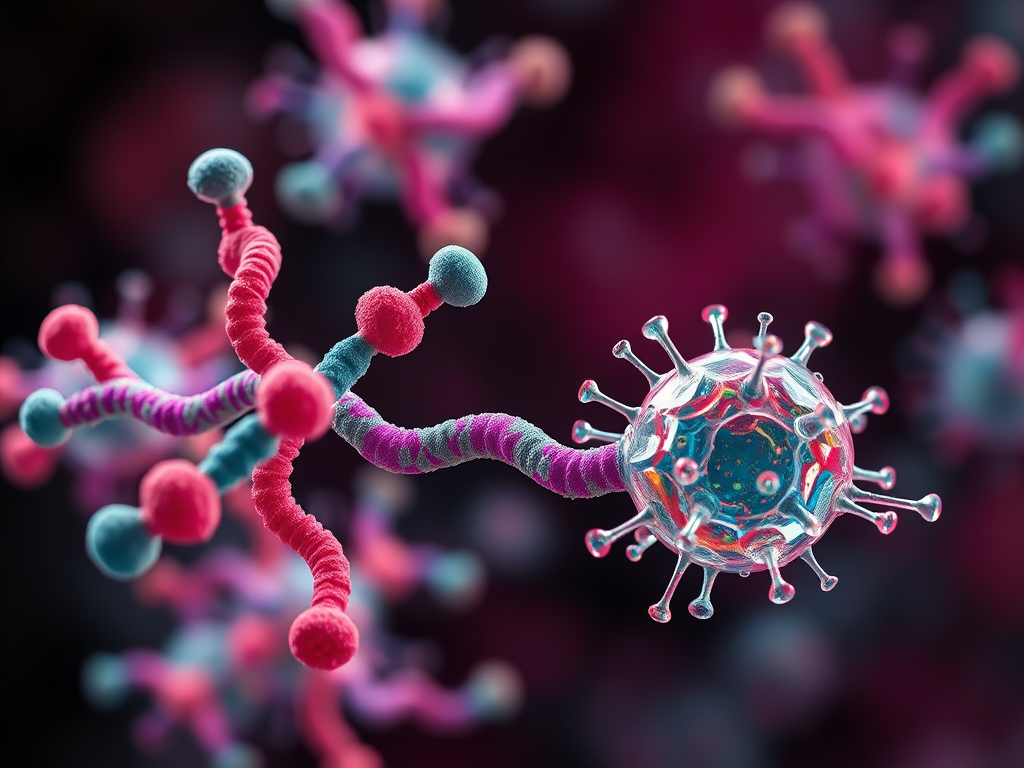
Now AI is designing antibodies too

Do you understand the human immune system, or the even vaster world of immunology? Neither do we. Too big, too vast, too complicated. And that’s despite 43 years of trying and working along side some pretty nifty immunologists, back in the day. But AI does, Fresh from its triumphs on protein design (LSS passim) its superior intelligence has now been turned on the knotty problem of how to run up new antibodies. Read this, AI designed antibodies race towards trials from the indefatigable Nature Briefing

Scientists say they are on the cusp of turning antibodies designed by artificial intelligence (AI) into potential therapies just a year after they debuted the first example of an entirely AI-designed antibody. Previously, the structure of antibodies proved somewhat of a black box to AI models. But new and improved models — such as an updated version of AlphaFold — have more successfully predicted the shape of flexible structures that give antibodies the specificity they need to bind to foreign molecules. Researchers at several companies now say they’ve designed ‘drug-like’ antibodies. Nature | 5 min read

There’s a lot to unpick here, and we won’t try to do it all. The first thing that stands out is how quickly this is moving from proof of concept to clinical reality, The second is that the possibility that designed antibodies will target receptor sites hitherto off-limits to their natural predecessors. Think infectious diseases first, and rightly. But the implications for cancer therapy -and dare we hope, neurodegenerative diseases?- are clear after a moment’s reflection. Designer antibodies will greatly reduce the need for much animal immunisation and testing. And, perhaps a best of all, a thriving commercial ecosystem of start-up companies is beginning to form around the new learning, ready to turn it into everyday reality in a hospital or medical prectice near you, gentle reader.

Although we can’t claim credit for these advances-you all know us too well- we think it striking that they have come from the qualities we prize . Careful observation. Null hypotheses testing. Slow steady work. And always looking for what proves you wrong not what proves you right. Those qualities are what save lives and generally make them better. A shame that they are being abandoned now by a hysterical ignorant population and so many of its foolish leaders.

#immunology #antibodies #medicine #health #cancer #disease #biotechnology

PERT: Next step in gene editing offers real hope for hereditary diseases

Almost a quarter of hereditary diseases can be put down to mutations which break an established pattern of DNA, so it can no longer be read. No wonder they are called nonsense mutations. Often these mutations are expressed as STOP codons: just a short three letter sequence that stops protein synthesis dead, like a bad piece of coding in a computer programme. Now a new technique called PERT (Prime Editing RNA Therapy)allows the cellular process to override glitch in the DNA and resume synthesis. The new technique equips cells with engineered tRNAs that override these stop signals, letting the ribosome continue translation and produce the full protein. Here once again is Nature Briefing with one of their excellent short explanations Versatile gene-editing tool fixes nonsense, plus hyperlinks if you wish to delve deeper.

A multipurpose gene-editing tool can correct several genetic conditions in mice by restoring proteins that have been cut short by disease-causing mutations. The method, called PERT, uses engineered RNA molecules that allow protein synthesis to continue even when a DNA mutation tells it to stop prematurely. These ‘nonsense mutations’ comprise nearly one-quarter of known disease-causing DNA variants. As such, if PERT proves effective in humans, it could overcome the need to design bespoke treatments for individual diseases.Nature | 5 min read
Reference: Nature paper

There’s a lot to like here. Firstly the prime editing is straight out of the same stable as the CRISPR and Base Pair Editing techniques which we have heralded here for years (LSS passim) Secondly, unlike most gene therapies, which must be tailored to each mutation, PERT could treat many different diseases with a single editing agent. This is a huge shift in scalability. And if the suppressor tRNA is permanently installed in the patients genome, it is possible that only one treatment may be needed. Once again we are reporting at the early stages (that’s our brief) so all parties are careful to emphasise we are nowhere near clinical applications yet. However, just as we learned during the COVID 19 pandemic , the ability to intervene at the RNA level, precisely between gene and protein, appears to be one of the most fertile areas in medical knowledge for years to come.

#hereditary disease #RNA #DNA #molecular biology #health #medicine

Making an end to Cervical Cancer, making a start on an end to Alzheimers- two stories of real hope

At a time when ignorance and anger are gleefully presenting themselves as the new norms, it’s heartening to see that some people are still active on our side. And achieving real, substantial progress. That’s why we’re proud to bring you two stories which show what educated minds, still employing the twin discipline of fact and reason, have achieved lately.

Repurposing old medicines. Regular readers will will recall our enthusiasm for lateral thinking, using old things which were there all along to do unexpected new ones. So Sharon Wooller of the Mail has a triple whammy for us this week.[1] After screening 80 commonly used drugs or vaccines , ingenious scientists at the University of Exeter selected three that might have a bearing on the terrible scourge of Alzheimers disease. They are: Viagra, which stops those pesky tau plaques from building up. Riluzole which may actually bring them down. And the shingles vaccine Zostavax which may also affect the immune system. Now we know the brain barrier frontier is pretty much down (LSS passim) this has to be a powerful runner, gentle readers. But best of of all is why these scientists set out to do this. To quote Sharon. in a nutshell:

Making drugs from scratch can take ten to 15 years and cost billions of pounds, with no guarantee they will work.

If you cant afford new ones, why not try a few old ones? Quod erat demonstrandum

Cervical success People can co-operate, even across national lines, when there is “cause sufficient”. One of these was cervical cancer, which not only blighted and destroyed lives, but effectively deprived the world of much of the better half of its workforce. Two releases today from GAVI and the WHO evince the remarkable strides in the vaccination programmes which have done do much to eliminate this disease. Hats off not just to the scientists, but also to the intrepid field workers who have combed the wildest, remotest corners of the earth, employing the most recondite means, to save lives and afford a brighter future to millions [2] [3]

When we read stories like these we know we are not alone. Our side is still out there. And unless they crush all universities and research institutes everywhere, we shall be back one day. For keeps.

[1]https://www.dailymail.co.uk/health/article-15298699/Viagra-Alzheimers-drugs-hope.html

[2] https://www.gavi.org/news/media-room/cervical-cancer-vaccines-save-over-1-million-lives-lower-income-countries

[3]https://www.who.int/news/item/17-11-2025-world-marks-cervical-cancer-elimination-day-as-countries-accelerate-action

#vaccine #drug #medicine #alzheimers #cervical cancer #women #health

If you want to know the truth about cancer, ask Liz O’Riordan

Because she’s seen it from both sides, is why. First she was a doctor, who like, worked in the field? And then because, she got it herself, right? Became a patient, and experienced all the heart stopping, roller coasting, will-I -won’t-I? chain of emotions that all her own patients did. If those aren’t qualifications enough, gentle readers, we don’t know what are. And-she has one other which seals the deal as far as we’re concerned. Read on, and you will learn what that is.

We came across Dr O’Riordan in the course of listening to a series called Marianna in Conspiracyland on BBC Radio 4 [1] Not having an especially large legal department we must be careful what we say. But the programme details the activities of the types of people who disparage reason-based science and evidence-based medicine. And instead offer a dubious range of alternative theories, explanations and prescriptions to people who are scared out of their wits by a cancer diagnosis. In the nicest possible way, the programme tried to explain the consequences of choosing these paths of treatment, And Dr O’Riordan was one of the speakers they called in their support. A little bit like the prosecution in a criminal case calling an expert witness in DNA or drugs, as t’were.

Because since her own diagnosis and treatment, Dr O’Riordan has spent her days ceaselessly writing, speaking, making media appearances, all to one end. Refuting fallacies, identifying illogicalities, reasoning with the unreasonable. In books like The Cancer Roadmap [2] she tries to explain the science behind why cancers develop and grow, what the best treatments are, and why so-called “alternative systems” don’t seem to be up to much. In this undertaking she joins a great tradition of rationalists and sceptics starting with Lucian of Samosata,[3] and stretching all the way through to people like Peter Medawar, Carl Sagan and Dr Ben Goldacre.

But she goes one step further. Because she never condemns or sneers at anyone. Instead she tries to ask why people turn from rational medicine to alternatives and faith. In other words she deploys human qualities of empathy and compassion. And we could all learn from that. For years on this blog we have bemoaned the growth of fake information, conspiracies and general rubbish which grows on the interweb like the digital equivalent of a cancer. Not just in cancer theory; in matters like global warming, politics and economics. Hasn’t done much good. Somehow, the easy, comforting answer outpaces the complicated rational one each time, and by ratios of thousands. We are in danger of becoming the last generation of enlightened, rational thinkers, perhaps for thousands of years. Time to listen to Liz and her methods. Soon.

[1]https://www.bbc.co.uk/programmes/m001mssm

[2]https://liz.oriordan.co.uk/author/

[3]https://en.wikipedia.org/wiki/Lucian

[4]https://en.wikipedia.org/wiki/Ben_Goldacre

#cancer #medicine #alternative medicine #rational #empirical #science #health

Could this new mRNA vaccine end cancer?

In the UK alone cancer accounts for 24% of all deaths.[1] Which means you, gentle reader have a close to one in four chance of going that way. You might hope that someone might do something about it. Today we bring you news that somebody has, via the industrious Luke Andrews of the Daily Mail [2] But before then, a tiny apology.

Because in reporting this we have no desire to disparage the heroic efforts of scientists, doctors, fund raisers and honest-to-God patients who have already done so much to ameliorate and already effect cures for this terrible disease. Luke’s story could be a game changer-but only because it comes at the ned of an enormous process of scholarship and research. That said, it is truly exciting. Firstly, because it tries to use the new mRNA vaccines which came of age during the COVID 19 pandemic. Secondl, because it offers a hope, however tentative at this stage, of a universal vaccine. Luke explains matters really well,. with all the links you need to the source journals, so we’ll leave you to him. Upbeat to say the least.

Vaccines are a contentious subject. We have talked about cancer vaccines here before(LSS 24 5 21 et al) and are aware of the mixed reactions we get. We suspect that not all anti-vaxxers are bad people: among them you will will find the stubborn types who refuse to accept any information coming down from above on whatever subject. Grit in the wheels of the machine; but one day you just might need them. But we in what might be called the empirically based community have our uses too.(we invented the computer you’re reading this on) it’s time for a dialogue, instead of hissing and growling at each other like so many cats and dogs. The patients deserve that.

[1]https://www.cancerresearchuk.org/health-professional/cancer-statistics/mortality

[2]https://www.dailymail.co.uk/health/article-14919401/immune-hack-vaccine-mrna.html

#mRNA #cancer #vaccine #medicine #health

Cancer testing saves lives-and shows why science works

Today we a re going to talk about cancer. In the UK alone it kills 167 000 people annually, which is about 29% of all recorded deaths . Meanwhile about 3.5 million people are trying to live with it on a daily basis. The statistics for your country will be comparable, gentle reader. Nothing would cheer us more than to report some good news. And today we think we can, courtesy oft the far sighted Professor Peter Sasieni and his team at London’s Queen Mary University via the Mail [1] [2]

Professor Sasieni and his team are not pioneering cures directly. Their skill is devising new ways of testing. To detect the terrible disease early, before it can wreak havoc, and unleash the cures when they have the optimal chances of success. The linked article is a good summary of all the wonderful work they are doing. But we have filleted out this tiny quote which will give you some flavour of what they are achieving

Yearly screening under the fast tumour growth scenario led to a higher number of diagnoses than usual care – 370 more cancer signs were detected per year per 100,000 people screened. There were also 49 per cent fewer late-stage diagnoses and 21 per cent fewer deaths within five years than patients receiving usual care. 

If that’s not hope we don’t know what is

But there’s a deeper story here. For us, the best working definition of intelligence is how you respond to reality. You may have a lot of money, talk well, and even have a genius IQ. But if you ignore facts, deny them, or distort them, then you are a fool. There’s no mystery about science. It is simply a way of collecting true facts and organising them according to the rules of logic, which is what Professor Sasieni has done. This works globally for things like changes in the climate. It works locally, for things like diseases in the human body such as a diagnosis of cancer To deny truth once is the start of denying it always. With fatal results.

[1]https://www.dailymail.co.uk/health/article-14694059/blood-tests-detect-earliest-signs-cancer-prevent-advanced-stage.html

[2]https://www.qmul.ac.uk/wiph/people/profiles/peter-sasieni.html

#cancer #testing #screening #health #medicine

If you want to cure cancer, try paying more taxes

Cancer is the great unspoken truth running through our civilisation. Everyone knows someone who has it. Most people know someone who has died of it. The statistics suggest one in two of us will develop it in one form or another. When strangers discover that we run a science blog it isn’t long before cancer cures edge into the conversation. Everyone deep down wonders “will it happen to me?” You do, don’t you?

Which is why it gets a lot of coverage, and fresh discoveries always make the news. Following Ellyn Lapointe for the Mail [1] and the Korean owned Medical Life Sciences News,[2] we showcase the work of the brilliant Professor Kwang-Hyun Cho of the Korean Advanced Institute of Science and Technology. Instead of painful drawn-out chemical treatments it looks to cure cancer by manipulating the biochemical mechanisms of the cell. Admirable, and you can read more by following the links. But for us, for today, that is not the point.

Look again. The Korean Advanced Institute of Science and Technology. Turns out it’s state owned. Paid for by taxes, Its at the centre of an ecosystem of research institutes, university departments, private companies and assorted government and non-government organisations whose collective wisdom and output is far more than the sum of its parts. It’s not so much arriving at another cure for cancer that is important for us today. It is because this cure is part of a rolling programme of research and discovery that throws up such discoveries as it goes along. Creating a thriving centre of excellence and high value jobs.

The view taken by most people in the UK is that taxes are evil things. The State is an evil parasite holding back economic growth and thereby progress. But isn’t our story today prime evidence that the opposite is the case?

[1]https://www.dailymail.co.uk/sciencetech/article-14369821/breakthrough-switch-reverses-cancer-human-body.html

[2]https://www.news-medical.net/news/20241223/Groundbreaking-technology-converts-cancer-cells-into-normal-cells.aspx?form=MG0AV3
#cancer #medical sciences #economics #research

Can you Catch Cancer from a Cut?

Just because something is rare doesn’t mean that it’s insignificant. At least, not if it comes surrounded by well-attested research from trained professionals. Which is why this intriguing article by Alexa Lardieri of the Mail has really got us thinking.[1]

A man in Germany was operated on for a rare type of tumour. During the process, the poor surgeon cut his hand. It was cleansed and bandaged immediately. Six months later a tumour, which was genetically identical to his patient’s cancer, was found to be growing on the surgeon’s hand. This all happened back in 1996; but the case continues to excite speculation to this day.

Much more can be found in Alexa’s cogent article. Riffing on it, it suggests the following questions

1 How does transmission occur? Is it via nuclear DNA? Is there an epigenetic mechanism? Dare we speculate that a protein might be involved?

2 Alexa reports that the poor surgeon’s immune system may not have been quite as strong as it might have been. So…are we being bombarded with unknown carcinogens all the time, and it’s only our immune systems keeping us safe?

3 What do we mean by “cause” anyway? Does buying cigarettes give you cancer? Or is it smoking them? Or is it something in the smoke, like tar? Or could we even speculate that it is not the tar per se, but the molecular changes it induces in the cells of the victim? Where does cause end, and effect begin?

Yet it is in such cracks in logic that the most fruitful discoveries are to be found. This case, and the questions it raises are one such example. Thanks, Alexa, for bringing it back from 1996. Which was a great year for music too.

[1]https://www.msn.com/en-ae/public-safety-and-emergencies/health-and-safety-alerts/surgeon-catches-cancer-from-patient-in-first-of-its-kind-case/ar-AA1wRLpW?ocid=Bin

cancer #dna #epigenetics #immune system #health #medicine

Ian Sample: Science offers five reasons to be cheerful

Just for kicks, we thought we’d change the slightly pessimistic zeitgeist of this blog, and offer you some stories of real hope. Those-and a little moral homily at the end which we hope will justify these humble inclusions. The stories come, as so often, from Guardian science writer Ian Sample, whose thoughts we often praise here.[1] We hope they might offer a glimpse of what we are about to lose if certain tendencies play out.

Stem Cell transplants could reverse diabetes. All that intricate and detailed work on stem cells may at last be finding a pay-off in the real world, with an almost infinite relief of human suffering. We respect the beliefs of the religious: but would just praying have got us this far?

Cancer vaccines from RNA We have covered this before here. If nothing else, the COVID-19 pandemic witnessed a major leap forward in vaccine technology, especially in mRNA. Where would cancer patients be now if all those anti-vaxxers had their way?

AI detects cancers To bring in another LSS old favourite: AI can now be used to screen and detect cancers more quickly than ever before. When we think of cancer, we think of old acquaintances who used to deny smoking had anything to do with cancer. Does that remind you of climate change deniers?

Occupants of interplanetary Space For lovers of pure science, there can be little more amazing the discoveries offered by the James Webb telescope. Once upon a time, the Inquisition threatened to burn Galileo for looking up at four little satellites around Jupiter. Will someone try the same on this new telescope?

Renewable energy is on the way. Remember all those programmes and articles that tried to suggest that renewables could never, ever replace fossil fuels? But there’s real hope now that renewables will displace fossils by 2030. Both China and India seem poised to lead the way ahead. USA take note.

Yet we promised you a moral on this one, so here it is. All these discoveries, all this science, which Ian has just showed us is dependent on the free and fearless interchange of information. Which in turn depends on open societies and the rule of law. There is strong reason to believe that this era is coming to an end. In some countries, religious obscurantists and zealots are close to extinguishing freedom forever. in others, violent ethno-nationalists have seized power, or are close to doing so. These societies may well offer social stratification and the appearance of security. Yet in all of them. the sole definition of value is “does this bolster the regime?” There can be no truth in science, no beauty in art, no trust in money which does not meet this criterion. Ultimately, such societies stagnate. And then decline. You still have time to change your minds. In some countries, at least.

[1]://www.theguardian.com/world/2024/nov/09/reasons-to-be-hopeful-five-ways-science-is-making-the-world-better?CMP=Share_iOSApp_Other

#science #learning #objective truth #empiricism #vaccines #rna #astronomy #medicine

Round up: Stem Cells, Venezuela, allergies, goodbye to Old King Coal, and the second-most-famous Austrian of all time

stories that caught our eye

Adios, Venezuela, Stage Left : It has always been a conceit on the Left that somehow, whatever bad things we do, we are still somehow the exclusive guardians of the flame of human progress. Whereas the Right, poor dears, are steeped in superstition and ignorance. But Left-wing Governments, at least extreme ones, can do just as much damage to the scientific culture of their country as any Right-wing theocracy, as this piece form Nature Briefings makes clear

Some researchers in Venezuela fear that science in the country is “going down the drain”. The country’s economy has been in crisis and national science funding is proportionally smaller than in comparable countries, leaving research institutions and universities struggling to stay open. Young scientists have left in droves seeking out high-quality education or stable career prospects. And an ‘anti-NGO’ law now requires non-governmental organizations to share information about their funding with the Venezuelan government. Researchers, who sometimes look to NGOs for support, worry that this gives the government discretion to prosecute anyone whose motives it does not agree with.Nature | 6 min read

Every Breath you take: We hear a lot about microplastics in water and food. Now it seems we are breathing them in from the very air itself. And what’s really scary is that the risks of this are quite, quite uncharted, a bit like tobacco in 1924. Here’s Michael Richardson and Meiru Wang for The Conversation:

Stem Cells give hope for diabetics About twenty or so years ago, we had the privilege of a few words with one of the greatest scientific entrepreneurs of this generation. And he told us that Stem Cells were going to be in the in thing for the future. Proof of this foresight comes in this second piece from Nature Briefings

A woman with type 1 diabetes started producing her own insulin less than three months after a transplant of reprogrammed stem cells. This case represents the first successful treatment for the disease using stem cells from the recipient’s own body, which could avoid the need for immunosuppressants. She was injected with the equivalent of 1.5 million stem-cell-derived islets in June 2023. While promising, the woman’s cells must continue to produce insulin for up to five years before considering her ‘cured’, cautions endocrinologist Jay Skyler.Nature | 6 min read
Reference: Cell paper

Allergies Rising? One of the few good things about the Covid-19 pandemic was the rise to prominence of Professor Devi Sridhar, that most clear-sighted of thinkers. So when she says: “allergies are really on the rise, this is not just a sampling error”, we sit up and take notice. So should you, via her article for The Guardian.

https://www.theguardian.com/commentisfree/2024/sep/30/food-allergies-children-england

Goodbye Coal and steel No one gloats at the loss of great workplaces and the terrible social changes their workers must now endure. And no one more than us, blissed-out children of the Enlightenment/Industrial Revolution can deny that coal and steel were really big steps forward in their day. But their comes a time both for individuals and societies when they really must move on, because it’s the future where reality lies. So Britain closes its last coal power station and blast furnaces. It is a brave step, and one day it will pay off.

https://www.bbc.co.uk/news/articles/ckgn4gg5y2yo

https://www.bbc.co.uk/news/articles/c8vdq6y56v0o

Mozart Rise and Fall of a genius few years ago we saw a rather nifty series called Rise of the Nazis. It was one of those drama documentaries where they mix a narrator over pictures of actors depicting real people, including such luminaries as Heinrich Himmler, Herman Goering and a certain Mr A. Hitler. It looks like the producers must have sat down and asked themselves; “Who’s the next most famous Austrian everyone’s heard of we can do?” No it wasn’t Arnold Schwarzenegger: instead they came up with this excellent series on Wolfgang Amadeus Mozart. We have always put him right up there in the top five or so musicians of All Time. So we loved it, and hope you will too Here’s a link which we hope works to the BBC i Player. Hasta la vista, baby!

https://www.bbc.co.uk/iplayer/episodes/m0021zdr/mozart-rise-of-a-genius#:~:text=Mozart:%20Rise%20of%20a%20Genius.%20Child%20prodigy,%20flawed

#allergies #microplastics #mozart #president maduro #venezuela #climate change #fossil fuels #stem cells #diabetes #medicine #health