
Article of the week: Fascinating Rhythm and the origins of language

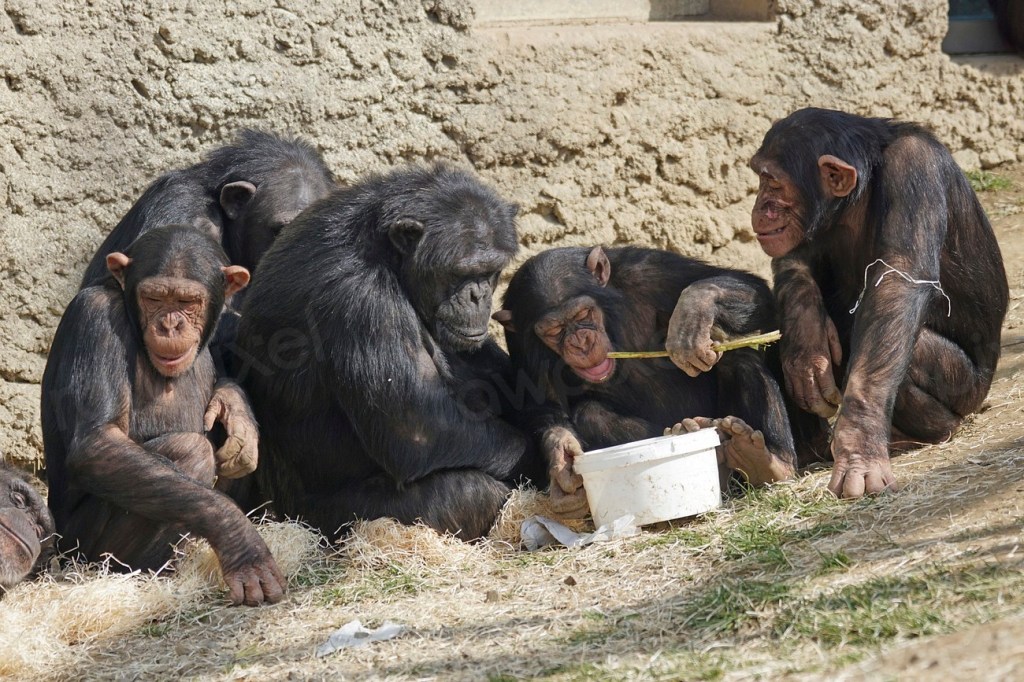
Any attempt to study the origins of language faces one huge, almost insurmountable, problem. At one end are the utterances of our nearest relatives, such as Chimps and Bonobos. At the other; fully formed, lexical and syntactic languages which only humans speak. What happened in between? And how long did it take?

The study of language acquisition in infants provides a possible model for how early hominins extracted meaningful patterns from the sounds around them. It even hints at the way protolanguages could have functioned, usefully, before the development of discrete units such as phonemes or systems such as syntax. Jamie Grierson of the Guardian [1] reports on how a Cambridge team has studied the neural response of infants of various ages when presented with songs and nursery rhymes.[2] For us, the key feature is:

The study concluded that infants learn languages from rhythmic information – the rise and fall of tone – as seen in nursery rhymes or songs, such as the ubiquitous alphabet song.

The team at Cambridge also discovered that babies do not begin to process phonetic information – the smallest sounds of speech – until they are about seven months old.

The team think that infants study the rhythm of their interlocutors to determine where words begin and end, and slowly begin to recognise and store a lexicon of repeatable, meaningful phonemes. Words, in other words.

The first hominin to use words faced major problem; none of his/her companions could understand them. However, if protolanguages developed slowly through a series of mutually intelligible codes, they would still be of adaptive use. Especially in certain areas, such as child rearing. The discoveries of the Cambridge team hint, tantalisingly, that such neural pathways may slowly have evolved, and would have been selected for. A worthy winner of Article of the Week.

[1]https://www.theguardian.com/science/2023/dec/01/singing-to-babies-is-vital-to-help-them-understand-language-say-scientists

[2]https://www.nature.com/articles/s41467-023-43490-x

#origin of language #humans #hominins #protolanguage #chimpanzee #phoneme #syntax #natural selection

Cop 28: Ten must-see graphs that tell you all you need to know(almost)

It’s COP time again; they come around so quickly these days, don’t they? In sunny Dubai, the Great and the Good, the Panjandrums of Climate Change, as well as quite a few of the people who got us into this mess, are gathering once again. “This time we’re really going to to something!” they proclaim. Or go the way of a certain well-known group of scaley reptiles, one of whose images is displayed at the head of this post, we surmise.

Out on the fringes, and in certain quarters of the Right-wing press, will be a number of opinionators who will be trying to undermine the whole thing. They and their so-called “experts” never seem do any original research, mind you. But they dig and snipe in the desperate hope of preserving their dirty failing old world, and presumably the memory of a time when they were moderately sexually attractive. (good heavens-which one was it?-ed)

If you want to counter this, a fantastic team of Guardian writers (Damien Carrington, Anna Leach, Paul Scruton and Harvey Symons) has put together a series of quick, easy-to-reference graphs which show the true urgency of the crisis. Here, in terms so simple even a Sun reader could understand them, are all the facts. Rising C02 and methane, forest destruction and the creeping flood which will make Noah‘s little matter look like a puddle in the park. One tiny quibble: nothing references the changing C12/C13 ratio level which for us was the clinching piece of evidence that the whole thing is human-made.[2] But that is to quibble. Marvellous work, and we urge every last one of you, gentle readers, to gaze upon it. Assiduously.

[1]https://www.theguardian.com/environment/2023/nov/30/the-climate-crisis-explained-in-10-charts-co2-green-energy-cop28

[2]https://www.realclimate.org/index.php/archives/2004/12/how-do-we-know-that-recent-cosub2sub-increases-are-due-to-human-activities-updated/

#global warming #climate change #cop 28

27,000 year pyramid claims offer lesson in good thinking

We have no training in Archaeology. We do like a good new story from that field, however. Hre is one from Nature Briefings, about claims that a 27 000 year old pyramid has been unearthed on the island of Java:

A paper claiming that a structure in Indonesia is the oldest pyramid in the world has raised the eyebrows of archaeologists and prompted an investigation by publisher Wiley’s ethics team. The study concludes that a structure lying beneath the prehistoric site of Gunung Padang in West Java might have been constructed as far back as 27,000 years ago — long before Egypt’s great pyramids. However, critics say that the buried layers are more likely to have occurred naturally, and that there’s no evidence people had the skills to build a pyramid at the time. The site has been linked to a fringe idea of an advanced global civilization that was wiped out 12,000 years ago, at the end of the last ice age.Nature | 5 min read

We are in no position to judge the truth or otherwise of the claims made by the discoverers. However, the world is full of huge eye catching claims- from hikes in interest rates all the way out someone peddling an interview with the Abominable Snowman. We cannot be trained in every discipline from Economics to Zoology. But there is one intellectual rule of thumb which can help sift the wheat from the chaff;

extraordinary claims require extraordinary evidence

And that’s true in every field. So while the idea of a 27000-year- old pyramid is possible, it’s so far out of the bounds of our experience that experts are rightly looking carefully at every shred of evidence. And considering alternative hypotheses. Sometimes something extraordinary does go mainstream (think Geocentrism, Continental Drift and the bacterial origins of infectious disease) But to do so there needed to be the slow accumulation of careful, much-reasoned, evidence.

Anyone can make a big claim about anything. If someone says to you “policy makers have made a mistake over marginal tax rates” it may be worth discussing. But if someone says “Policy Makers are in league with Beelzebub and all his satanic crew” you are going to need a lot of facts before you even give them time of day.

#logic #reason #epidemiology #conspiracy theory #archaeology

A Big Thank-you

As November draws to its darkening close (that’s enough imagery-ed) we would like to offer a big thank you to all our readers, researchers and contributors. There have been a few new followers lately, so welcome aboard our little blog. A few points:

We haven’t always been that good at posting and registering all of your comments. This is for technological reasons: we’re rubbish at it, and still can’t seem to make it work. There are Sasquatches in the backwoods of Canada who are better that IT than we are, so it makes it the more moving when you stick with us despite our ham-fisted incompetence.

We do try to visit as many of your blogs and websites as possible. Many are very good indeed. But you can imagine how, with a colossal mainstream media/new media reading list every day, there cannot always be time.

Why don’t we write in Spanish? Because we are not good enough, that’s why. Unless you are a native speaker it is almost impossible to write in a language without it sounding mangled and artificial. Maybe AI and chat GPT will change that; but by which time it won’t be worth doing anyway.

And finally- why don’t we go out and do more Good Works to help the Needy and Comfort the Afflicted? Well we would. Except recently we have been subjected to a plague of questionnaires about the service we received every time we go into a shop/doctor/dentist/garage/railway station/park…who’s going to do them next, your local Bordello? By the time we’ve answered them, most of the day has gone, and our soul shrivelled with it. The needy and afflicted have probably perished; but the companies concerned have a bit more data to justify cutting out assistants and introducing more of those ghastly serve your self check outs.

We wish all of you success in all your enterprises, and look forward to our next message in this personal tone closer to Christmas.

#blog #lss #thank you

If you want economic growth educate-and some

Followers of the “learning” aspect of our little blog will have spotted us trying to suggest a link between education and economic growth. Sometimes we point to the importance of technology as a multiplier of national wealth. Sometimes we’ve tried to say that money is the result of economic success rather than its cause. On the whole we’ve been a bit tentative, grasping at truths that might have been better expressed. Sorry.

Which is why it’s nice to come across a careful, well, studied report which lays out our preoccupations far better than we could. It’s called The Contribution of Education to Economic Growth by Catherine Grant[1], and its published by the Institute of Development Studies. So if you ever get into an argument with someone who wants to reduce the education budget to fund tax cuts, it,s all here for you. Blow by blow, across the whole gamut of primary to tertiary levels, and the whole range of countries from low to middle to high income. But what really stuck out for us here was this simple exposition of the value of education from page one:

First, it increases the collective ability of the workforce to carry out existing
tasks more quickly. Second, secondary and tertiary education especially facilitate the transfer of
knowledge about new information, products, and technologies created by others ………..Finally, by increasing creativity it b
oosts a country’s own capacity to create new
knowledge, products, and technologies
.

It’s that last part which we think justifies our efforts on this blog for the last three years.

There’s some real hostility to education growing again these days. Not just from old style religious fundamentalists but from right wing rationalists who ought to know better. Some of their websites bemoan the existence of Universities as breeding grounds for progressive voters. We have been personally told of Conservative candidates not to waste time on households where they see the presence of books. But, as this report shows, their hostility affords a long term disservice to their societies. But don’t take our word for it: have a look at the Bible, Proverbs 2 13,

13 Happy is the Man that findeth wisdom, and the man that getteth understanding

14 For the merchandise of it is better than the merchandise of silver and the gain thereof than fine gold

If that really is the word of God, then we agree with Him. Or Her.

[1] https://assets.publishing.service.gov.uk/media/5b9b87f340f0b67896977bae/K4D_HDR_The_Contribution_of_Education_to_Economic_Growth_Final.pdf

#gdp #economics #growth #education #training

Article of the week: how innocent fertiliser may contain deadly toxins

Nothing seems more innocent and sensible than to take human sewage waste and spread it on the fields as fertiliser. Simple recycling, and supposedly the way Mother Nature does things. Or did, before we came along.

But what if that innocent sludge contains a cocktail of poisonous compounds? What if they get into the food chain, and come back to us? Could there be long-term effects on cancer rates, birth defects, or nervous diseases? George Monbiot of the Guardian wants some answers to these questions. [1] Because in the UK

…….Instead of taking their liquid waste to dedicated disposal facilities, chemical and cosmetics manufacturers now pay water companies for the right to dump their loads into sewage treatment works. In other words, two completely different waste streams – human excrement and industrial effluent – are being deliberately and irremediably mixed……..

And George goes on to list a a whole raft of nasties including polychlorinated biphenyls, dioxins, phthalates, antibiotics(look, it’s our old favourite!), microplastics, and many more.

We choose our article of the week because it tells us something we didn’t know before we read it. Something potentially significant. something that might affect you, gentle reader. Because although this article is Anglocentric, we seriously doubt that the UK is the only, or the worst, offender. And it teaches us all this final lesson: just because someone appears to be doing the right thing, you still need to look very carefully to make sure. George raises so many long term questions, you just have to look at this one, gentle readers

[2]https://www.theguardian.com/commentisfree/2023/nov/18/cocktail-toxins-poisoning-fields-humans-sewage-sludge-fighting-dirty?CMP=Share_iOSApp_Other

#fertiliser #pollution #sewage #toxins #food chain

Resistant Bacteria: now even bleach is beginning to fail

Forget Israel and Palestine. Because there is now a gun pointed at the head of every man, woman and child on the planet. It’s called Clostridium difficile. The clue is in the second part of the name, because according to this chilling sentence the admirable Nicola Davis of the Guardian[1]

Liquid bleach does not kill off a hospital superbug that can cause fatal infections, researchers have found.

Think about that very carefully indeed. Since the age of Pasteur and Semmelweiss, the way we have worked things has been pretty clever. Any bacterium, resistant or not, must first get through a wall of sterilisation and cleanliness before it can reach a human body. And that wall is made up pretty largely of disinfectants like bleaches. If the wall fails an almost infinite number of bacteria will be on us, multiplying fast. Which will give them correspondingly huge opportunities to evolve new forms of resistance. It is unlikely that our present group of antibiotics could hold the line for more than a year or two. After which the mass dying starts. After all if C. difficile can do it, why not every other bacterium? [2] And even the odd fungus?

We frankly admit that we were not expecting this, gentle readers. Around the offices and workshops of LSS, hygiene and cleanliness rules are pretty tight, to say the least. Howard Hughes would have loved it in our little corner of Croydon.. To think it’s all in vain is a bit, well, disconcerting, to say the least. But we take comfort on behalf of all those exobiologists investigating the possibilities of life in Outer Space. It shows that organisms will evolve to surpass any conceivable obstacle, if they get the chance. So that particular research community now has something to cheer. For the time being.

[1]https://www.theguardian.com/science/2023/nov/22/bleach-does-not-tackle-fatal-hospital-superbug-uk-researchers-find

[2]https://en.wikipedia.org/wiki/Clostridioides_difficile_infection

#bleach #disinfectant #hygiene #cleaning #antibiotic resistance #pandemic #clostridium difficile

Wealth and Money are two different things. Ask your local Bank Robber

Imagine you are standing with a suitcase which contains $1000 000 in untraceable notes. That’s quite a lot of change, even by today’s inflationary standards. It can buy a lot. Are you wealthy? It depends.

Now imagine that you have just stolen that money in a successful bank raid, and you are climbing into your getaway car. Firstly, there is the getaway. The Police may well come after you, and in the USA they have guns. If you are wounded, dare you risk going for treatment-or will it give away your identity? Assuming the getaway is successful, for how long will you be looking over your shoulder for the Police and Bank Investigators to take you? As for that million-how much will your co-conspirators, your girlfriend, the local Mr Big of the underworld, need to stay silent? Or will someone else inform? Or will some tiny trace of forensic evidence like firearms residues or DNA one day catch you. Even if you bury the money for your release, how much of that million pays for a year in prison?

Compare that to someone who has just legally withdrawn the equivalent of $20 in an advanced country, perhaps one of the Nordics members of the EU. Ok, they don’t have so much disposable income, as taxes are higher. But no one will steal that money, there are too many police around. If they get sick, they ride on fast, clean public transport to a public hospital where treatment is covered. The streets around are clean, paved and full of things like colleges, parks, museums. And gymnasiums and safe places to eat, because the taxes have paid for for food inspectors.

So here’s a question: who has money? And who is wealthy?

Richard Wilkinson and Kate Pickett The Spirit Level Penguin

Three cheers for Tilos

Can we really hope for an economy where nearly everything is recycled? Where waste and pollution are things of the past, like stone axes and Spice Girls? Well, according to Melanie Goldberg of The Big Issue [1] the little Greek Island of Tilos is showing us how.

Through carefully constructed programmes of recycling, they have eliminated all need for a landfill site. Add this to the facts that they have been entirely energy sufficient since 2018. and a nature reserve since the distant 1980s, and you get a picture of real hope for us all.

Why do we say this? Because it demonstrates a vital concept. When you are doing anything new, start small and get proof of concept. Next scale up. And Melanie explains how Abu Dhabi will now try to take a green leaf from Tilos’ book, to see if it works in somewhere much larger. If it does, then something special could happen. Because if seen from anywhere much beyond the Moon(i.e objectively) this planet is only a tiny, self contained community much like Tilos. Thanks to those good people, there is no room for despair and every rerason to hope.

We thank Mr Peter Seymour for this story

[1]https://www.bigissue.com/news/environment/greece-island-tilos-zero-waste/

#recycle #waste #renewables #energy #tilos #abu dhabi

Nature Antibiotics-profound resource for researchers and campaigners

It’s always been our aim for this blog to act as a clearing site for all those interested in antibiotics. Researchers, health care professionals and tireless campaigners who tramp the streets in all weathers gathering monies and raising awareness.

Awareness. Now there’s a word. And nothing will keep all of us more aware than Nature, that exemplar of the most advanced research and thinking. Their page Antibiotics articles from across Nature Portfolio is a pipeline of the very latest research reports from leading scientific journals. You don’t have to read every one. But here is just about everything you do need, carefully curated by some of the finest minds in the business.

Wisdom is worth more than gold, silver and jewels. So said the author of the Proverbs. Here is all the wisdom you need if you have any skin in this game at all

https://www.nature.com/subjects/antibiotic