
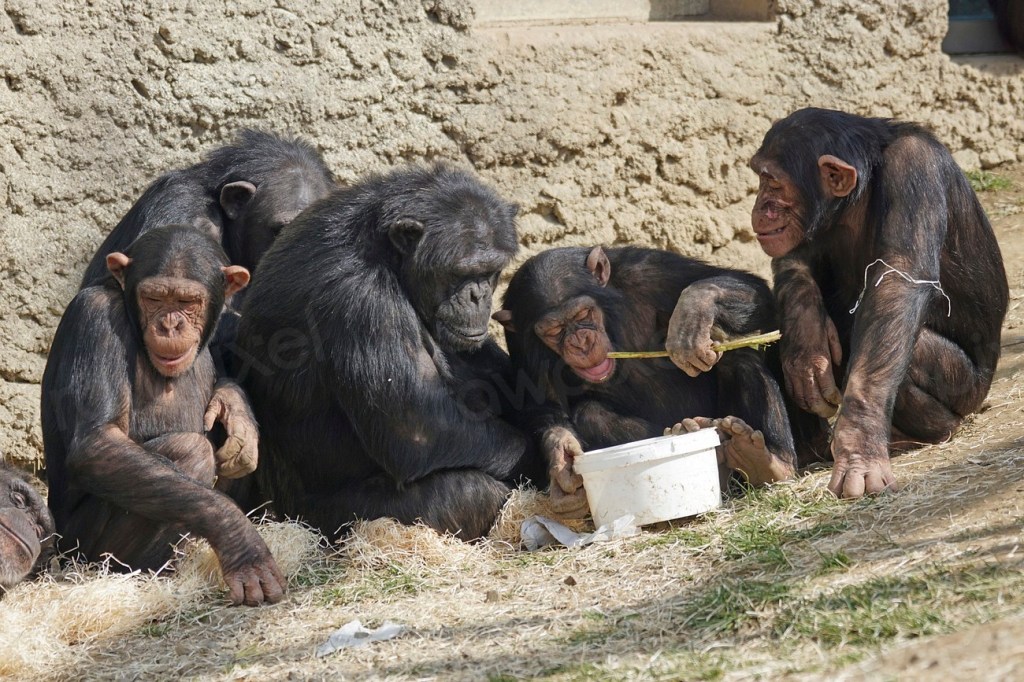

Any attempt to study the origins of language faces one huge, almost insurmountable, problem. At one end are the utterances of our nearest relatives, such as Chimps and Bonobos. At the other; fully formed, lexical and syntactic languages which only humans speak. What happened in between? And how long did it take?
The study of language acquisition in infants provides a possible model for how early hominins extracted meaningful patterns from the sounds around them. It even hints at the way protolanguages could have functioned, usefully, before the development of discrete units such as phonemes or systems such as syntax. Jamie Grierson of the Guardian [1] reports on how a Cambridge team has studied the neural response of infants of various ages when presented with songs and nursery rhymes.[2] For us, the key feature is:
The study concluded that infants learn languages from rhythmic information – the rise and fall of tone – as seen in nursery rhymes or songs, such as the ubiquitous alphabet song.
The team at Cambridge also discovered that babies do not begin to process phonetic information – the smallest sounds of speech – until they are about seven months old.
The team think that infants study the rhythm of their interlocutors to determine where words begin and end, and slowly begin to recognise and store a lexicon of repeatable, meaningful phonemes. Words, in other words.
The first hominin to use words faced major problem; none of his/her companions could understand them. However, if protolanguages developed slowly through a series of mutually intelligible codes, they would still be of adaptive use. Especially in certain areas, such as child rearing. The discoveries of the Cambridge team hint, tantalisingly, that such neural pathways may slowly have evolved, and would have been selected for. A worthy winner of Article of the Week.
[2]https://www.nature.com/articles/s41467-023-43490-x
#origin of language #humans #hominins #protolanguage #chimpanzee #phoneme #syntax #natural selection

 Learning, Science and Society